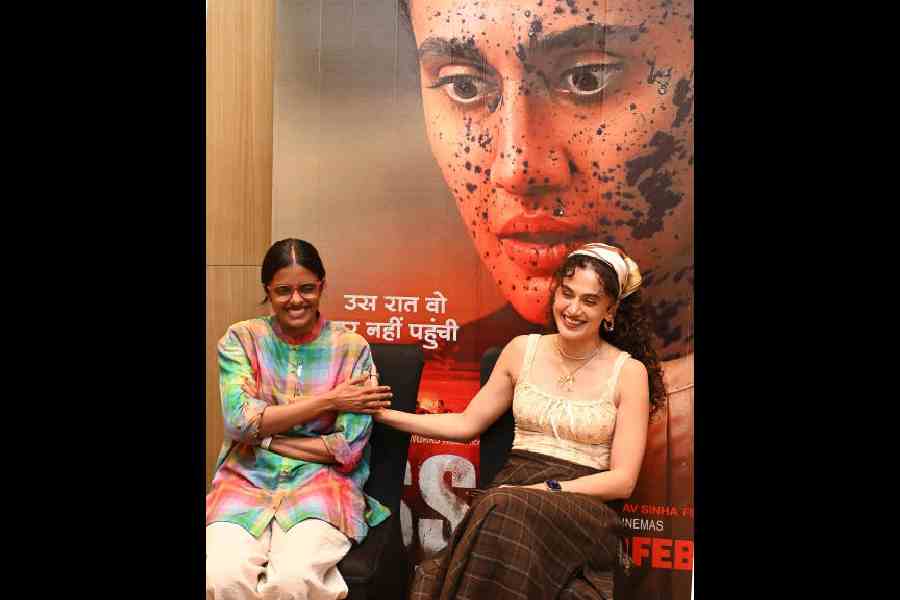
The power-packed combination of actor Taapsee Pannu and director Anubhav Sinha — who have made hard-hitting films like Mulk and Thappad together — is back in theatres today with Assi. Promising to be yet another conversation starter, Assi focuses on a brutal gangrape investigation and stars Taapsee as the lawyer of the rape survivor, played by Cannes winner All We Imagine As Light’s Kani Kusruti, in what is her Hindi cinema debut. Assi boasts a heavyweight ensemble cast comprising Naseeruddin Shah, Revathy, Manoj Pahwa, Kumud Mishra, Mohd Zeeshan Ayyub and more.
In Calcutta earlier this week to promote and screen their film, Taapsee and Kani made time at ITC Royal Bengal for a freewheeling chat with t2.
I am pretty intrigued by the fact that the team managed to keep Assi under wraps for so long, especially in an age where nothing remains hush hush. How did you manage that and was that a mandate?
Taapsee Pannu: It was Anubhav sir’s (Anubhav Sinha, director) decision. We had been talking about this film for quite some time. I don’t know what he told the other people in the film, but to me, he said: “Let’s not announce the film now”. It is not that that we were trying to forcefully hide it. In fact, when we were shooting Assi in Delhi, I did put out some pictures of us on set after wrap, but didn’t specifically mention which film. People could gauge that Anubhav sir and I were making a film together but no other details were made available. It was sir’s decision to keep it like that, and I was happy to go along... after all, he is the producer and director of the film (smiles).
Actually, we all wanted to keep the mystery surrounding Assi alive. Nobody knew that Kani (Kusruti) was doing her first Hindi film. We wanted to “preserve” her! (Laughs)
What is the primary reason that made the two of you say “yes” to Assi?
Kani Kusruti: This is a subject that is very close to my heart. There was some apprehension from my end in terms of how it would be approached. But I realised that this is not about making a perfect film... the idea is to put out something into the world which is really urgent. It may have its flaws and as an actor, one may have failed in some parts, but Assi is the kind of subject which requires you to put yourself out there to learn as well as unlearn.
I also wanted to understand what my contribution would be to a subject like this. Anubhav sir has written the film along with Gaurav (Solanki) and we would have discussions where I had the freedom to tell them what I agree with, what I don’t agree with.... This was a film that gave me a lot of opportunity to learn as well as put forth my point of view.
Taapsee: Before Assi, I had done two films (Mulk and Thappad) with Anubhav sir and by now, he knows what kind of subject I will say “yes” or “no” to. Along with being professionals, we have also developed a personal equation. Even when we aren’t working together, we meet often and though it has been six years since Thappad, and both he and I have done other films, we remain connected. I have discussed my other projects with him as well, and so by now, he knows what kind of films get me excited as an actor. I also know what kind of stuff he is capable of giving me even before I officially read the script. We have reached that stage in our equation.
Every film, I am sure, feels personal on some level or the other. Did Assi, as women, feel a lot more personal to you than the majority of work you have done before?
Taapsee: To be honest, I felt very strongly for what I did in Thappad (which dealt with domestic abuse) as well. Or for that matter, even Pink (about consent) a decade ago. But yes, the women in us will always be slightly biased towards films like Assi. Thankfully, I wasn’t playing the survivor this time because being the victim stays on with you a lot longer. I am glad this film spared me that (smiles). I play a lawyer in Assi and I approached the film with the same kind of anger that I feel as a human and a woman... with the law degree, of course! (Laughs)
Kani, you play the victim/survivor. This film, as is evident from the trailer, must have taken a lot out of you...
Kani: Honestly, I think this film should feel personal to everyone and not just me. The women in the audience, of course, will feel a surge of emotions, and so will a majority of men, I think. If not, then one should really question oneself.
As an artiste, I have not been lucky enough to feel personal about every film I have done. Sometimes, I struggle with things like why is this subject awkward or why is this kind of an aesthetic being used or why is the gaze going a certain way.... But in the case of Assi, the subject and its urgency superseded everything.
Assi raises a lot of questions — what happens after a woman is sexually assaulted? What can we do to ensure that she isn’t humiliated again and again? What kind of education can we give? How should we raise our children? Since I was six or seven, I have been extremely aware of all these things.
I approached this role objectively... I tried to understand what exactly is happening instead of putting myself entirely in the shoes of my character. In fact, I largely approach my characters in the same way. For me, Assi is not just about the survivor. It shows the trauma even beyond — what happens to her after that, what happens to her family, what takes place in the rapist’s house, how do the relatives and neighbours see it.... There is also a lawyer, a judge, the police and an entire system and we see how it works. Assi really goes deep into all of that.
The name of the film is based on a horrifying statistic, 80 being the approximate number of rapes that take place in India daily. Were any other shocking things about rape culture and beyond that you discovered along the way and which shocked you?
Taapsee: There are certain things in the film like that which can’t be revealed before its release. There is something that the audience will discover towards the end of the film. What made me very uncomfortable — which also happened with Pink — was the kind of judgment that individuals and society at large pass on rape survivors. Sometimes, even what the court decides can shock you. It is stomach churning on many levels.
Kani: This country has so much corruption and that is the root cause of everything... it is something that sets off a domino effect. There is large-scale tampering of evidence in so many rape cases. Right from childhood, I have always been angered by the widespread corruption that is present in our country... it affects every aspect of our development and evolution as a country.
Assi is written by two men. As women, did you have the freedom to put in your voice, perspective and gaze whenever you felt it was necessary?
Taapsee: I understand when people talk about the feminist gaze and a female point of view in writing. But there are so many feminist men in the industry as well... most of the men I have worked with fall into that category. Sometimes, I have noticed, that their gaze is more feminist than that of many women. With Anubhav sir, that has been proved time and again, especially in the films we have collaborated on. Manmarziyaan may have been written by Kanika Dhillon, but it was Anurag Kashyap’s directorial vision that one got to see on screen. In that film, Anurag beautifully presented the love story from the point of view of the woman.
I have had some very strong feminist men writing and directing the films that I have done and those are the films that people have the maximum recall for. Pink (written by Ritesh Shah, directed by Aniruddha Roy Chowdhury) is another example. It is the thought process more than the gender that counts.
So hopefully more men, as well as women, will start telling women’s stories in Hindi cinema...
Taapsee: Women should tell stories, regardless of it being on women or not. If men can tell stories on women why can’t women tell stories on men? The important thing is that more and more women need to tell stories... the number of female filmmakers we have is still abysmally low. I don’t think a woman is necessarily represented best on screen by a woman only... so many men have done that so well, and continue to do so.
But as I said, we need more women storytellers. Similarly, we are in a very nascent stage when it comes to Indian female actors being given the chance to lead films which are bankable, which give good returns and are in the mainstream space.
Kani: For me, having a male gaze doesn’t necessarily mean that a man is behind it. Across world cinema, I have seen certain women directors having a very titillating gaze towards their material and most of the time it is done in service of the story. As Taapsee said, the core lies in letting women tell whatever story they want to, irrespective of gender or gaze.
Taapsee, in an age where most of your contemporaries are always out there, on social media and outside it, you make sure you are rarely seen beyond your films. Now, you even have a second home in Denmark. How have you not succumbed to the pressure of always being in the news cycle?
Taapsee: There is a lot of noise around us in this profession (smiles). There is constant chatter saying: “You should do this, you should do that”. After a point, it became very stressful for me. Also, this is a profession where the output is not entirely in the hands of an actor, but we are invariably the face of it. Movie making is a team effort. When a film is received well, actors get the maximum love, but if it isn’t, we are also the ones who get the maximum brickbats.
In this industry, it has increasingly become the norm to talk about how much we are seen at what place, seeing what people are talking about us, are we being written alongside certain names.... Then there is always a new (social media) trend that pops up... things like: “Okay, doing this will keep you in the public eye”. Honestly, the way these trends keep changing, I find myself incapable of keeping up! (Laughs) By the time I understand one trend, others have moved on to the next!
But what I am good at is knowing what I like to do. I have developed a sense of security in life. I have a life in films and a life beyond it. I really cherish that. I don’t have too much of a fear of failure. I am human, of course, and I am emotional about my work, but that does not mean that my life will end if a couple of my films don’t work. That gives me the confidence to say that I will come into the public eye and be on social media when I have a film releasing. My question to people is: “Why do you want to keep swiping on me?”
I just want to be left to grow as a human being. If I am constantly managing my image in front of the public, I will not have time for myself, I will not be able to preserve myself. Before I took this step, I kept increasingly feeling that the vulnerability within me was dying. That is because I was constantly getting hardened inside, which was potentially very damaging for me as a person as well as an actor because I knew that I couldn’t really perform my best if I became that way. I told myself: “Okay, what is the worst that will happen if I am not the most-seen celebrity or if I am not talked about so much?” It wouldn’t mean that I wouldn’t get roles or that people would fail to recognise me.
It was then that I pulled back and decided that I will be seen only when my film is about to come out. I think it will take some time for people to understand what I am trying to do.... Right now, most think that I have just vanished but the reality is that I was constantly working... I was just not forcing myself on anyone’s face on social media or outside it.
Which is your favourite woman-led film directed by a man?
Tell t2@abp.in