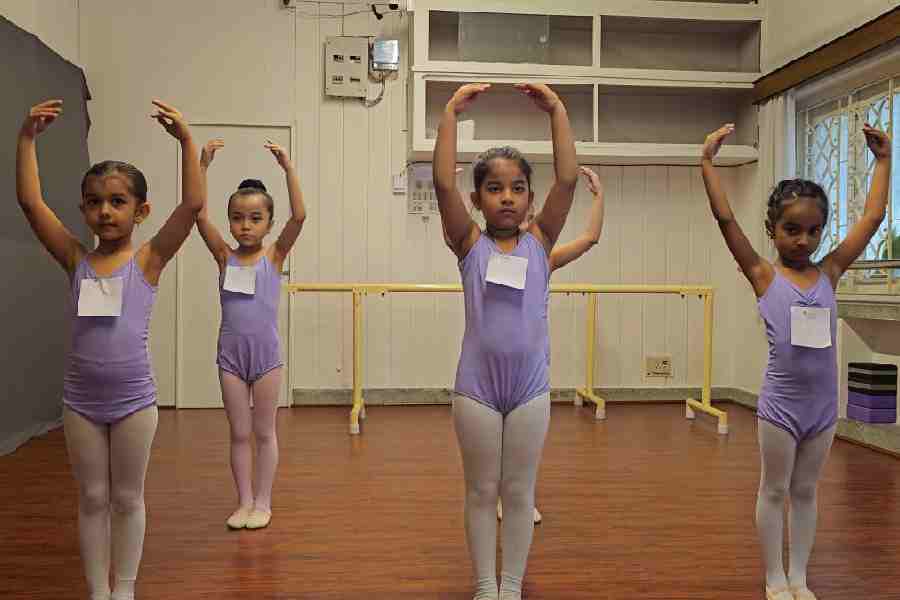
Recently, 44 young girls — a spring in their step and dreams in their eyes — danced their way into what is a first for the city. A ballet examination conducted by Reverie Dance Academy, under the aegis of Association of Russian Ballet and Theatre Arts (ARBTA), a non-profit organisation that is committed to raising the standards of ballet the world over. ARBTA provides a programme of study and examinations accredited by GQAL board, for beginners through to professional dancers, based on the elite Russian method of ballet, known as Vaganova.
“For the first time in Calcutta, a ballet examination on this scale was conducted under the GQAL board, which holds international recognition and validity worldwide. This marks a significant milestone for the city’s dance community, opening global pathways for aspiring ballet students,” Antara Basu, founder-teacher of Reverie Dance Academy, which is located in Salt Lake, told t2. Reverie, Basu says, was founded with the idea of not only nurturing and enhancing the ballet talent in the city, but also aimed at bringing a ballet exam of this level to Calcutta.
Basu, who started off with contemporary dance 14 years ago, but “fell in love with ballet even more”, stressed that the growth of ballet in Calcutta has been truly remarkable. “When I started in 2018, awareness was quite limited, but over the years, I have seen a steady and encouraging rise in both interest and participation. Today, there are many students with exceptional potential and they are genuinely eager to learn and grow,” she added.
Tamara Vile from ARBTA flew down exclusively to assess the students. “It was an honour to have been the first examiner to conduct examinations in Calcutta. The students are a shining example of the quality good teachers can produce,” said Vile. “The beauty of the Russian method — called Vaganova method — is its ability to evolve and create industry-ready dancers through structured syllabus-based teaching. Even as a hobby, students are enriched by the strength, poise and elegance of the method as well as the examinations that are held. Antara’s students are already achieving exceptional results and it is so exciting to see this development in the future,” she added.
Basu herself is pursuing her teacher certification through ARBTA, an experience that she said gave her the vision and opportunity to bring this specific syllabus and training method to Calcutta. Students who have appeared for this examination will receive a certified qualification that is acknowledged internationally. This certification not only reflects their technical proficiency and discipline in ballet, but also adds strong value to their overall academic and extracurricular profile.
“During the pandemic, I started teaching students from different cities through virtual platforms. That is when I realised the importance of a structured syllabus and graded progression for students to clearly understand their growth. The students here are now well aware of what they are learning and in the future, if they want to pursue ballet, they have the right certificates to show as their qualification,” said Basu.
The benefits of this certification are not limited to those pursuing ballet as a career. Even students from different educational streams can leverage this achievement in the future — for higher education applications, international opportunities, and personal development. It showcases dedication, consistency, artistic ability and the capability to work towards structured goals.
Basu, however, emphasised on the fact that there still exists a need for deeper understanding of the art form, that originated during the Italian Renaissance in the 15th century and later developed into a concert dance form. “Ballet is not something that develops overnight — it is a highly disciplined art form that requires years of consistent training and patience. I believe the shift now is not just about increasing numbers, but about building the right mindset towards training, technique and long-term commitment,” she said.