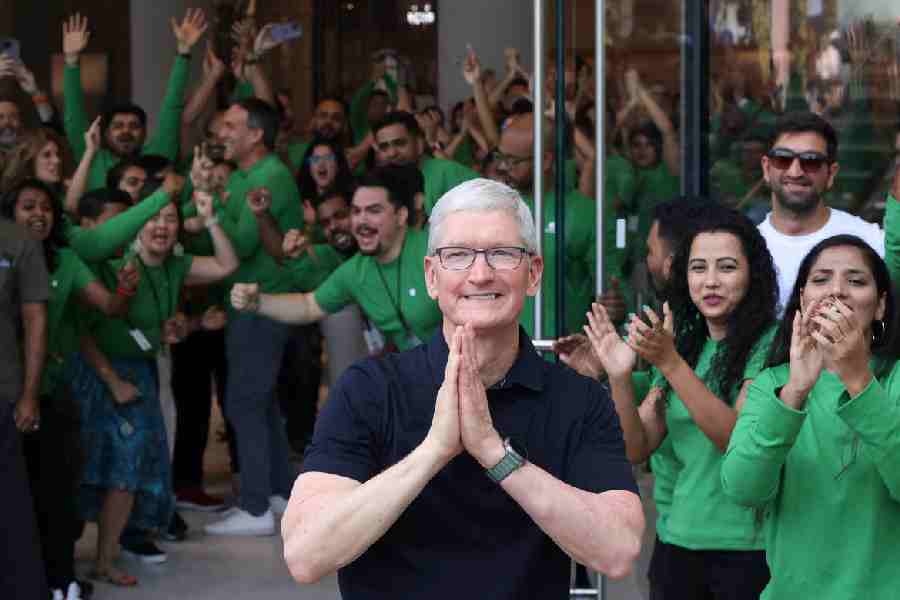
Yes, Apple Park looks like a spaceship from the air, but for those who work there or visit, it appears as a ring pulsating with energy. Once inside, a visitor might feel as though they are walking for miles — and chances are, they will make fitness a part of their everyday routine. Outgoing Apple CEO Tim Cook famously reflected on the company’s greatest contribution to mankind in a 2019 interview: “If you zoom out into the future, and you look back, and you ask the question: ‘What was Apple’s greatest contribution to mankind?’ — it will be about health. We’re democratising it. We’re taking what has been with the institutions and empowering the individual to manage their health.”
Cook’s legacy will forever be tied to how he steered the company towards accessible wearable health technology, though he has also done a remarkable job giving Apple an envious bottom line. “Apple has done exceedingly well in Tim Cook era as its volume market share has climbed to almost 9 per cent level as the sixth largest smartphone brand and leads with 28 per cent revenue share. Apple has also done well expanding its own Apple stores to six in just three years exemplifying the importance of India market,” Neil Shah, research vice-president at Counterpoint Research, a technology market research firm, told this newspaper.
Health has indeed become a pillar of Apple’s foundation — in the way the Apple Watch has evolved over the years, how the Health app has nudged iPhone users, how Fitness+ has raised the fitness bar, and how the latest AirPods Pro has placed a health sensor directly in the ear.
Each time Cook took the stage to launch a new iPhone in September, he made a point of highlighting how the Apple Watch had made people more conscious of their fitness — and how the device had saved lives through its ECG feature. It truly has, alerting wearers to key health metrics at crucial moments.
Turning back the clock to February 2015, he made a bold statement at the Goldman Sachs Technology and Internet Conference: “If I sit for too long, it will actually tap me on the wrist to remind me to get up and move, because a lot of doctors think sitting is the new cancer.”
His remark sparked a flurry of articles on the subject, and, as it turns out, moving around for a few minutes every hour does make a difference. Ten minutes before the hour, the Apple Watch gently reminds users to do just that. It takes a little getting used to when you first strap one on, but it soon becomes second nature.
At the time, many tech critics were preoccupied with how the Apple Watch would fare against traditional timepieces and whether it would put the Swiss watch industry under strain. In the end, all categories coexisted — many consumers simply chose the Apple Watch alongside their mechanical pieces. It did, however, squeeze the low-priced quartz segment and put pressure on entry-level mechanical watches.
Once the Apple Watch became available in April 2015, a cascade of milestones followed. It began with something straightforward: monitoring heart rate. The company then “figured out we could pick up heart signals to get to an EKG and an AFib determination” — and that proved to be a game-changer. Over the years, Cook received a stream of letters and notes from people who credited the wrist alert with saving their lives.
It is worth remembering that the Apple Watch was the first new Apple product in the post-Steve Jobs era. Its success was bound up with Cook’s leadership and demonstrated that Apple could continue to innovate without Jobs at the helm. That said, it would be remiss to focus on Cook alone. Legendary designer Jony Ive shaped the device’s iconic form, and Steve Jobs’s own healthcare experiences while battling pancreatic cancer have also been cited as a profound influence behind its creation.
Success was elusive at first, but from Series 4 onwards, the Apple Watch became a template for the modern wearables industry. The “Dear Tim” letters it generated are the stuff of legend.
The man behind the mission
Cook has had a lifelong relationship with America’s national parks, making a point of visiting several each year. On the Outside Podcast in 2020, he spoke at length about the importance of spending time outdoors. “My advice to everyone that goes to a national park is to leave your selfie stick behind,” he said, “and just soak in the beauty of the park itself — because that will stay with you a lot longer than any photo will.”
His daily routine begins between 4 am and 4.30 am — an hour working through emails, followed by an hour at the gym focused mainly on strength training. During this window, the iPhone barely gets a look-in.
Exercise, for Cook, is non-negotiable: it keeps stress at bay, and closing the Rings on his Apple Watch keeps him honest.
“Having the Watch there to motivate me — I can choose whatever — pretty much every workout known to man is in there now,” he has said.
Cook is among the earliest tech CEOs to recognise wearables as a force for democratising healthcare. Launching the inaugural Apple Heart Study and the Apple Research app has opened significant doors for clinical researchers. The Heart Study alone drew 400,000 participants in 2017.
During the Covid pandemic, researchers used a range of wearable devices to investigate whether they could detect early signs of infectious illness. One 2021 study found that the Apple Watch could detect Covid up to a week before a conventional nasal-swab test. The device has continued to make remarkable strides since — it can now offer sleep apnoea notifications, and newer models can alert users with hypertension.
In 2022, the release of Apple Watch Ultra marked a watershed moment for smartwatches, becoming the go-to device for endurance athletes covering marathons, scuba diving, snorkelling, swimming, and mountain climbing — disciplines that place demands most smartwatches simply cannot meet.
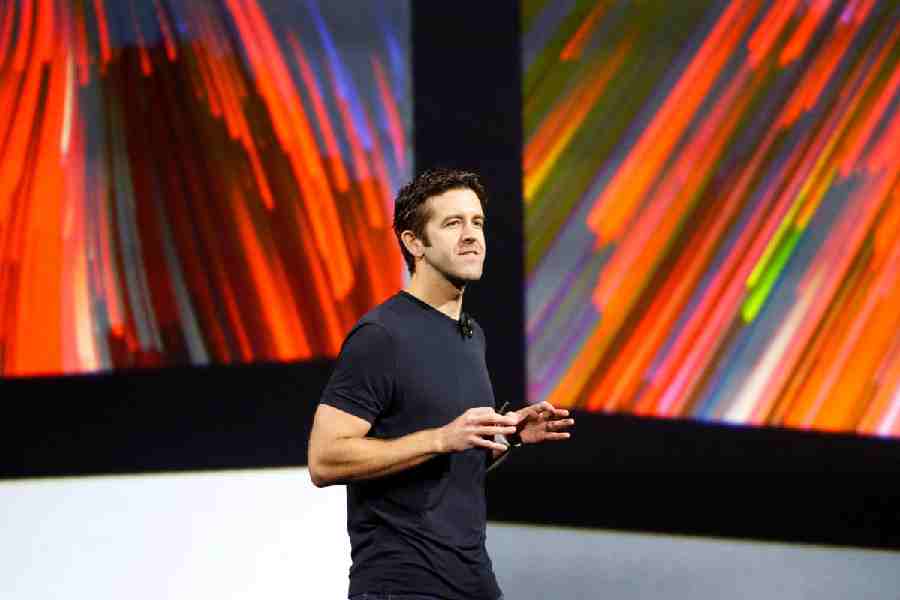
John Ternus speaks during Apple's annual developer conference in San Jose File picture
The latest Ultra 3 pushed further still, with a 3D-printed titanium casing and improved repairability — work overseen in large part by John Ternus, the engineer set to succeed Cook as CEO on September 1. It is a fitting inheritance: Ternus is no stranger to physical endeavour himself, having won the 50-metre freestyle and the 200-metre medley for the University of Pennsylvania back in 1994.
Beyond the wrist
The Cook era’s contribution to health extends well beyond the Apple Watch. The AirPods have played a quietly significant role too. Both the AirPods Pro 2 and Pro 3 can assist those with hearing loss — a meaningful shift in a space where hearing aids have long been prohibitively expensive. The earbuds can function as a personalised hearing aid, generating a hearing profile that is automatically applied across music, films, and phone calls on all of a user’s devices.
Cook told Wired in 2024: “The vast majority of people with hearing issues have not been diagnosed. For some people, hearing aids have a stigma, and we can counter that with AirPods.” It is, as he put it, the democratisation of health.
Another landmark was the 2020 launch of Apple Fitness+, which brought studio-style workouts to iPhone, iPad, and Apple TV — intelligently weaving in Apple Watch metrics for a personalised, immersive experience that users can complete wherever and whenever suits them. The service arrived in India in December of last year.
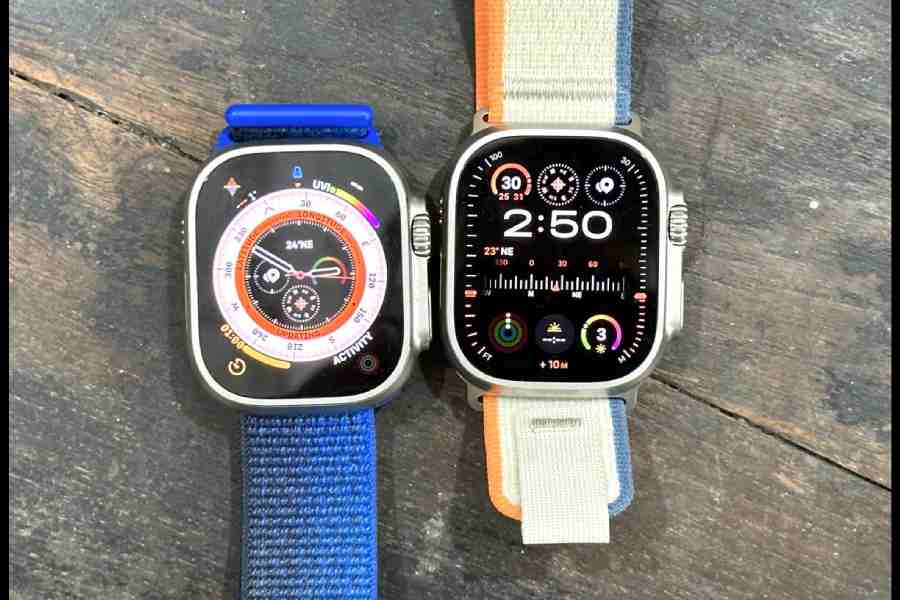
Apple Watch Ultra 2 (right) features 95 per cent recycled titanium, compared to no recycled titanium in the first Apple Watch Ultra Stock photographer
Apple is also reportedly working on non-invasive glucose monitoring. Most blood-sugar tests currently require a skin prick, but the company’s technology — which may use optical absorption spectroscopy and lasers to determine glucose concentration without breaking the skin — could prove to be another game-changer.
The mantle now passes to Ternus, who has left his mark on almost every product in Apple’s lineup: the AirPods, the historic Mac transition to Apple’s own processors, the iMac Pro, the modular Mac Pro, and the Apple Watch. He understands, both professionally and personally, what it means to push the body to its limits. The next chapter of Apple’s health story is very much in his hands.