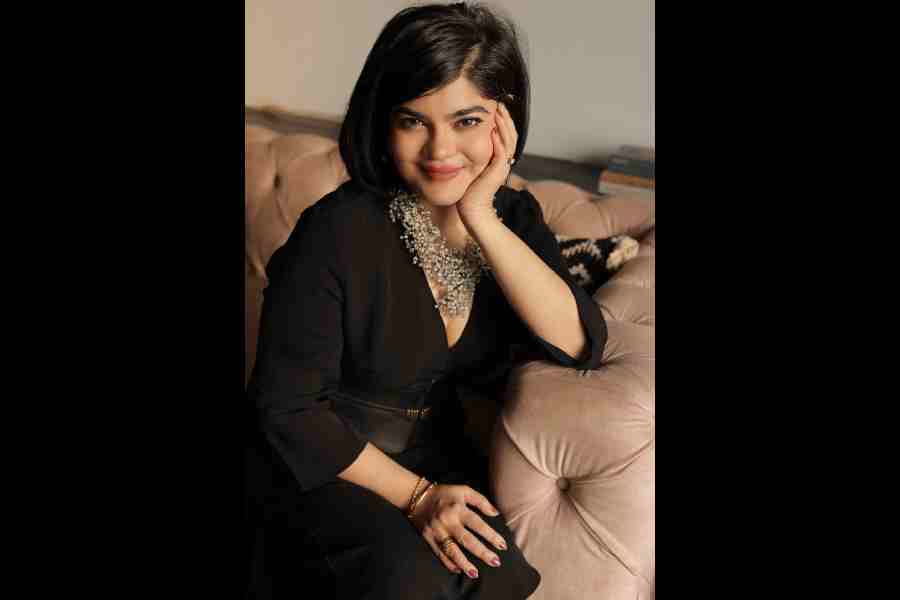
There is something quietly compelling about people who refuse to remain confined to a single creative identity. Tanya Sen belongs to that rare group — artistes who move across disciplines not out of restlessness, but from a deeper instinct to express themselves more fully. Her transition from music to interior design might, at first glance, seem like a dramatic shift, but when she spoke about it with t2, the connection feels almost inevitable.
For Tanya, design was never an external discovery; it was always present, shaping her sensibilities from within. “Design and aesthetics have always been an intrinsic part of who I am,” she said, recalling a childhood spent poring over design magazines. Those hours were formative. “I would spend hours immersed in them, finding both inspiration and a sense of calm,” she reflects.
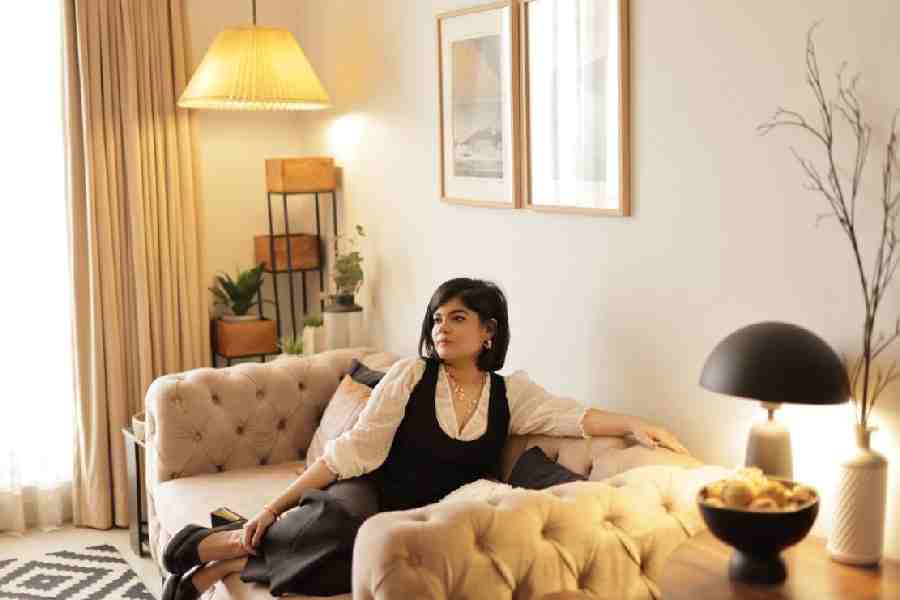
A living room space designed by Tanya
Her father’s profession as an interior designer further sharpened her perspective. Growing up in that environment meant that spaces were never just functional; they were narratives, carefully constructed and deeply considered. Yet, despite this early exposure, Tanya did not immediately follow that path. Music came first, and for years, it remained her primary medium of expression. The turning point arrived through a personal project — designing her own home. “Seeing spaces come to life through my own vision made me realise how much I connected with the process,” she explains. It was a moment of recognition and a quiet understanding that this, too, was a language she spoke fluently.
Like many creative journeys in recent years, hers was further shaped by the pandemic. The forced stillness of that period created space for introspection and experimentation. “Being confined to our homes, I started experimenting more intentionally with my space,” said Tanya. What began as an exercise in reimagining her immediate surroundings gradually evolved into something more profound. “I discovered how deeply passionate I am about designing environments and how it allows me to express myself.” That realisation led to a decisive shift. She chose to “take a leap, reinvent my path, and channel my creativity through spatial storytelling.” The phrase is significant — spatial storytelling — because it encapsulates the bridge between her two worlds. It also became the foundation of her design venture, NYNE, a platform through which she continues to articulate her evolving aesthetic.
For Sen, interior design is not a departure from music but an extension of it. “Absolutely, I see interior design as a powerful art form of storytelling, very much like music,” she said. The comparison is rooted in the way both mediums engage with emotion. She continued saying, “Music can instantly transport us. A single song can take you back to a specific moment, a memory, or an emotion you once felt.” She believes spaces function in much the same way. “When you walk into a space, it can immediately influence how you feel — it can uplift you, calm you, energise you, or even evoke nostalgia.” This emphasis on emotional resonance defines her work. With NYNE, she aims to create environments that are not merely aesthetically pleasing but experientially rich. “I want people to feel something the moment they enter, whether it’s comfort, warmth, or inspiration,” she said.
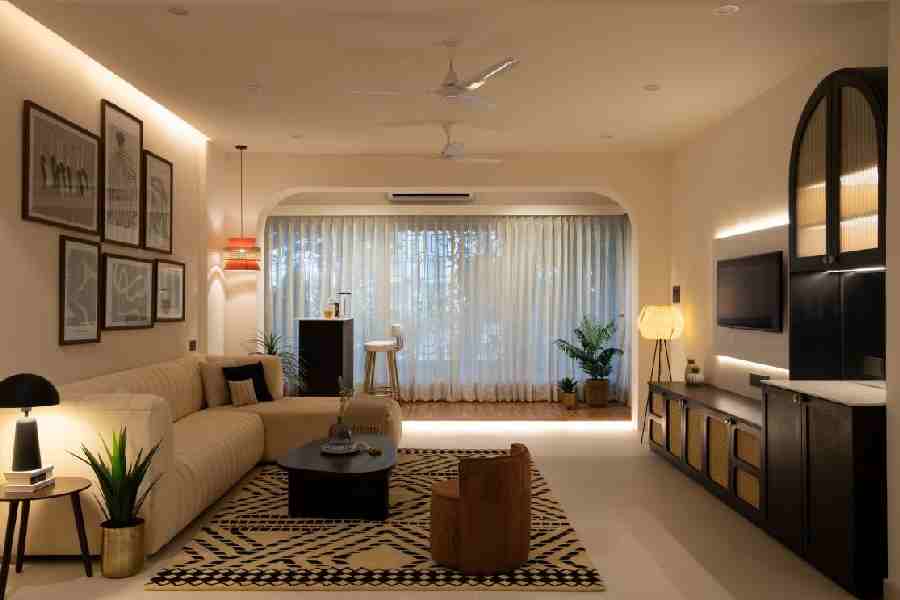
A living room space designed by Tanya
In her view, design operates on a sensory and psychological level that often goes unacknowledged. “To me, design is a powerful, almost therapeutic medium that can shape how we think, feel, and live.” It is an approach that resists the trend-driven nature of contemporary interiors, favouring instead a more intuitive, human-centred philosophy. That intuition, she believes, is directly inherited from her years in music. “Music, at its core, is about emotion and intuition, and that naturally carries into how I design spaces,” Tanya explains. Rather than relying strictly on technical frameworks or prevailing trends, she approaches design organically. “I focus on how a space should feel,” she says, emphasising a process guided as much by instinct as by skill.
Her background as a performer has also played a significant role in shaping her professional journey. Years spent engaging with audiences have given her a strong sense of connection and communication, qualities that translate seamlessly into client relationships. “Performing on stage and engaging with diverse audiences helped me build strong connections and a wide network,” she notes. When she transitioned into design, that existing community followed her in a sense. “People who connected with my music were able to connect with my design sensibility as well.”
Like any creative professional, Tanya Sen is no stranger to moments of doubt and creative block. Interestingly, her approach to overcoming them echoes her broader philosophy — step back, rather than push harder. At NYNE, she maintains a hands-on approach, personally handling the design work rather than outsourcing it. This level of involvement, while rewarding, can also be mentally demanding. “When I’m deeply immersed in a project, I tend to get completely absorbed in it,” she says. There are times when the inability to execute an initial vision leads to frustration. “I can be quite hard on myself and end up pushing even harder, which ironically leads to a creative block.” Experience has taught her to recognise this pattern and respond differently. “The most effective way for me to reset is to consciously take a break,” she explains. Whether it involves travelling, meeting people, or simply disconnecting, the goal is to create distance from work. “When I return after a few days, I almost always see things more clearly, and ideas begin to flow naturally again.” It is a reminder that creativity often thrives not under pressure, but in moments of release.
Despite her growing commitment to design, music remains an inseparable part of her life. “I don’t think I ever truly left music, because I don’t believe it’s something you can ever really walk away from,” said Tanya. The shift, then, is not about abandoning one passion for another, but about recalibrating priorities. “At the moment, NYNE demands the majority of my attention,” she acknowledges. Yet her relationship with music has simply evolved. “I’m now more drawn towards meaningful musical experiences rather than doing frequent gigs.” The emphasis has shifted from quantity to intention. She is interested in projects that resonate on a deeper level, collaborations or performances that carry a sense of purpose. Her recent work reflects this approach. “Just last year, my song from Joto Kando Kolkatatei came out,” she said, signalling that her musical journey continues, albeit on her own terms. “For me, it’s no longer about quantity, but about intention and impact.”
Whether through music or design, her work is anchored in the same core principle, the desire to evoke feeling. It is this consistency, rather than the medium itself, that defines her journey. What emerges is a portrait of an artiste who understands that creativity is not confined to a single discipline. It moves, adapts, and finds new
forms. And in doing so, it often reveals connections that were always there, waiting to be recognised.