
Custom certainly hasn't staled Dhiraj Choudhury, still sprightly at 80 plus. His signature is as clear as ever and yet a new energy has set it throbbing through a range of works seen at a recent solo show with which a quaint new gallery was inaugurated as well: Zs' Precinct, on Dover Road, a compact building of intimate proportions and period windows. The worth of the exhibition lay in its comprehensive reach, covering luminous paintings on tile, and on paper and canvas, drawings, needle and brush images, graphics, ceramics, wood engravings and sculptures, both metal and wood.
Choudhury's figures remain lean and wiry, the colours as radiant and the scribble of lines as sweeping, looped and tangled; his women haven't lost their sumptuous Banalata Sen hair - the Jibanananda muse was seen here in a show sometime in the 1990s - nor has the foliage lost its tremulous lissomeness. In other words, this art is vintage Dhiraj, entirely recognizable, but never appears customary or tedious, and draws the viewer into its magnetic field.
This is particularly true of the wood carvings. An emaciated Jesus with deep lines cut into his body is riveting. Two heads hewn from blocks of wood, and gaunt bronzes tell you how fluent he is in sculpting form.
But the most remarkable work, undoubtedly, is a triptych in monochrome, a take on da Vinci's Last Supper that covers two canvases. The third, on the Crucifixion, probably wishes to echo the arrangement at Santa Maria delle Grazie, where Montorfano's Crucifixion is on the opposite wall. Choudhury's sketchiness of style, with a composition that does not follow the neat, linear setting of the original, the stress on white in the foreground counterpointing the cluster of darkened robes on the other side of the table, the detailing of objects on it give it a dramatic charge and bring to mind the allegories of Durer.

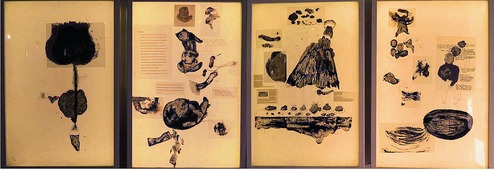
But it's interesting that the Last Supper isn't just deified but may also be debunked. Prasanta Ghosh, one of the three artists being presented by Studio 21 in its current show, does precisely that. He professes inspiration from Julia Kristeva's Powers of Horror, so seductively French in its enquiry into the concept of abjection. The young artist's apparent fascination with revulsion, his obsessive references to the scatological and the sexual, could well be described as what a Sartre scholar has termed "the revenge of the vulgar". Suspicious-looking lumps painted in ink greet you through displayed light boxes, as the accompanying text talks of different kinds of faeces; vials of urine are stored like chemicals or medicine; and a long horizontal table painted with more lumps - of rotting and smelly food, presumably - squints at Last Supper.
However, you do wonder if this 'excrementalism' has, in its choice of underground gestures, any purpose other than breaching bastions of the bhadralok code. Ghosh, no doubt, is bold and willing to stick his neck out into not-so-known areas. That is also seen in the work titled I Am Still Searching. Its type-written sheets aren't meant to mean anything. Rather, his arrangement of letters as accidental rather than universally accepted sequences lays bare the stupendous enigma - and indeed arbitrariness - of communication. Through mere sounds perceived as words and shapes perceived as letters. In numerous languages.
Perhaps Ghosh's antics are one important reason why the exhibition, on till July 22, is titled Good Smell, Bad Smell, trailing suggestions of corporeality. And, yes, though the youthful gallery doesn't go so far as to actually assault viewers' olfactory organs with smells good and bad - their labelling largely a matter of, well, cultural inheritance - an oppressive odour from a chemical coating used by Mithun Das for his installation does hang in the next room, which is themed in black. It has a packing crate in the middle, large enough for a human body to be bundled into. Titled Third Time is Last Time, the work echoes the warning/demand from neighbourhood thugs that anybody ignoring their unspoken writ in the artist's locality could find themselves inside such a crate, in pieces. This is a chilling reminder of the dark night that lurks beyond urban glitter.
For Jayeti Bhattacharya, however, the dominant colour is an evanescent brown: it comes from the mud around her home. Her little Fragments combining prints and watercolour on paper are like snatches of conversations, excerpts drifting from memory, faded, dissonant, like pieces of a jigsaw puzzle: a chair, a towel, a terrace corner, a tap... But it does summon up good smells, the comforting and familiar fragrance of home.