The oil crises of the 1970s have never quite left India’s collective memory. What tends to get lost, however, is that the real failure of that decade was not import dependence but the absence of foresight. India did not map energy risk or quantify system-wide fallout, and oil was not treated as a systemic vulnerability until the crisis forced recognition.
Nearly half a century later, India is, once again, walking into a blind spot, this time far quieter, far more complex, and potentially more disruptive. The next shock will not arrive through crude tankers, but through lithium, cobalt, copper, rare earths, graphite, gallium and germanium. These critical minerals are now embedded in everything India wants to build: defence platforms, power grids, digital infrastructure, electric mobility and renewable energy systems. If oil once powered growth, minerals now structure it.
The Union budget proposed the idea of developing critical mineral corridors, reflecting an official recognition that India’s exposure to mineral supply risks is no longer hypothetical but systemic. Such corridors signal a shift away from viewing critical minerals merely as extractive resources and towards treating them as integrated value chains, linking mining, processing, manufacturing, logistics and recycling within strategically coordinated industrial and infrastructure frameworks.
Unlike oil or gas, critical minerals are not burnt and replaced. They are locked into long-lived capital, batteries, turbines, transmission lines, semiconductors and defence hardware. When supply chains break, the loss is not temporary. A disrupted lithium supply does not delay one production cycle; it slows the entire trajectory of electric mobility. A shortage of rare earths does not pause wind installations; it constrains grid expansion itself.
This makes mineral insecurity a systemic risk and not just a sectoral one. Defence indigenisation depends on speciality alloys and rare earth magnets. Digitalisation depends on semiconductor materials. Green electrification depends on copper, lithium, nickel and cobalt. A single mineral disruption can quietly undermine multiple national missions at once.
India, Australia and Africa were once part of Gondwanaland. If Australia and Africa host abundant mineral deposits, how is it plausible that India does not? The counter-argument to this is also sobering. India may not lack minerals; it may lack the ability to see them. The subsurface exploration requires advanced geophysical technologies, patient capital, and specialised human expertise. Much of India’s exploration remains shallow, fragmented and technologically dated. China, by contrast, has spent decades investing not only in exploration technologies but also in acquiring geological talent globally.
This raises an uncomfortable policy truth. Large-scale exploration requires sustained investment that governments alone struggle to finance. Private capital is necessary. Yet mining in India carries a reputation, sometimes deserved, as a dirty business, entangled with local politics, rent-seeker goons and ‘mafias’, and poor work cultures. Investors hesitate not only because minerals might be absent but also because governance risks are opaque.
Until India confronts this political economy honestly, exploration will remain cautious, and uncertainty will persist underground.
India is not alone in confronting this vulnerability, but others are acting sooner. Just last year, the United Kingdom released an updated Critical Minerals Strategy, expanding domestic stockpiling, strengthening recycling and securing overseas supply routes. The European Union has already enacted the Critical Raw Materials Act, setting 2030 targets for domestic extraction, processing and recycling. The United States of America has invoked the Defence Production Act to classify critical minerals as strategic assets.
India’s National Critical Minerals Mission was launched in 2025 with the aim of accelerating exploration, developing processing capabilities, incentivising recycling, and securing overseas assets. Public sector initiatives, such as Khanij Bidesh India Limited, have been tasked with acquiring mineral resources abroad, particularly in Latin America and Africa. But Indian firms are discovering a harsh reality. In many promising geographies, Chile, Argentina, parts of Africa, the Chinese companies arrived earlier, secured stakes faster and integrated assets into downstream processing long ago. China’s advantage is not merely geological; it is temporal. It acted before minerals became geopolitics.
This asymmetry explains a striking global fact: despite its geopolitical reach, even the US finds itself constrained in pressuring China on critical minerals, unlike its other partners. Control over material foundations translates into strategic leverage. Countries that arrive late do not just pay higher prices; they accept tighter constraints.
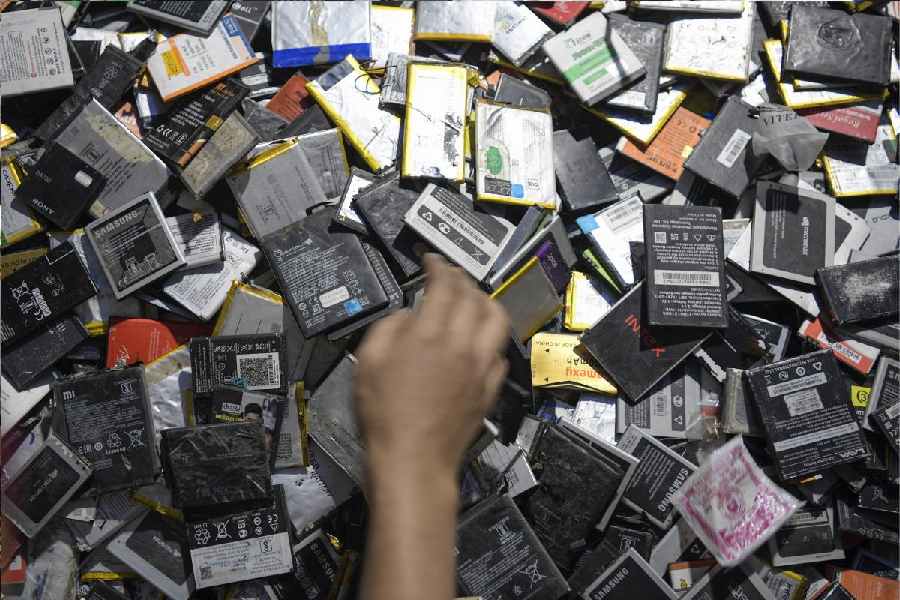
However, India has a hidden advantage. If India cannot mine fast enough, it must recycle faster. Here, India holds a rare and undervalued asset: its informal recycling economy. Across cities like Seelampur, Moradabad, Mandoli, Pudupet and Bhiwandi, thousands of informal enterprises already dismantle electronic waste, recover metals and aggregate scrap with remarkable efficiency. These networks function as ‘secondary mines’, extracting copper, aluminium, cobalt and nickel daily, often at costs far below formal systems.
Globally, secondary mining is 70-90% less energy-intensive than primary extraction. For India, recycling is not merely an environmental obligation; it is the quickest route to mineral resilience. The challenge is integration, not replacement. Informal workers need safer technologies and training, formal offtake agreements, and partnerships with private refiners.
There is another underused lever: global scrap. Over the next decade, advanced economies will generate vast volumes of battery waste and electronic scrap rich in lithium, cobalt, nickel and rare earths. Much of this material will be exported.
India could position itself as a global hub for secondary mineral recovery, importing scrap, processing it domestically, and embedding recovered materials into manufacturing. This approach bypasses some geopolitical risks of overseas mining while leveraging domestic labour and recycling expertise.
India still does not know, with sufficient precision, how much of each critical mineral this nation will require between now and 2047 to achieve Viksit Bharat growth, and up to 2070 to accomplish net-zero decarbonisation. We do not know how much can realistically be sourced domestically, how much must be imported, and where the most damaging choke points lie.
The oil shocks taught India a painful lesson: management without measurement is a vulnerable idea. Minerals now occupy the same structural position that oil once did, but across more sectors, with longer-lasting consequences. India has begun to act. But action without foresight remains incomplete. Unless mineral demand is mapped, vulnerabilities quantified, and recycling systems integrated at scale, India risks discovering its exposure only after constraints tighten.
Suvajit Banerjee is a Fellow at the National Council of Applied Economic Research, New Delhi. Views are personal