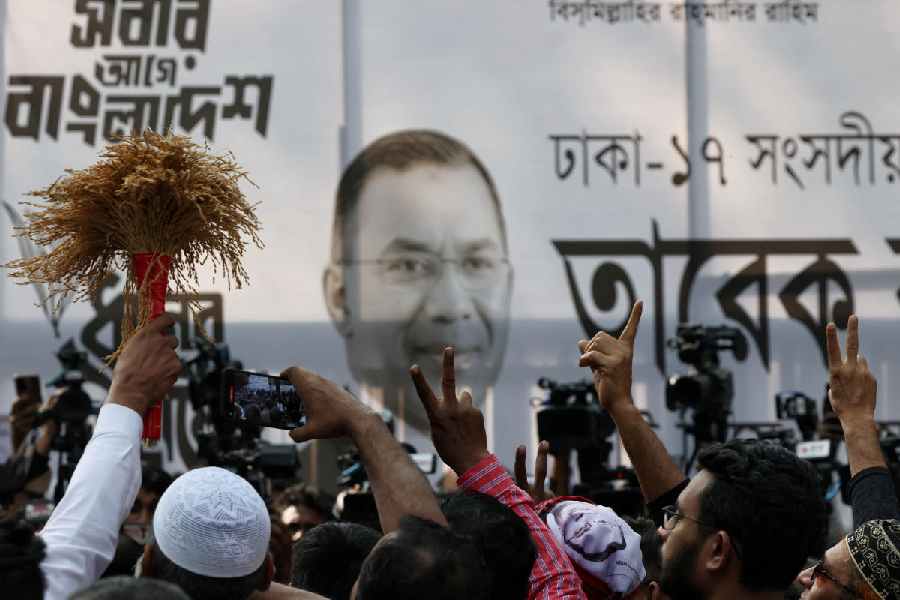
Unlike his father, Bangladesh’s new ruler will not have to fight for ceremonial honours from India. When Ziaur Rahman paid a two-day state visit to New Delhi in December 1977, he had to insist on all the protocol courtesies that had been showered on his murdered predecessor, Sheikh Mujibur Rahman. This time round, thanks to Narendra Modi’s pre-emptive greetings, Bangladesh’s prime minister-in-waiting may know that it might be open season for minorities in his country (though not for Hindus alone), but that he is always welcome in India.
This is an acknowledgement of the integrity of an electoral process that allowed an expelled Bangladesh Nationalist Party member, Rumeen Farhana, a feisty barrister who was called to the Bar from Lincoln’s Inn in London, to successfully contest the polls from Brahmanbaria. It was also a recognition of the spirit that has animated the party ever since Zia, 'Announcer of the Liberation', famously broadcast the declaration of independence on March 27, 1971 from the Swadhin Bangla Betar Kendra radio station in Kalurghat in Chittagong. But many might point out that formal diplomacy is probably the least of the problems that bedevil a complex relationship that operates at many levels, seen and unseen, on both sides of the border. It encompasses land and water, trade and tariffs, rebels and patriots, China and Pakistan, life itself. The spate of murders of anonymous, inoffensive Hindu working men in Bangladesh may be inspired by communal hatred but seem more likely to be the product of local quarrels.
I wouldn’t be surprised if surveying the participants in Thursday’s voting, the British Broadcasting Corporation’s Mark Tully, who passed away on January 25, had given Bangladesh’s election pride of place in his calendar. Not only was Bangladesh Mark’s first major assignment way back in 1971 when he became famous as the 'Voice of India', but the vote and simultaneous referendum on the so-called July Charter with 84 innovations promising a 'New Bangladesh' could have also seriously impacted the entire region. If there’s anything at all shady about the process, it’s not so much the sadly restricted two-horse race as the attempt to sneak in a sweeping revolution through the back door while elections clutter up the front entrance.
Was it Khaleda Zia who said that everything began in London? Sheikh Mujib was there, bare-bodied above his lungyi in an East End Bangladeshi flat, when Bangladesh was only a state of mind. Mark was still marking time over a beer waiting for the war to engulf Dhaka when I first ran into him in the BBC Club. Ever the pragmatist, he had left India voluntarily to avoid being bracketed with foreign journalists Indira Gandhi had evicted. "I was among the first to be let into Bangladesh”, he boasted. “This was the most important thing that happened to me in my career and that made my name and reputation.” He hadn’t quite soared to stellar heights but was already a uniquely India hand, having taken care to be born in Calcutta where his father worked for Gillanders Arbuthnot, the Gladstone family firm whose indentured labour system laid the foundations of a post-slave trade fortune. The link remained close. When India suddenly nationalised a highly profitable Gillanders subsidiary, Indian Copper Corporation, and merged it with the loss-making, state-owned Hindustan Copper, whose profits miraculously soared, one of Gillanders’ early Indian burra sahibs, S.B. (Montu) Datta, told me that my outraged editorial in The Statesman had been sent to Hawarden Castle, in north Wales, the Gladstone seat.
“Tully Sahib’s”, as John Elliott of the Financial Times, another British journalist to nurture ties with India, called him, wasn’t quite the voice of India. It was the archaic, accented, slightly patronising voice of caring orientalists like Lawrence of Arabia or Lady Hester Stanhope, or any other British adventurer who treated the world — or selected parts of it — as his oyster. Fond as he was of India, Mark’s horse sense demanded a shrewd distance from his subject. We were covering the Shah Commission’s findings when a certain “Tuli Sahib” was mentioned. I couldn’t resist a flippant “That was before he anglicized the name to ‘Tully’!” but it was no laughing matter for Mark. He kept me engaged for 30 minutes with details of all his ancestors who had served in the subcontinent with nary a touch of what was called the tar-brush.
Mark would have concluded that Bangladesh’s residual Hindu minority — about 8% of voters — might feel that its best bet in a heads-I-win-tails-you-lose situation lies in throwing itself behind a relatively moderate BNP. With their obvious first choice, the Awami League, excluded, and the 11-party coalition led by the Jamaat-e-Islami, which opposed independence from Pakistan and was banned under Sheikh Hasina, this election brought Bangladesh’s 13 million Hindus face to face with the grim reality that Zulfikar Ali Bhutto had outlined in 1971, adding a rider to Muhammad Ali Jinnah’s two-nation theory by warning that “Muslim Bangla” should decide whether it is first and foremost Bengali or Muslim. If the former, its destiny lies in Indian Bengal; otherwise, it should remain East Pakistan.
That stark choice also underlay the Nehru-Liaquat Ali Pact, signed 76 years ago, supposedly to protect religious minorities. Jogendra Nath Mandal, a courageous Dalit politician from Barisal who was briefly Pakistan’s law, labour, Commonwealth and Kashmir affairs minister, had much to complain of even before Liaquat’s assassination on October 16, 1951 and the communal clashes that exposed the razor’s edge of uncertainty on which Pakistan’s Hindus were poised. With demographics reversed, it’s now the Indian Muslim condition that prompts Human Rights Watch’s reports criticising Bharatiya Janata Party bigotry, condemning Ahmedabad’s demolition of thousands of houses, leaving mostly Muslim families homeless, demonising religious minorities and treating Bengali-speaking Muslims and Rohingya refugees from Myanmar with scant sympathy. HRW also highlights the official crackdown on critics and pressure on the media to practise self-censorship, which further encourages abuses. Media reports of Muslims being lynched on suspicion of storing beef and of campaigns under the 'love jihad' and the 'vote jihad' banners show how easy it is to mobilise communal passions at the grassroots.
When Bangladesh’s Constitution was amended for the eighth time on June 9, 1988 to declare Islam the state religion, critics of the president, Hussain Muhammad Ershad, accused him of trying to marginalise the two battling begums, Ershad having told people, including this writer, that Islam demands rulers who can lead the nation in prayers which rules out women. The ineffective ploy prompted a former foreign minister, Kamal Hossain, dubbed 'Father of the Bangladeshi Constitution', to comment sarcastically that Ershad had probably never heard of the 13th-century empress, Raziya. A parallel change this time might be the removal of the word, 'secularism', from Bangladesh’s Constitution and its replacement with the insipid 'pluralism'.
New voters, foreign influences, a cosmopolitan BNP leader like Tarique Rahman who straddles several worlds, an assertive Washington’s Indo-Pacific expectations and the importance Narendra Modi attaches to Hindutva are straws in a wind suggesting that “Muslim Bangla” hasn’t yet answered Bhutto’s question. Lal Krishna Advani called Jinnah’s August 11, 1947 address to Pakistan’s Constituent Assembly “a classic and a forceful espousal of a secular state in which every citizen would be free to follow his own religion.” But the Pakistan army’s 1971 Operation Searchlight, murdering about 140 students, professors and staff, and the vandalism of the local mob that stormed Dhaka’s Jagannath Hall on August 5, 2024, and, finding no other target, defaced a bust of Sheikh Mujib, indicate that public anger — possibly incited from abroad — has not spent itself.
That makes the Nehru-Liaquat agreement’s pieties seem somewhat redundant. Much depends on how Bangladeshis handle the election outcome. One is loath to abandon anything that might set a healthy precedent but unpleasant portents cannot also be ignored. First families are doomed. The possibility of a total population exchange, as between Greece and Turkey in 1923, cannot be summarily dismissed. Meanwhile, India’s best course would be strict neutrality as a renascent Bangladesh navigates the waters to seek out its most rewarding course. No Bangladeshi can afford to believe that India alone matters in South Asia, as Sheikh Hasina is said to have done. Nor can any Bangladeshi be graceless enough to deny the universality signified in 1971 by the choice of London’s Ganges restaurant as the still unborn nation’s informal global HQ.