
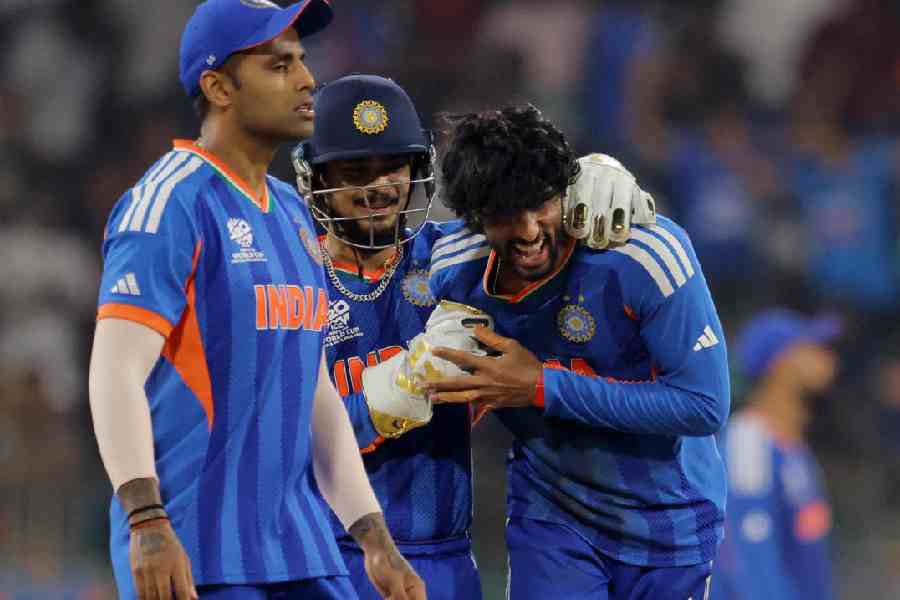
India did not simply win in Colombo. They imposed themselves.
On a packed R Premadasa Stadium, it was Ishan Kishan’s calculated aggression and a relentless bowling performance that powered India to a commanding 61-run victory over Pakistan in their ICC Men's T20 World Cup 2026 group clash.
Pakistan had won the toss and opted to field, backing their attack to exploit early movement. For a brief phase, the surface offered encouragement. There was grip, there was discipline, and India were made to work.
Then Kishan took control.
He began watchfully, absorbing pressure, before shifting gears with clarity. Short balls were pulled with authority, fuller lengths driven cleanly through the line. His footwork against spin was decisive, his intent unmistakable. What stood out was not recklessness but timing. He chose his moments.
The left-hander’s 77 off 40 balls altered the rhythm of the innings. A crucial stand with Tilak Varma steadied India after early movement, and once the platform was secure, the scoring rate rarely dipped. Suryakumar Yadav added fluency through the middle, while the lower order ensured the final overs carried punch.
India closed on 175 for seven, a total that felt imposing on a surface that did not allow free strokeplay.
If 175 required composure from Pakistan, the first few overs of their chase required precision. They found neither.
Jasprit Bumrah set the tone with unerring lengths. Hardik Pandya attacked the stumps. Axar Patel controlled the middle overs. The pressure was constant and suffocating.
When Babar Azam fell cheaply, undone by discipline rather than drama, the chase began to unravel. Pakistan were forced into strokes they did not fully trust. Dot balls mounted. Risks increased. Mistakes followed.
There was no dramatic implosion, just a steady collapse. Wickets fell at regular intervals, and the required rate climbed beyond comfort. India’s fielders backed the bowlers with sharp work in the ring, ensuring there was no easy release.
Pakistan eventually crumbled to 114 in 18 overs, never truly recovering from the early blows. The margin, 63 runs, reflected the gulf across phases.
What defined India’s performance was balance. Kishan’s assault provided impetus, but the innings was constructed rather than chaotic. With the ball, there was discipline before aggression, control before celebration.
Pakistan, in contrast, appeared caught between caution and urgency. The scoreboard demanded acceleration; the pitch demanded patience. They managed neither for long enough.
In high-profile India-Pakistan encounters, emotion often dictates narrative. In Colombo, execution dictated outcome.
Kishan supplied the spark. The bowlers ensured there was no resistance.
India claimed two points. More importantly, they delivered a performance that was complete.