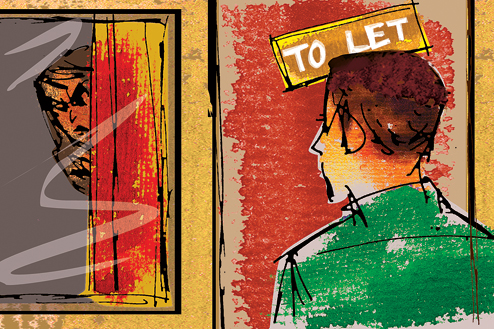

A young business management student from Mumbai applies for a job in a diamond export company and is told that it doesn’t hire Muslims. In Muradabad, Uttar Pradesh, a Muslim family cannot enter their house in a predominantly Hindu locality. A respected academic and former vice-chancellor, seeking to rent a house in Delhi, is turned away by landlords because he has a Muslim name.
There are numerous stories — from across the country — of Muslims being discriminated against because of their religion. Discrimination in India, legal and human rights activists stress, is not just against Muslims, but affects many sections of people, from Dalits and backward classes to other religious minority communities, handicapped people and women.
Not surprisingly, a demand for legislation to deal with situations such as these is gathering ground. Even though the Constitution forbids discrimination, discriminatory practices are rife, experts point out.
The Constitution of India states that there can be no discrimination in the name of religion, cast, creed or sex. Article 15(1), under Fundamental Rights, states: “The State shall not discriminate against any citizen on grounds only of religion, race, caste, sex, place of birth or any of them.” Article 14 stresses that the State “shall not deny to any person equality before the law or the equal protection of the laws within the territory of India”.
But senior Supreme Court lawyer Rajiv Dhawan points out that the articles have their limitations because they speak about state bodies and do not apply to private individuals. “It is absolutely necessary to have such a law, as it is very difficult to prevent private discrimination by non-state bodies,” he says.
On the other hand, if the government is not interested in tackling the issue, will a new law make a difference? It won’t, holds senior advocate Fali S. Nariman, as long as governments — at the Centre or in the states — “tolerate” discriminatory actions.
“If despite Articles 14 and 15(1) ‘things have not changed’, it is not because of lack of laws but because of the avowed lack of will to implement existing laws. ‘Minorities’ are so described in the Constitution because they are groups of Indian citizens who need to be protected by the Constitution against State-made ‘laws’ and anti-discriminatory practices of a majority group of citizens,” he says. “The sooner we as a people realise that ours is a plural society not dominated by one ideology or one race or one religion, the better.”
To be sure, successive governments have tried to deal with the issue. Over the years, several committees have been set up to examine the status of minorities. The Madhava Menon committee, set up in 2008, advocated creating an Equal Opportunities Commission. “[This] will be a significant step towards fulfilling the constitutional promise of equality in its different dimensions,” it said.
The poor status of Muslims — lack of jobs, education and so on — was highlighted by the Sachar Committee, appointed in 2005. In 2014, a report by the Post Sachar Evaluation Committee, headed by Amitabh Kundu, recommended the enactment of anti-discrimination legislation to “prohibit discrimination based on disability, sex, caste, religion” to move away from quotas and quota politics. It said: “Diversity index and anti-discrimination legislation together can help build a more equitable society…”
In many parts of the world, including the US and UK, anti-discrimination laws are in place. The law can regulate discrimination in employment even by private employers in some other countries, points out senior Supreme Court advocate Harish Salve. “For example, a business in the UK cannot refuse employment on religious grounds,” he says.
Can the courts step in — as they have done in many instances, such as in addressing the issue of gender justice? “While a court cannot direct legislation, in the case of gender justice the court has framed guidelines,” Salve says. “These are not as effective as a law — there is no real sanction. Thus there is need for legislation to address discrimination in employment.”
However, Subhash C. Kashyap, honorary professor at the Centre for Policy Research and a constitutional expert, believes that it is not necessary to have a law to fight discrimination, because of the fundamental principles of the Constitution. “The obligation is on the State to treat everyone equally and not to discriminate,” he says.
In other words, he stresses, the fundamental rights of the individual are legally enforceable by
Article 32.
Human rights activist Colin Gonsalves also believes that the State has the power to stop discrimination. “A housing society, for example, is registered by the registrar of societies, which is a government body. If the State wants to prevent such incidents, the registrar, who is a government employee, could easily refuse to register a society, showing their discriminatory policy as anti-constitutional.”
But with discrimination still a reality, a law can further safeguard an individual’s rights. It’s not just the individual who’ll gain, but the country, too, Salve emphasises. “The State benefits when levels of injustice such as by discrimination are reduced,” he says. Nariman adds: “Peace and order are not only good policy objectives. They are also conducive to development and to economic prosperity.”
Nariman, however, seeks to stress that the need of the hour is a change in mindset. “It is not in laws, but in our minds and hearts and through education that constitutional values get inculcated and respected,” he points out. “A lack of compassion amongst citizens (not the lack of laws) is the cause of discriminating practices.”
The jurist quotes the chief justice of the US Supreme Court, John Roberts, to sum up: “The way to stop discrimination… is to stop discriminating.”