Pleasure first
Sir — The International Kolkata Book Fair celebrates reading. Yet a visit to it also reflects how reading culture has changed. Reading was once casual and unremarkable. People read comics, novels, and serious books without ranking them. Today, reading is framed as a productive pursuit. Visitors often discuss how many books they buy, what lessons they gain, or how titles fit personal improvement goals. This approach turns reading into a chore. Pleasure, curiosity, and boredom-driven reading lose legitimacy and readers feel pressure to justify their choices. Reading declines when it feels like work.
Anupam Neogi,
Calcutta
Just concerns
Sir — The Economic Survey 2025-26 describes an economy that looks strong on paper yet an uneasiness persists underneath. Growth numbers remain solid and inflation appears controlled, but household spending feels weak in many towns and cities. Private companies are cautious about fresh investment. Exports are not rising fast enough. These gaps explain why foreign investors are pulling money out despite healthy headlines. Today’s Union budget will hopefully restore confidence at the level of household consumption and not rely only on macro indicators.
Mohammed Hasnain,
Mumbai
Sir — At first glance, the falling rupee seems puzzling when other economic fundamentals appear stable in India. The Economic Survey offers a useful reminder that currency markets respond to investor sentiment. Capital inflows matter for keeping the rupee steady. When global investors see better opportunities elsewhere, the currency suffers. India needs stronger foreign currency earnings from exports and investment. This is not about chasing foreign direct investments. It is about building confidence that lasts.
Sreemoyee Acharya,
Calcutta
Sir — One of the Economic Survey’s clearest warnings concerns fiscal populism at the state level. Unconditional cash transfers have expanded rapidly in recent years. According to official estimates, these schemes now absorb a large share of state revenues. Salaries, pensions, interest payments, and subsidies already consume most resources. This leaves little room for spending on infrastructure, health, or education. Equally, there needs to be clarity from the Centre about which expenses are being pushed onto the states as well the amount of money being given to the states
from Central taxes. Voters deserve honesty about these trade-offs before new promises appear in the Union budget.
Minisha L. Awomi,
Tuensang, Nagaland
Sir — The projected growth rate of 6.8% to 7.2% for 2026-27 in the Economic Survey sounds respectable. But achieving it will be difficult in a world facing geopolitical tension and slow global trade. India cannot assume past momentum will continue automatically. Policy choices now matter greatly. The Economic Survey raises the right questions. The real test lies in whether the Union budget reflects these concerns.
Sayantan Basu,
Calcutta
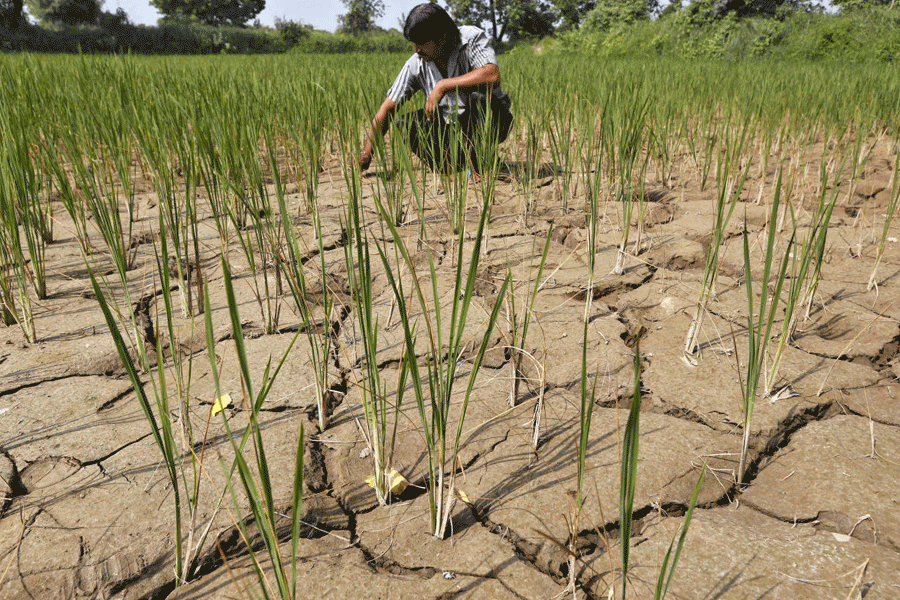
Sir — The agricultural reforms suggested in the Economic Survey deserve serious public debate. Direct per-acre urea subsidies could reduce wasteful fertiliser use without hurting farmers’ incomes. Support for crop diversification may ease pressure on water and public finances. Reviving village commons would strengthen rural livelihoods. These proposals are careful and phased. Their inclusion in the Union budget would signal a shift from blunt subsidies toward smarter, more sustainable, support for agriculture. But this government is not known for taking such well-planned steps. One will not be surprised if a slew of sops are announced for Bengal and Assam before the assembly elections there.
Nibedita Das,
Calcutta