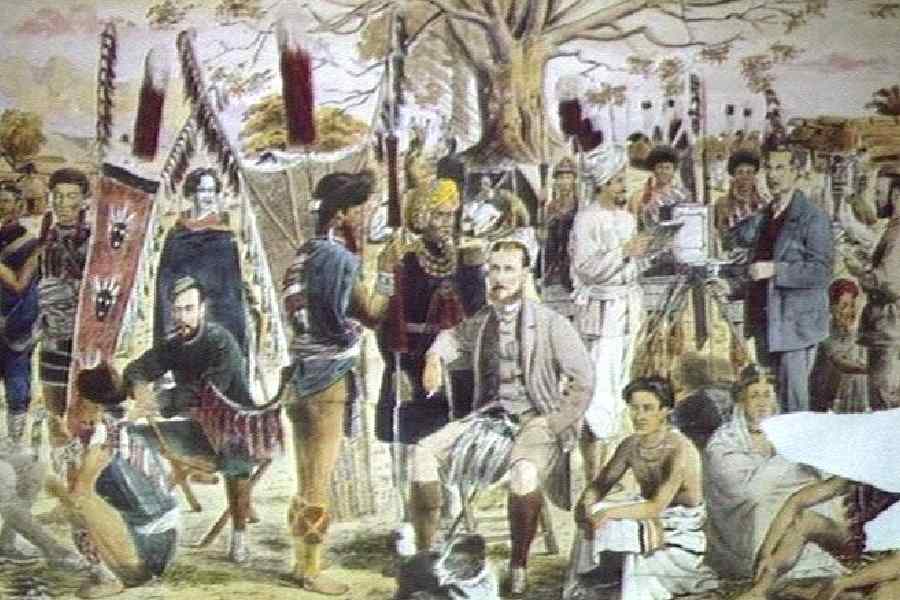
February 24 was an important date for the Northeast but it passed virtually unnoticed. On this day, the Treaty of Yandaboo (1826) completed 200 years. This treaty formally ended a dark era of occupation of the region, in particular the Ahom (Assam) and the Manipur kingdoms, by Ava (Burma), then under King Bagyidaw, the seventh of eleven kings of the Konbaung dynasty. The treaty is epochal not only for ending this brutal occupation but also for changing the course of the history of the region. It marked the start of the British takeover of the region and, beyond it, Burma.
The treaty was signed at Yandaboo, not far from Ava, the then capital of Burma (today’s Mandalay), between the British and the Burmese after the latter were defeated in the first of three Anglo-Burmese Wars. One of the terms of this treaty was for Burma to cede Assam and Manipur, which they had occupied for over seven years, a period remembered as Chahi Taret Khuntakpa (seven years of devastation) in Manipur and as Manar Upadrab (days of darkness) in Assam.
Assam was thereafter annexed and merged with the British Bengal province, while Manipur and other principalities, such as Tripura, were left as protectorate princely states. Burma was annexed in three phases into British India. After the Treaty of Yandaboo, the British took over Burmese territories adjacent to Bengal, namely Arakan and Tenasserim. After the Second War in 1852, Lower Burma, including Rangoon, was annexed, and after the Third War in 1885, the British annexed the whole of Burma. Of the three, in the words of the scholar, Alastair Lamb, only the first was a real war. The second and third were excuses to annex territories.
The fact that the Treaty of Yandaboo is today relegated to the margins of historical memory vindicates the argument that history is the interpretation of the past from the standpoint of the present — often unconsciously but, at other times, deliberate and motivated. Yandaboo is a game-changing historical pivot because many legacies of the British administration in the Northeast still live on, some doing good while others remain as thorns, causing friction amongst communities. After annexing Assam in 1826, the British introduced two distinct administrative regions — the directly administered revenue plains and the ‘wild’ mountains, which were claimed but left unadministered, except for occasional punitive expeditions. In Assam, the British actually drew an ‘Inner Line’ along the base of surrounding mountains by the Bengal Eastern Frontier Regulation 1873. The ‘unadministered’ areas beyond this line later became the ‘excluded’ and ‘partially excluded’ areas. This administrative strategy was also extended to Burma after the annexation in 1885.
While it is convenient to interpret this segregation as colonial divide and rule, the truth is more complex. In pre-colonial times, too, this strategy was in practice, as the ‘Posa’ system of Ahom kings bears evidence. The British found this administrative strategy useful and adopted it. The ‘Inner Line’ they drew, as Bodhisattva Kar shows in his essay, “When was the Postcolonial”, was not just a line in territorial terms but also a line in time. It was a line that divided pre-modern from modern, and ‘no law’ from ‘law’.
The reality was that it is in the valleys where agricultural surpluses led to State formation, centralising bureaucracies under one authority making it easier to standardise one law. In the mountains, the numerous villages were each a tiny kingdom, often at war with one another. An agreement with one would not hold in the next village a few hundred metres away, prompting the approach of leaving them in the ‘unadministered’ or ‘excluded’ areas bracket.
India inherited this administrative cartography in the Northeast. Much of the frictions the region faces today are on account of different land laws and administrative mechanisms for its hills and plains, adopted to tackle the same problem. Two centuries after Yandaboo, as the socio-economic playfields have levelled out, efforts must be to evolve suitable, consensual reforms to bring the region out of this time warp to integrate it with the modern.
Pradip Phanjoubam is editor, Imphal Review of Arts and Politics