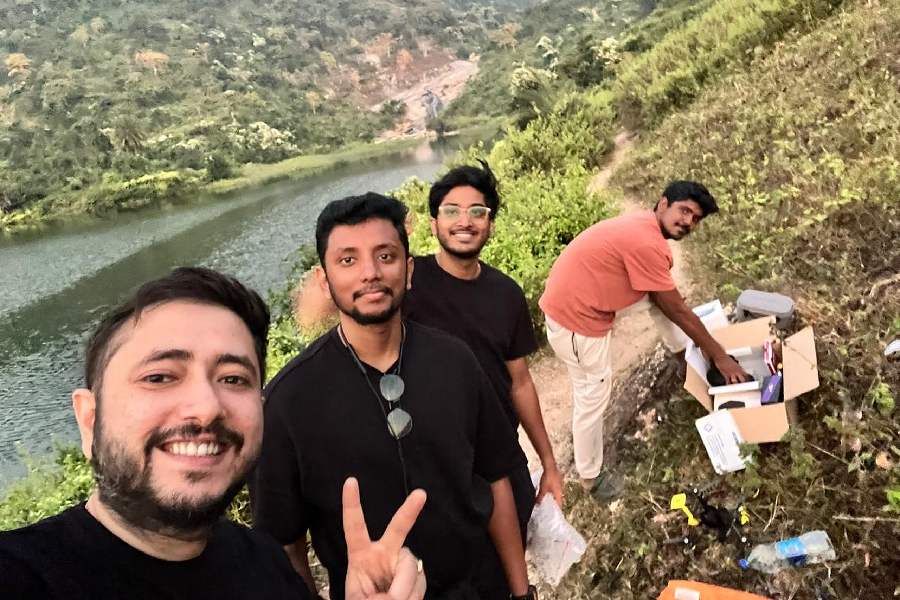
Arnava Chakraborty and Anik Bhattacharya, like many youngsters in Bengal, were part of bands in school and college. The two school friends from Methodist Dankuni always wanted to build something, be it a guitar amplifier or something more sophisticated.
That passion resulted in DarkMatter, a start-up that makes drone components in the narrow lanes of Bally Halt in West Bengal, a state not world famous for being business-friendly.
DarkMatter started in a rented room that one of Bhattacharya’s relatives let them use with a single fan to keep it cool. Now, the single room has AC and an automated machine to assemble the drone parts, and unlimited snacks for long night sessions of programming.
Bhattacharya and Chakraborty have completed their engineering in Electronics and Electricals respectively from Academy of Technology, Adishaptagram.
“Anik and I have known each other since childhood,” Chakraborty tells My Kolkata. “We studied in the same school. We became proper friends in college. We always wanted to make something, be it an amplifier or a drone.”
The duo co-founded DarkMatter, which makes drone components such as flight controllers and electronic speed controllers, in 2022, and licensed it a year after. Now, DarkMatter is a four-man team, with Himadri Mukherjee as production manager and Rahul Setty as manufacturing handler.
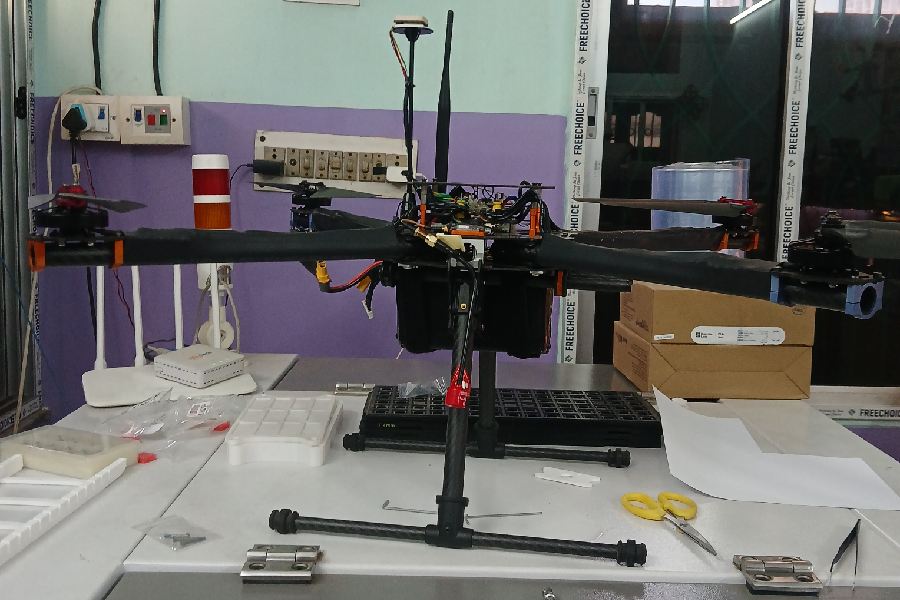
DarkMatter makes drone components such as flight controllers and electronic speed controllers
Using four operating systems to fly-test their drones, the start-up has quickly become a force in the emerging market of drone making. DarkMatter says it is the only company of its kind in Bengal and the third such company in India.
“We have had to learn everything on our own,” says Mukherjee. “From flight simulations to operating systems, I learnt from the founders, who in turn learnt from trial and error.”
The idea for DarkMatter was formed when an acquaintance brought a large drone to Bhattacharya around 2022 to figure out how to use it.
“Once we dived into the components, we saw there is almost no sustainable market for drone enthusiasts. From no reliable component supplier to product quality, everything was haywire. That is how the idea of DarkMatter came into being,” Bhattacharya says.
“In China, Japan, or Switzerland, the electronics industry is developed. They have been developing from silicone. When they build a motherboard, they know what to do with the board. When the PCB was manufactured, they did the same thing. So, they see the industry at every stage.,” Chakraborty explains.
“We are seeing all these developments suddenly, where advancements have taken leaps. So, we are trying to grow from that stage with that backlog of knowledge.”
The DarkMatter folks say there are several independent drone makers in Bengal with no ecosystem to support them.
“Many people are making drones in Bengal. But the total, if you call it the infrastructure of business or maybe the start-up ecosystem, is lagging because there is no proper support,” Bhattacharya says. “Proper support comes in the form of funds, which should be distributed to start-ups who are doing real things or solving problems.
“Given the history of Bengal, no one wants to invest here either,” he adds. “In India, there are three prominent companies. One is us. The other two are IIT-backed.”
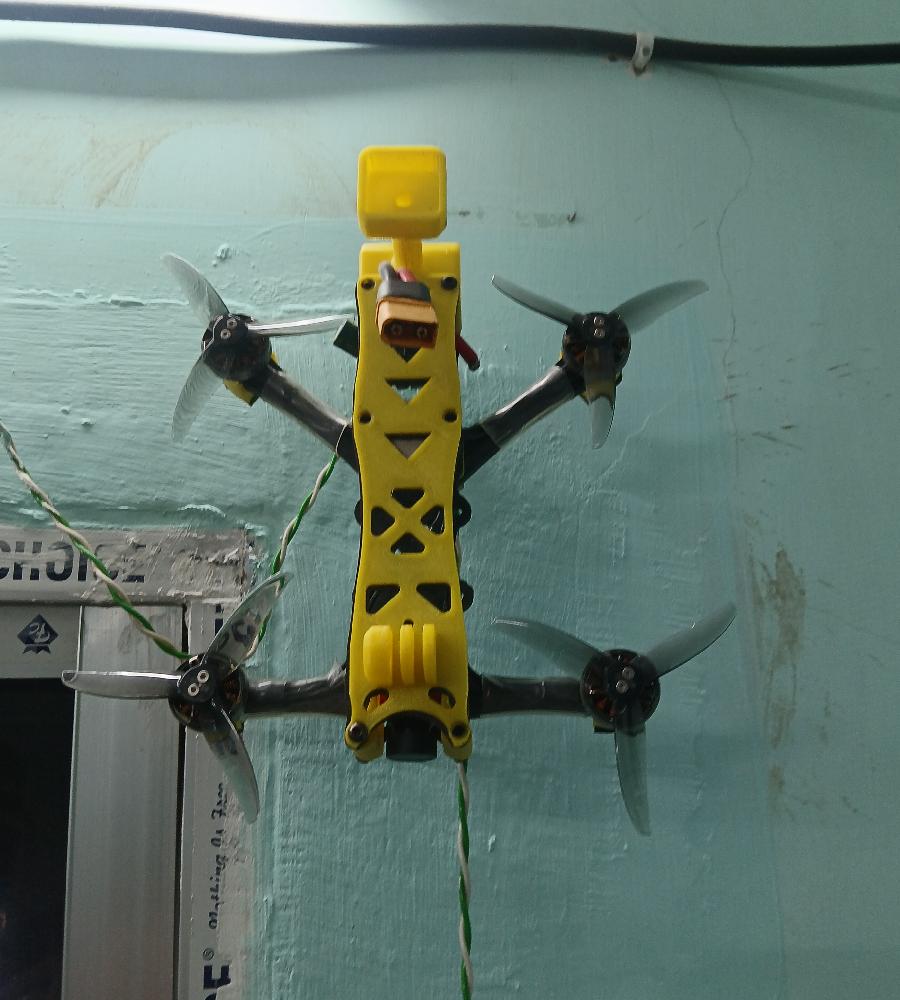
The team at DarkMatter say they have sold bulk orders to private buyers as well as Indian military divisions
The slow growing research and development section for drone making thus faces a problem.
“People who develop things, because they have funds, they have a mental peace that even if the first two prototypes do not work, there’s a cushion. From the third prototype maybe it will show some results,” says Chakraborty.
Because Bengal lacks that cushion of funding for research, it is essentially the added risk for companies like DarkMatter to create prototypes for newer innovations, he says.
The team at DarkMatter say they have sold bulk orders to private buyers as well as Indian military divisions.
“The layman part [of drone usage] is for delivery of goods for a distance of 5 to 10km. Then there is surveillance. Daily progress update of what is happening and not. Then there is the mining sector. [Through drones] you get the daily report of how the mining is going on. There’s agriculture, leisure photography, and racing.
“Then, there is military use – from aerial surveillance to sending arms and ammunition. Drones can be also used as kamikaze drones, which reach a specified location and destroy stuff,” said Bhattacharya.
The Indian Chamber of Commerce has featured the duo in its Success Story magazine, and the company has also won first place at an all-India innovation conference in Delhi.