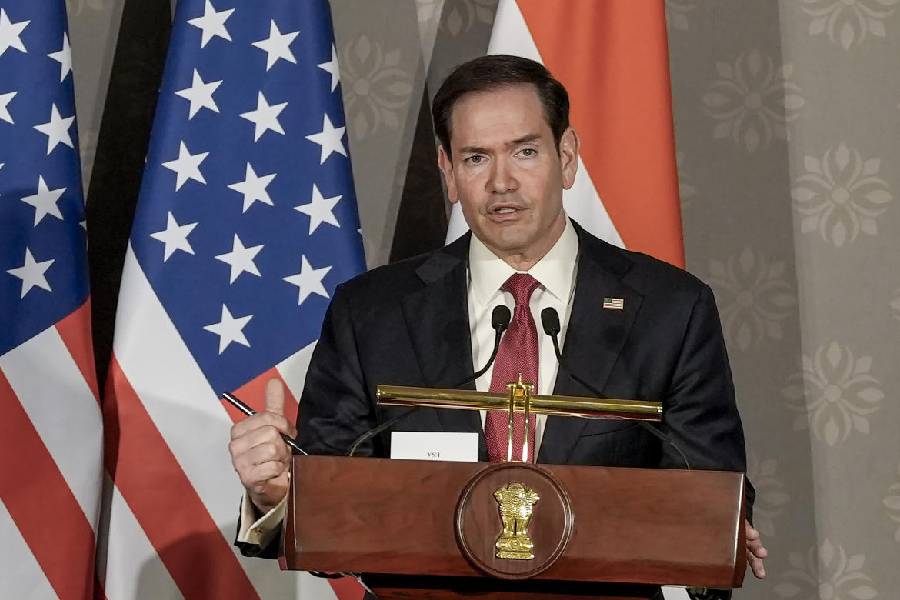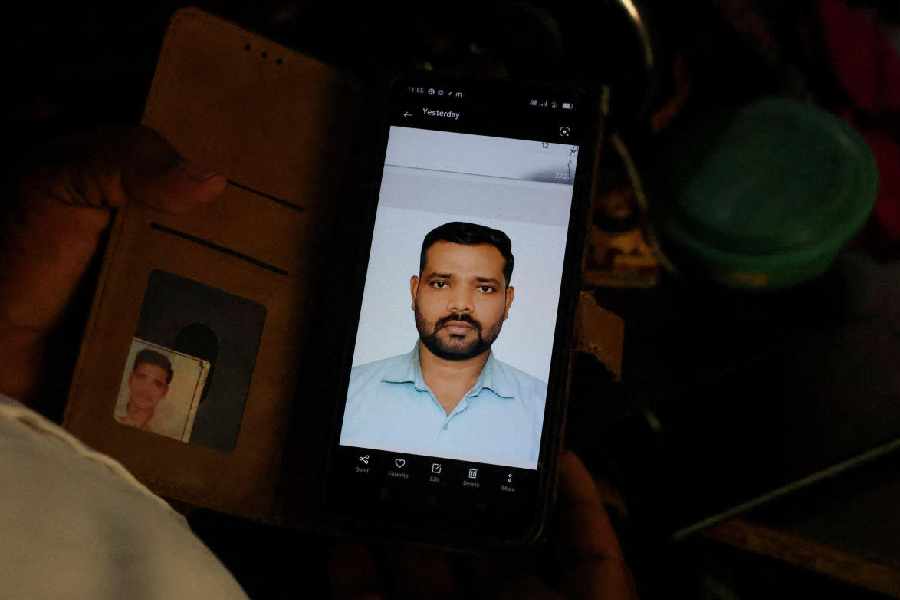
India’s external affairs minister, S. Jaishankar, posted a statement on X days after US strikes on merchant tankers crewed by Indian sailors where three sailors were killed and the rest were left to drown. “Spoke to US Secretary of State Marco Rubio this evening. I reiterated India’s strong protest at the attacks by the US Navy in the Gulf that killed three Indian mariners. Such lethal actions against commercial shipping are not justified.” He didn’t tell us what, if anything, Rubio said in response.
Earlier, the same ministry had twice summoned the US chargé d’affaires to lodge “strong protests” about America’s blithe and brutal “precision” strikes on civilian vessels. Narendra Modi hadn’t publicly acknowledged or addressed the murder of Indian citizens in international waters. He did, however, reply to a congratulatory message from Donald Trump on serving twelve years as prime minister.
The US has expressed no contrition and it’s evident that India’s foreign policy establishment doesn’t want to make an issue of these attacks. In the immediate aftermath of the strikes, Indian news sites carried reports citing official sources that suggested that these vessels were to blame for trying to breach the US blockade. These reports didn’t bother to carry the denials of the shipping companies that owned these ships.
It’s worth setting out India’s stake in the safety of its sailor citizens. Indians make up around 12% of the workforce of the world’s merchant marine. The US bombed Indian sailors with Hellfire missiles and Hornet fighters and India’s response was pro forma protest that elicited no regret. The same external affairs minister who had declared that India would continue to buy Russian oil in the national interest despite its war on Ukraine was now content not just to comply with US embargoes but to look on as America declares open season on Indians at sea.
As Pakistan’s self-appointed Field Marshal sits spider-like at the centre of a web of negotiations with Iran, the US, Egypt, Turkey and China designed to solve the Hormuz crisis, the Indian foreign policy establishment crouches like a ball boy on the sidelines of this conflict unfolding in its near abroad. It watches as its principal partner in the Quad (the prime minister’s great geopolitical adventure) bombs its citizens. How did we get here?
To tell this story, it’s useful to unpack the tendency in Indian foreign policy that sails under the flag of ‘multi-alignment’, a term birthed by Shashi Tharoor during his brief tenure as minister and then fostered by Jaishankar. Multi-alignment is a way of signalling an abandonment of non-alignment, which in the eyes of its critics was a passive holding of powerful countries at arm’s length. Multi-alignment, for both Tharoor and Jaishankar, was a dynamic engagement with nations and groups of nations guided by a transactional notion of the national interest. It was a way of saying that India is ready to do business without the quixotic idealism and sanctimony that had held it back till liberalisation unleashed its animal spirits.
In effect, it implied a decisive re-orientation of Indian foreign policy towards the US and its allies, particularly Israel. This was bipartisan; the shift began in the early Nineties and culminated for the United Progressive Alliance in the fabled Indo-US nuclear agreement for which Manmohan Singh burnt political capital. The Bharatiya Janata Party took this to another level after Modi came to power when the prime minister found in Trump and Benjamin Netanyahu ideological soulmates who offered the prospect of geopolitical power swaddled in shared prejudice.
Our predicament in the Gulf and our irrelevance to conflict resolution there are down to India riding the US-Israel bandwagon without a seat belt. This was painfully illustrated by the prime minister’s disastrous visit to Israel on the eve of the US-Israeli war on Iran. There are plausible reasons for the National Democratic Alliance’s enthusiasm for this duo, but at the core of this commitment is the idea that in a changing world, Modi’s India is best served by a club of illiberal democracies which will help one another out with military hardware and geopolitical alignments. Given the precarious state of liberal democracy in western Europe today, this wasn’t an implausible bet. Think of a National Rally-led France, an AfD-led Germany, a Reform-led UK, all travelling in Trump’s slipstream with Israel as their bouncer in the Middle East, and you can see why the BJP wants to bask in the sulphurous heat of this company.
Modi bet the house on Trump to the extent of cheerleading his prospects for a second term in rallies inside America. After the Joe Biden interregnum, he got his wish. But it turned out that bonhomie and bigotry weren’t stable foundations for foreign policy. Trump in his second term has treated Indians and their government with unprecedented hostility and contempt. The Quad is a dead letter (or several dead letters). India was singled out for swingeing tariffs. The US took Pakistan’s part after Operation Sindoor as, of course, did China. To manage to have both superpowers side with your oldest enemy during and after a war is geopolitical jiu-jitsu beyond the scope of poor Nehru’s imagination.
From Indians deported from the US in shackles, to Indian livelihoods destroyed by tariffs, to Trump’s boosting of Pakistan, to Indian sailors killed without warning in the Gulf, India has deferred to brutal trolling. There is a pattern here. During Modi’s first term in office, after China’s border incursion, the government refused to acknowledge that China had taken control of territory previously patrolled by our troops. To acknowledge ceding ground would mean losing face, so the government declared that it hadn’t happened.
The pattern is a broad deference to superior power. Jaishankar once plaintively asked how India was meant to take on China, a country with an economy several times the size of India’s. There is a crouching realism here, that could be dignified into a doctrine. Multi-Allied Deference (MAD) could be the doctrine. Deference and Denial (DAD) could be its signature strategy.
All foreign policy establishments need a cadre of international relations pundits and academics to make sense of their choices. In the spirit of the BJP’s excellent term, ‘the Khan Market Gang’, let us call this cluster of IR and foreign policy mavens, ‘the Raisina Blob’ (I use the term as a geographical metaphor; it doesn’t refer to the Raisina Dialogues).
International relations is an odd discipline. The natural home of its practitioners is the think tank adjacent to the state, not the university, though many move between both. Since access to the foreign policy establishment is essential to geopolitical intellectuals, their prescriptions tend to shadow the state. In the case of the tilt towards the US, the natural tendency to reinforce the government’s lead was strengthened by the fact that the commanding heights of IR — its think tanks, its university departments, its fellowships, its journals — are American and their gravitational pull has played a role in manufacturing a pro-American consensus that is seldom acknowledged.
These attendant lords have, for thirty years and more, helped bring Indian foreign policy to this pass where we watch the superpower they endorsed literally bomb Indians into the water. But they are, at best, auxiliaries. The credit for the present crisis belongs to the political establishment that they service.
mukulkesavan@hotmail.com