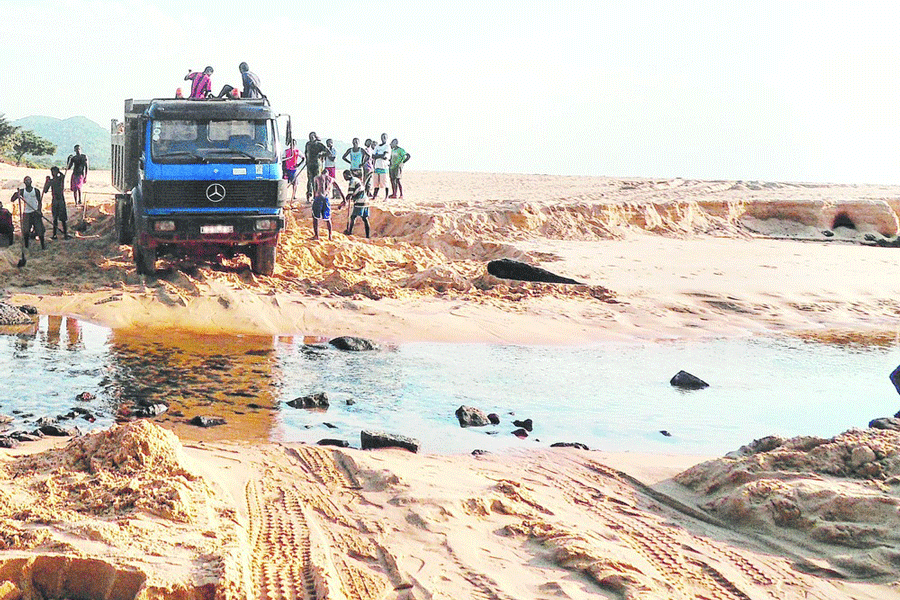
Sand mining from West Bengal’s rivers has critically altered their appearance, functioning and ecological character. A new study by researchers at Presidency University highlights how such changes occur and the marked signatures left behind by this extractive activity in the riparian environment. Unchecked, sand mining has the potential of substantially metamorphosing river behaviour, changing the channel geomorphology and stability, inducing riverbank erosion, and altering in-stream habitats for aquatic flora and fauna. Potentially deleterious impacts of unregulated sand mining can extend into the adjacent floodplains, leading to the loss of agricultural lands and the lowering of the local groundwater table.
Sand is considered to be a minor mineral as per Section 3(e) of The Mines and Minerals (Development and Regulation) Act, 1957. Sections 15 and 23C of the MMDR Act empower state governments to frame their own regulations for sand mining and devise pertinent Mineral Concession Rules. The West Bengal Sand (Mining, Transportation, Storage and Sale) Rules, 2021 regulate this activity in the state. These guidelines espouse the need to analyse ongoing riverscape transformations by sand mining and to monitor any leased sand mining blocks as per terms of the licenses issued.
The rise in demand for construction materials over the last decade has led to a marked increase in riverbed sand mining in southern West Bengal. This has created a new class of anthropogeomorphic landforms that are distinct from those fashioned by natural river processes. As part of an Anusandhan National Research Foundation-funded research project, this writer and his team mapped such new features.
The researchers used historical and present-day, high-resolution satellite images from the Google Earth platform to track changes caused by sand mining in rivers like the Ajay, Damodar and Subarnarekha within the Rarh region of West Bengal. During the dry season, tracks made by JCBs and numerous trucks radiate out across exposed sand bar surfaces to access different points. Temporary bridges of piled-up sand are used by these vehicles to ford the river. As the mining period, stretching typically from November to May, progresses, more and more sand is scooped up from between these tracks, creating hollows within the sand bars. Continual lowering of this surface ends up consuming the sand bar during the ensuing months and creates deep sand mining
pools on the river bed. While it is generally assumed that such hollows shall be replenished by fresh sediments delivered in the subsequent monsoon, pre-existing mining scars can often persist for years on the riverbed and alter its channel morphology substantially.
Both the Damodar and the Ajay have a long history of sand mining. However, our study discerned newly-mined stretches within the Subarnarekha, which was quite pristine earlier. Along this river, mining features like sand pools had increased by almost five times between 2020 and 2022, while sand hollows had doubled. The increase in total areal coverage of such sand pools, rising from 7,650 m2 in 2020 to 22,477 m2 in 2022, indicates extensive mining regimes. The cumulative effect of such sand bridges and pools is the stagnation of the river’s flow and the impairing of its upstream to downstream water discharge and sediment connectivity.
Scooping out the riverbed sand also makes the water turbid. Changes in water quality due to this extractive process along with a marked drop in dissolved oxygen at mining sites were noted. The study also found that the total suspended sediment concentration in these rivers during the peak mining period in January exceeded the standards specified by the Central Pollution Control Board.
The demand for sand is slated to increase substantially. Thus, the magnitude of sand-mining activities shall experience further growth. Continued monitoring and effective enforcement of sustainable mining norms would enable these rivers to replenish and recover.
Priyank Patel is Assistant Professor, Department of Geography, Presidency University