|
|

A lot of reporters probably envy Tintin, but very few would dare to treat him as a role model. For real-life reporters, the globe-trotting boy who always emerges victorious from the trials and tribulations of his missions has very little professional resemblance with themselves. Truth to be told, Tintin as a journalist is a bit of a disaster, unless we are talking about the kind of activist-journalism that we sometimes see around us these days. As a journalism manual, the Tintin comics could easily be subtitled, “What not to do as a reporter”. And the list would include taking sides, toppling governments, letting one’s inquisitiveness get the better of one’s professional responsibilities, failing to be politically correct and objective, and so on.
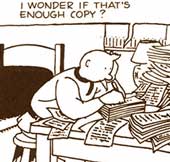
But there is no need to take Tintin’s journalism too seriously, because, although a boy of very strong principles, he isn’t much of a reporter. His first adventure, “In the Land of the Soviets”, begins with Tintin, one of Le Petit Vingtième’s “top reporters”, being sent to Russia to keep the readers of the paper (of which Hergé happened to be the editor) “up to date on foreign affairs”. This is the only book where Tintin tries to file a copy, though Bolshevik intrigue makes sure that the copy is never sent across.
Why did Hergé have to make Tintin a reporter? For an answer, one needs to consider three things: the power equations in the world and in Europe a decade before World War II; the bid to establish a newly-launched supplement; and an artist’s desire to make his mark in the creative world. For Le Petit Vingtième (the employers of both Tintin and Hergé), Tintin had to tread the fuzzy area between the real and the unreal, providing the readers a window to world politics while giving them a vicarious sense of adventure. A reporter’s role suited him best.
But that was exactly what it was: a role, never to be played too seriously or earnestly. In “The Castafiore Emerald”, where two other reporters (from the Paris Flash International) actually turn up, the professional disjunction is for everyone to see. There is nothing in common between Tintin and the reporter-photographer duo of Christopher Willoughby-Drupe and Marco Rizotto, and that is not merely on account of the paparazzi qualities of the men from Paris Flash. In none of the books do we see Tintin competing with a reporter from a rival newspaper. His competitors, if ever there are any, are detectives like Thomson and Thompson or the hotel sleuth in Tintin in America, not to mention the best of the world’s evil minds.
Superman/Clark Kent, the other famous reporter-comic-strip hero goes to his Daily Planet office almost every day and interacts with fellow journalists, unlike Tintin. As far as literary heroes go, Tintin is more at home in the company of adventurers, from Ulysses to Gulliver, and spies, like Smiley and James Bond. In fact, if Tintin had shown a little more interest in drinks and women, he would be the perfect rival for Agent 007.