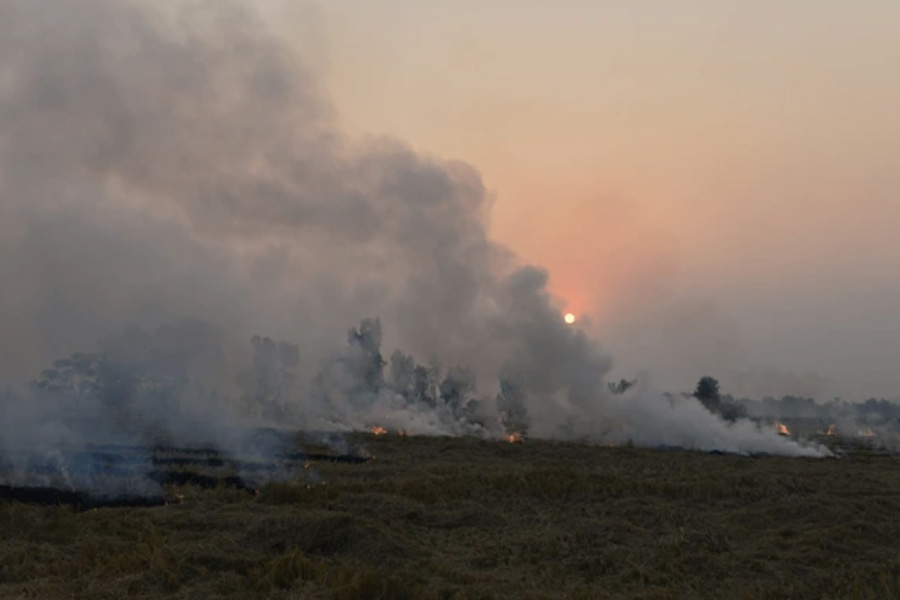
How does the government have the audacity — this word is being used judiciously — to deny the fact that Indians suffer ailments, even perish, on account of breathing poisonous air? Scientific research has repeatedly offered data suggesting a link between air pollution and mortality: the 2025 report of The Lancet Countdown on Health and Climate Change, to cite only one example, revealed that the burden of air pollution in India had reached over 1.7 million in 2022, a substantial 38% rise since 2010. Yet, Kirti Vardhan Singh, the minister of state for environment, forest and climate change, had the temerity to inform the Rajya Sabha recently that there is no conclusive data to link lung diseases with poor Air Quality Index. The government’s insensitivity and smugness regarding a serious public health crisis can be explained by a peculiar lacuna in Indian democracy: issues related to public welfare often disappear through the cracks in a terrain that is otherwise vociferous in terms of demands. The fact that air pollution is yet to become a phenomenon that can tilt the outcome of electoral contests or lead to spirited collective mobilisations is working to the advantage of the State, whatever the ideological shade of the government. Several factors can be attributed to air pollution not being a political phenomenon. There is room for improvement when it comes to raising awareness levels especially among people — the economically and the socially marginalised — who are most adversely affected by it. Solidarities that can coalesce around the issue are too fragmented: the resistance is, therefore, sporadic and weak. Significantly, at a time when young people around the world — the West especially — appear to be far more energetic in pushing ecological concerns into the electoral discourse, a similar movement by young, climate-conscious Indians — first-time voters — remains a fledgling entity.
The challenge of cleaning India’s air is also a stern test for the republic’s already fragile federal spirit. A public hazard like noxious air should be one of those rare issues that should have uniform support cutting across political and ideological crevices, bringing the government and the Opposition together to resolve the problem. Rahul Gandhi, the leader of the Opposition in the Lok Sabha, has made such a proposal and the Centre did seem amenable in its response. They should now follow through on it.