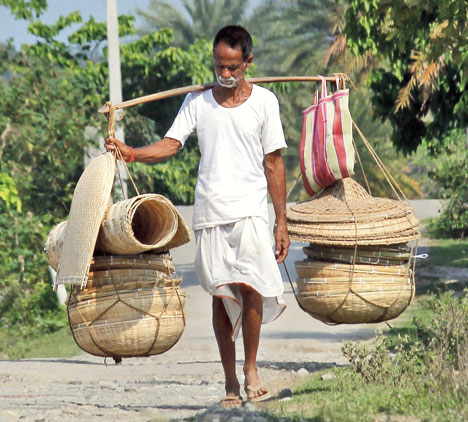

Cuttack: The state forest and environment department's Centre for Environmental Studies has expressed concern over the decline in the use of bamboo for industrial purposes, which has allegedly resulted in the loss of livelihood for those who are dependabt on extraction of bamboo from forests.
Centre for Environmental Studies director Ashutosh Debata expressed the concern at a workshop organised here recently.
Bamboo is one of the most abundant and renewable resources available in Odisha, covering about 30 per cent of the total forest area of the state.
"The use of bamboo from forest for its major industrial use - paper manufacturing - is decreasing. This has adversely affected the livelihood opportunities of the rural people, especially those who live on the fringes of the forest," said Debata.
"However, bamboo has the potential for generation of gainful employment through various bamboo-based industries which can be developed on technological advancements made in India and other countries," Debata said.
"It offers tremendous employment and income generation opportunities to the community for the invaluable role they can play covering bamboo harvesting and regeneration," he said.
"With a growing need for the development of sustainable materials, engineered bamboo combines the benefits of a natural fibre composite with advantages of a laminated material. Highly renewable, large-diameter bamboo used for structural applications is harvested every 3-5 years."
Debata also said: "Once harvested, the raw material can be processed into strips, which are then laminated into a board."
"The challenges we face today is to further improve and innovate the uses of bamboo. Since bamboo is the fastest growing plant on earth and a sustainable building material, it could easily substitute all known wood applications without having to cut down entire bamboo groves or plantations," he said.
He added: "Better yet, bamboo continuously grows after harvest without having to re-plant it. Bamboo also converts about 35 per cent more carbon dioxide into oxygen than a regular tree."