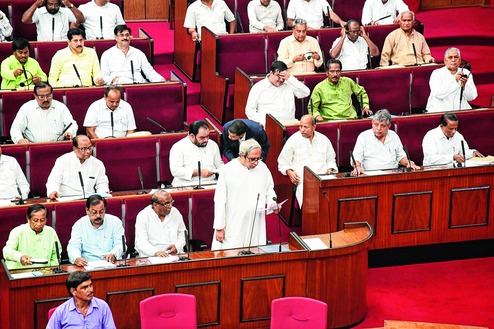

Picture by Ashwinee Pati
Bhubaneswar, May 18: The special session of the Assembly began today with the introduction of Odisha Goods and Services Tax Bill and Odisha Value Added Tax (Amendment) Bill.
However, the first day session was adjourned without a discussion as the members sought more time to study the contents of the proposed legislation.
"It will be discussed tomorrow," Speaker Pradip Kumar Amat announced after a meeting with the business advisory committee.
Introducing the GST Bill, finance minister Sashi Bhusan Behera said the states were required to pass the bill for implementation of GST, which would pave the way for introduction of a uniform tax structure in all states.
Odisha Value Added Tax Act needed to be amended since the states now have limited power to levy tax under entry 54 of the state list, he said.
Leader of the Opposition Narasingha Mishra said his party had "no objection to the passage of the two bills. But there are 174 clauses in the GST Bill and 23 clauses in the VAT (Amendment) Bill. Besides, large annexures are attached to the bills. Therefore, the members should be given adequate time to study and then discuss on the subject. Otherwise, people will think that a bunch of jokers are sitting in the Assembly."
The GST Bill, a comprehensive legislation, has 21 chapters dealing with tax administration, procedure of levy and collection of tax, registration, filing of returns, payment of tax, refunds, offences and penalties, confiscation of goods, inspection, search, seizure of premises and arrest, appeals and revision. Under the bill, a person with an aggregate turnover of more than Rs 20 lakh in a financial year is liable for registration.
The Odisha VAT Amendment Bill with 23 clauses and a few annexures, seeks to omit Schedule A, B, and D. Schedule A contains a lists of goods exempted, Schedule B is a list of goods taxable at the rate of one per cent, 5 per cent and 14.5 per cent and Schedule D contains the list of the type of capital goods taxable under the act.
The bill seeks to insert Schedule C with a list of goods subject to tax at a single point on turnover of sales or purchases.