Wednesday, 24 June 2026
Wednesday, 24 June 2026
Wednesday, 24 June 2026
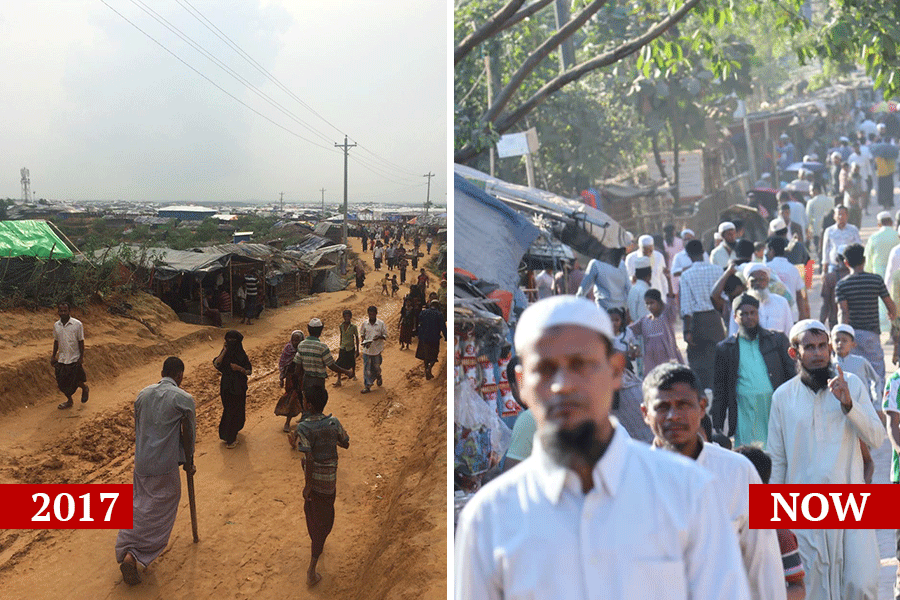
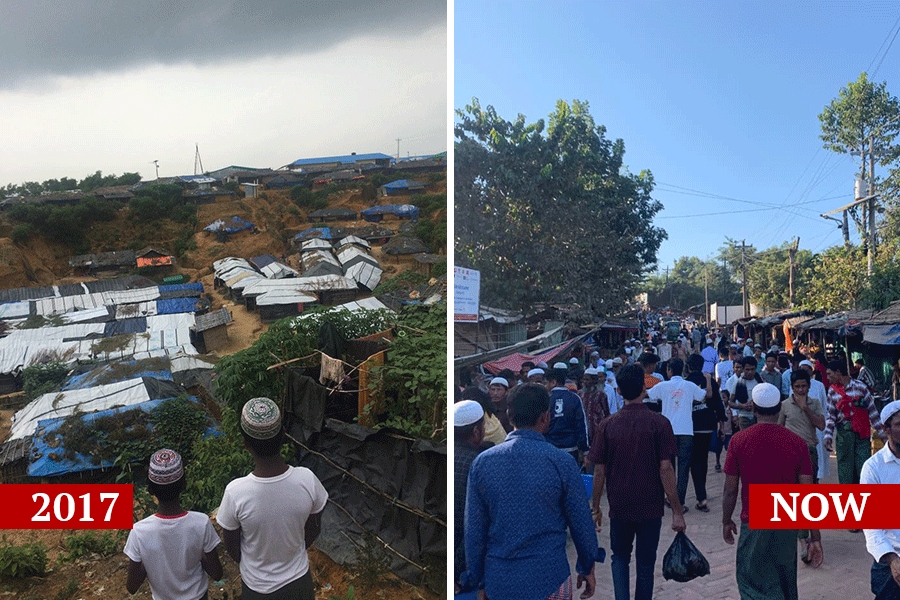
As Bangladesh braces for an election that will give the country its first non-Awami League government since 2008, around a million Rohingya refugees wait, consigned to camps in Cox’s Bazar and the offshore island of Bhasan Char, with their futures suspended by barbed wire and bureaucracy, and a story they would gladly not be a part of.
The Bangladesh Election Commission claims these camps are hotbeds for arms and drug trafficking and should be kept sealed, painting the Rohingyas not as victims but as suspects.
In reality, their lives are marked not by criminality but by stifling uncertainty and relentless persecution. Human Rights Watch has repeatedly said that it’s not safe for Rohingya refugees to be sent back to Myanmar, where they escaped from amid widespread killings, sexual violence and village burnings carried out by the Tatmadaw or Myanmar military in 2017.
The Bangladesh Nationalist Party (BNP) chief Tarique Rahman, in an interview to Reuters, has said that his party will try and work on the issue of repatriation only when it’s safe for them to return.
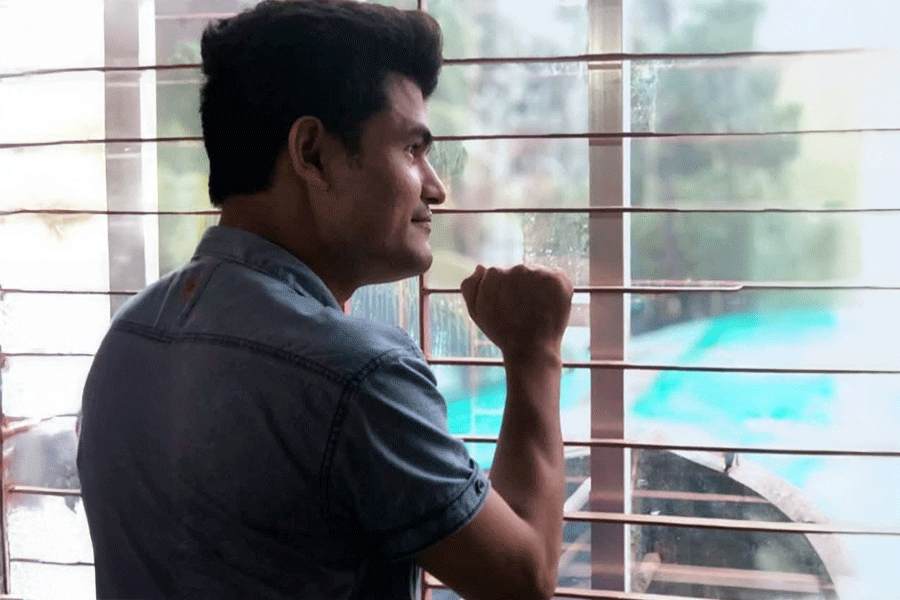
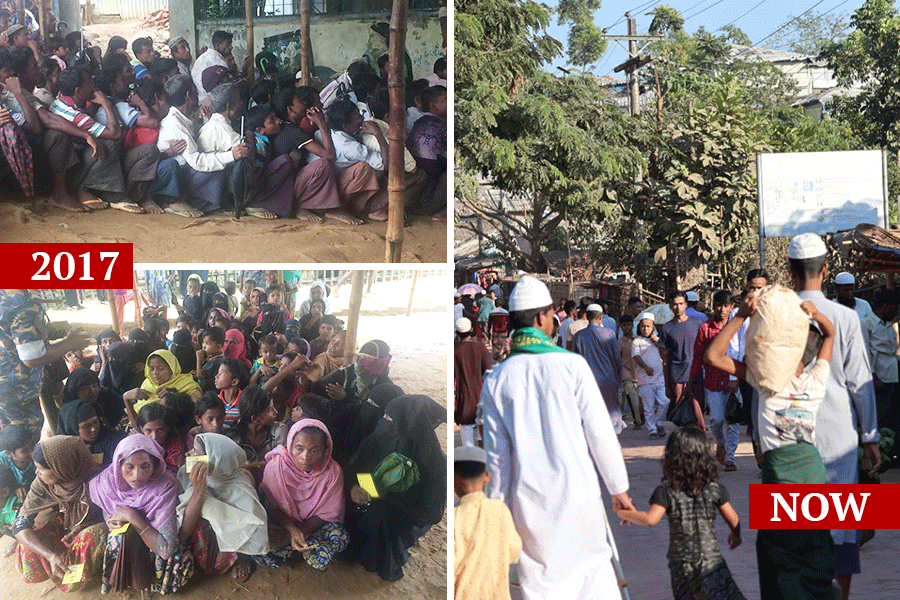
Nine years ago, when the army crackdown or genocide began in Myanmar, the Rohingya population in Rakhine province escaped to Bangladesh. Mohammad Arafat’s family was among them. Arafat, 32, now stays in the Kutupalung refugee camp, where inmates have been ordered to stay put until the ballots are cast.
“Five years before the crackdown, in 2012, I escaped Myanmar on foot with the help of smugglers, arriving first in Bangladesh and then in India. I graduated and began working as a translator for an NGO in India,” Arafat tells The Telegraph Online.
“In Myanmar, our citizenship rights were taken away in 1982 and then our human rights were gradually eroded.”
Arafat escaped that life in Myanmar. In India, he claims he was detained in Assam while working as a social activist and translator. He was sent to jail in December 2020. From the jail in Karimganj, he was sent to Silchar and then to the Matia detention centre, India’s largest, later called a transit camp.
In June 2024, Fortify Rights filed a complaint with the UN Working Group on Arbitrary Detention asking for Arafat’s immediate and unconditional release.
“I fought for the rights of other detainees, and they called me ‘master’ or ‘tutor’ in jail," Arafat says. “I requested jailors and sometimes they gave me the opportunity to write letters. Then, last year, they took me, blindfolded me and pushed me across the border at night."
In May 2025, he alleges he was sent back to Bangladesh, but he hesitates to talk about it. “My family and I are now together here, but I have suffered a lot and still suffer from mental-health problems,” he says. “Being a human rights defender, I have always tried to fight for justice.”
‘Fear and uncertainty’
One senses a similar desperation when one speaks to residents of the Teknaf refugee camp. They will remain anonymous and arrived here after the genocide of 2017, now being discussed at the International Court of Justice where public hearings began in The Hague in January 2026.
One person recounts the aftermath of a devastating fire in the refugee camp in January that left families homeless yet again, their trauma compounding as the world continues to look away. The sealing of these camps during elections, justified as a security measure, diverts attention from decades of denied justice and further stigmatises a population already rendered stateless.
“For my Rohingya community, the election [in Bangladesh] brings fear and uncertainty,” the resident, who reached Bangladesh in 2017, tells The Telegraph Online.
“During elections, movement restrictions increase, and the already trapped Rohingya refugees in the overcrowded camps where there is no freedom feel even more confined and silenced. We worry about reaching hospitals, receiving aid and meeting other basic needs. Beyond politics, what we feel is constant anxiety, the fear of being forgotten, the fear of further restrictions instead of hope.”
The Rohingyas know it is dangerous, or impossible, to return to Myanmar, and they are undesired in the broader political landscape of both Bangladesh and India. Statelessness and stigma pursue them relentlessly, haunting generations across land and sea. According to Unicef’s Bangladesh Situation Report, the overall security situation in the camps remains fragile, and global funding for humanitarian aid has shrunk.
“Motton halot ki oibo, zana nai or agor halot ki oibo, zana nai [I don’t know what the future holds]”, says a resident of the camp, underlining the unknown, uncertain future.
The Rohingya in Bangladesh
Rohingyas arriving in Bangladesh from Myanmar and being repatriated is not a new phenomenon. In July 1978, there was a secret repatriation agreement between the governments of Bangladesh and Myanmar (then Burma), which became public in 2014. Between mid-1991 and 1992, another wave of Rohingya refugees arrived in Bangladesh. In March 2002, Medicines Sans Frontier published a report about 10 years of the Rohingyas in Bangladesh, saying, among other things, “The refugees need to be viewed not as a burden or ‘residual caseload’ but as human beings, with hopes, voices and rights.”
More than two decades later, that report still rings true. Even though the BNP has mentioned an engagement with repatriation only if the situation is safe, the camps remain precarious. Not to mention that the conditions are usually unlivable.
Addressing the UN General Assembly in September 2022, then prime minister Sheikh Hasina had said that despite Bangladesh’s bilateral engagements with Myanmar, not a single Rohingya was repatriated by her country.
“Prolonged presence of the Rohingya has caused serious ramifications in the economy, environment, security and sociopolitical stability in Bangladesh,” she said. Hasina also said, “Uncertainty over repatriation has led to widespread frustration. Cross-border organised crimes, including human and drug trafficking, are on the rise.”
The stigma becomes stronger during elections.
When asked how the situation has changed in the camps, a Rohingya resident in the Teknaf refugee camp said: “Nothing has changed and we remain trapped. But the situation in Myanmar is even more dangerous for anyone to go back. Everyone knows that. Election or no election.”