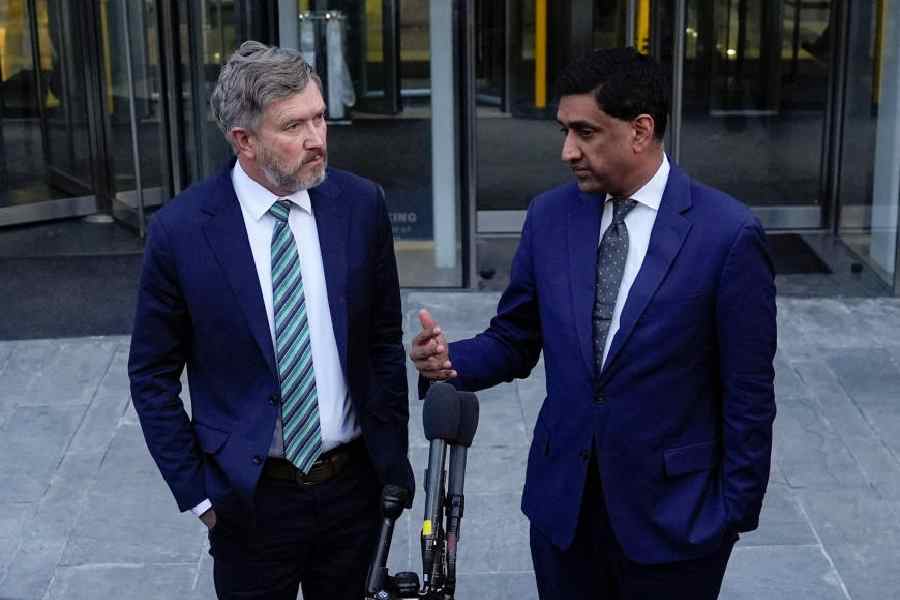
Two American lawmakers, one a Republican and the other a Democrat, have said they identified at least six men whose identities appeared to have been concealed without clear legal justification in the Jefrrey Epstein documents released by the US Department of Justice.
Republican US representative Thomas Massie and Democrat Ro Khanna said they zeroed in on these six men while examining the files inside a secure Justice Department reading room on Monday.

The two declined to disclose the names, saying they would first allow the department an opportunity to correct what they described as possible “over-redaction”.
Massie said the six included at least one American, at least one foreign national and an individual “pretty high up” in a foreign government, while Khanna described another as a prominent figure.
The lawmakers indicated they could raise the matter in a congressional hearing or on the House floor if the names are not released.
The review marked the first time members of Congress were permitted to examine the latest tranche of Epstein-related records after months of criticism that earlier public releases were heavily censored and yielded little new information.
The controversy centres on the Epstein Files Transparency Act, which requires the Justice Department to release unclassified records tied to Epstein and his associates and allows redactions only in narrow circumstances such as protecting victims’ identities or active investigations.

The law also bars concealment on grounds such as embarrassment or political sensitivity, the magazine added.
Several legislators from both parties said what they saw did not appear to meet those standards. Democrat Jamie Raskin said he encountered multiple instances where names were obscured even when the individuals were not victims and noted that Congress had yet to receive a required explanation detailing why specific passages were withheld.
Per reports, Raskin also pointed to a redacted 2009 email chain involving Epstein’s lawyers and lawyers for Donald Trump that summarised comments attributed to Trump about Epstein’s visits to the Mar-a-Lago club, saying the passage appeared to have been concealed without clear legal basis.
Trump has long denied wrongdoing related to Epstein and has not been accused or charged by authorities in connection with the case.
Other lawmakers emerging from the review said the material suggested the network extended beyond Epstein and his associate Ghislaine Maxwell.
Democrat Jared Moskowitz said the files contained references to multiple alleged co-conspirators involved in trafficking minors across countries.
Khanna said some documents appeared to have reached the Justice Department already redacted from FBI or grand jury sources, even though the law envisages fuller disclosure to reviewers.

He added that the issue was not partisan and that individuals in positions of power should face scrutiny if implicated.
The Justice Department has said it holds millions of Epstein-related records and previously acknowledged withholding or redacting hundreds of thousands of pages citing privileges such as attorney-client communications.
Lawmakers, however, argue those grounds may not be permitted under the transparency statute, the report added.
With only a handful of computers available for viewing, some legislators warned it could take years to examine the archive running into several million documents.
US Attorney General Pam Bondi is scheduled to testify before the House Judiciary Committee this week, where members from both parties are expected to seek answers on how the department processed and released the files.
Epstein, a wealthy financier with extensive political and social connections, was charged in 2019 with trafficking minors and died in a New York jail while awaiting trial, a death ruled a suicide.