
Paradip, April 1: Scientists at the Indian Institute of Science, Bangalore, have found that olive ridley sea turtles cover a short distance during their migration for mass nesting while leatherback turtles migrate to far-off lands to lay eggs.
The research showed that the olive ridley sea turtles stayed within the Bay of Bengal and do not go further than the Sri Lankan coastline. However, the leatherback turtles moved to the coastline to Mozambique.
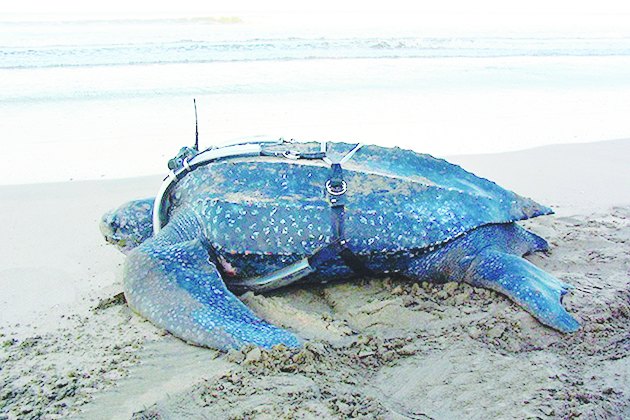
"The experiment was conducted on leatherback turtles by tagging satellite transmitters on them. In January last year, we had fitted two transmitters on two leatherback turtles in Little Andaman. One turtle was seen moving towards the coast of Mozambique. The turtle took 325 days to cover 5,000km and reached the East African coast in last November. Another one covered 6,713km and reached the Australian coast within a year," said turtle biologist Adhith Swaminathan of the centre for ecological science of the institute.
The institute has been conserving olive ridley sea turtles and studying the species along the state coastline since the past 10 years.
In April 2001, for the first time, the state forest department and the Wildlife Institute of India (WII) had also tagged four turtles with platform transmitter terminals.
Only one of the turtles was seen to migrate south towards Sri Lanka.
All four transmitters had stopped working within two to four months. The experts said that there might have been some technical problems or fishermen could have caught the turtles.
"In January 2009, the WII and the forest department personnel had tagged 10 olive ridley sea turtles at the nesting sites of Gahirmatha, Devi and Rushikulya. They tracked the routes of the turtles in the Indian Ocean, about 1,000km south of Sri Lanka. The turtles migrated to the southern coast of Sri Lanka by June 2009. After two to three months of foraging activity along the Sri Lankan coast, they started migrating back to the Bay of Bengal. They returned to the state coast by September 2009. This study indicated that the olive ridley sea turtles move between the state and Sri Lanka. However, leatherback turtles of Andaman swim across thousand of kilometres," said Sudhakar Kar, a wildlife biologist and the former research officer of the forest department.