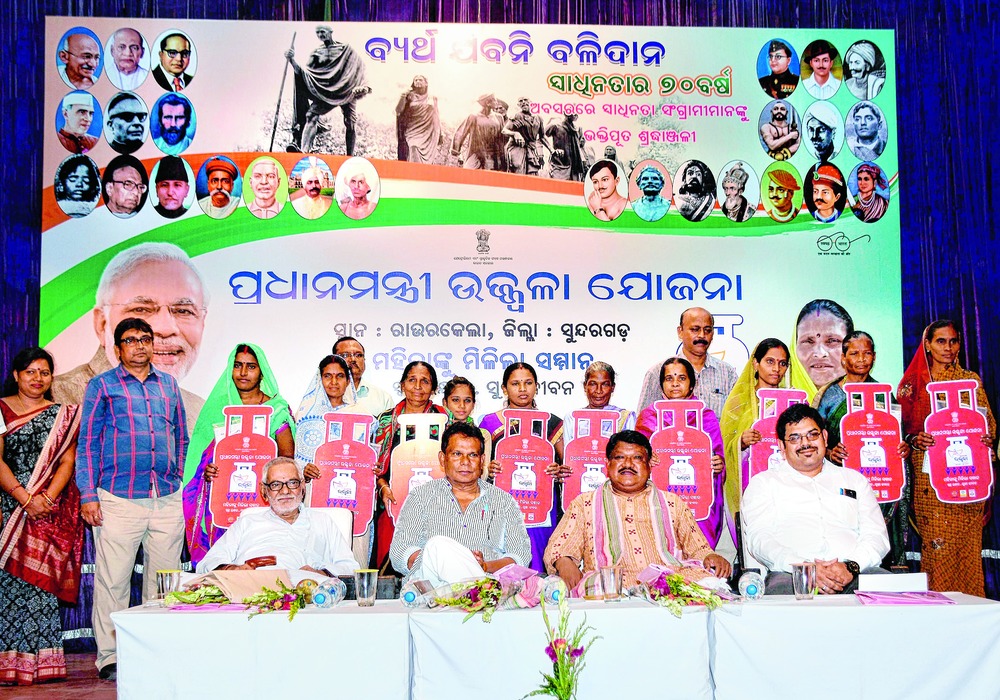

Bhubaneswar, Aug. 24: A game of political one-upmanship is on in the state, as the BJD and the BJP have locked horns over the implementation of Pradhan Mantri Ujjwala Yojana (PMUY), which aims at providing free LPG connections to poor women.
The tussle is reminiscent of the ones over distribution of cheap rice and execution of National Rural Health Mission (NRHM) and Pradhan Mantri Sadak Yojana (PMSY) where both claimed credit for the schemes.
Harking back to the war over the Re 1 rice scheme that benefits around 52 lakh people, the tug-of-war over PMUY with around 30 lakh target beneficiaries in the state is being seen as significant in terms of vote-bank politics with both parties having launched preparations for the big battle in 2019.
Things came to a head last week with BJD activists allegedly disrupting PMUY implementation meetings where BJP leaders had been invited to do the honours.
With the organisers being forced to cancel one of these programmes at Balanga in Nimapara on August 9 following alleged vandalism by ruling party workers, secretary, Union ministry of petroleum and natural gas, K.D. Tripathy, has shot off a letter to chief secretary Aditya Prasad Padhi urging him to ensure cooperation from district authorities in the implementation of the scheme.
Sources said immediate provocation for violence at Balanga was the presence of state BJP women's wing chief Prabhati Parida and her colleague Pinki Pradhan as chief guests at the PMUY programme. This was followed by a similar incident at Athgarh where alleged BJD activists were angry at the BJP effort to run away with credit for the scheme. This led to a ruckus that left the organisers shaken.
BJD spokesperson and Nimapara MLA Samir Dash sought to justify the anger of his party workers.
"We have no objection to the implementation of the scheme. But, we are against the BJP trying to extract political mileage out of it. It has been turned into a party scheme," he said.
Hitting out at the BJP, he alleged that the party was using the scheme to provide LPG connections to its party workers.
"They are providing connections first to their party workers. Besides, there is no attempt to involve local MPs and MLAs in the meetings organised for free distribution of connections. What else is this if not politics?" asked Dash.
The scheme has been spawning controversies since its launch in Sambalpur on June 20. BJD leaders, including Sambalpur MP Nagendra Pradhan, boycotted the event as local MLA Raseswari Panigrahy was not invited. It was seen as a deliberate omission on the part of the BJP, which is out to make political capital out of the central scheme.
However, state BJP spokesperson, Sajjan Sharma described alleged violence by BJD activists at PMUY programmes as panic reaction and a sign of frustration in the ruling party.
"This is happening because now they are unable to appropriate credit for central programmes. They are feeling frustrated," he said.
This is not the first time that the two parties have clashed over a central scheme. One of their biggest showdowns was over the Re.1 rice scheme for which the BJD had been taking credit since the days of UPA government. The party, which never once did acknowledge the fact that the rice it was distributing among the beneficiaries was heavily subsidised by the Centre, earned rich political dividends from it in the elections.
Political analysts pointed out, "While there was no resistance to BJD's blatant attempt at grabbing credit for the scheme during the UPA regime, the scenario changed drastically with NDA coming to power and BJP leaders in Odisha launching a campaign in the state to sensitize people about Centre's contribution to the cheap rice scheme. The party also sought to expose the ruling BJD's covert attempt to project 108 ambulance service under the National Rural Health Mission (NRHM) and Pradhan Mantri Sadak Yojana (PMSY) as its own with an eye to the vote-bank." "We are ensuring that they do not hoodwink people by making false claims. No wonder their frustration level is rising," said BJP spokesperson, Sajjan Sharma.