

Pictures by Pullock Dutta
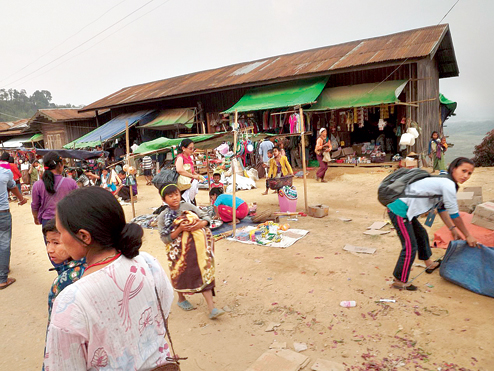
Pangsau (Myanmar), April 3: The knives are out as are clothes, cloves, salt, shoes, noodles and medicines - all spread out on large, coloured plastic sheets placed on the ground and watched over mainly by women vendors.
Welcome to the market without borders. Well, almost.
Imran Hussain, owner of a pharmacy at Nampong in Changlang district of adjoining Arunachal Pradesh in India, has travelled 15km on his motorcycle through Pangsau Pass to be at the Pangsau market in Kachin state of Myanmar to pick up his supply of an ointment.
"This Chinese ointment (a pain killer) is in great demand at Nampong and I come here to get this regularly," Imran, a migrant from Bihar, told The Telegraph.
Imran's pharmacy at Nampong, the last town on the Indian side of the border, is the only one in the subdivision by the same name.
On the other hand, Moya Kimsing is here for the knives. "The Chinese and Myanmarese knives are very good. My friend had purchased one and I have come today to buy a couple for myself," he said.
But it's not just buyers who come to Pangsau from Nampong.
Nimu Kibang, a resident of Nampong, spreads lengths of tarpaulin on one side of Stilwell Road at the market and arranges glucose biscuits, tobacco, noodles, salt and shoes.
It's the rate that Pangsau's residents are willing to pay which makes Kibang haul her merchandise to the market. In Nampong, salt goes for about Rs 20 a kg. In Pangsau, prices hover around Rs 100 a kg. Prices of other items from India are almost double here. It is the same for the Myanmarese and the Chinese items. A Chinese beer costs over Rs 200. Indian traders can bring in only edible items and things like cloth and garments to the market.
The region's isolation makes it a seller's market. But all this can change for the people when border trade between the two countries begins soon," an official at the sub-divisional office at Nampong said.
The market, which functions on the 10th, 20th and 30th of every month, is not only a buyers-sellers meet but also a mingling point for the tribal population living on either side of the border and a major tourist destination where people from India get an opportunity to get a glimpse of life across the border without a passport or visa.
An added attraction for the tourist is the Lake of No Return, located about 3km from the market, but visible. It is said to be a burial ground for many pilots and their warplanes that crashed into its water during World War II, thus draping itself in a Bermuda Triangle aura.
While no passport or visa is required, one has to obtain passes from the Arunachal Pradesh government to come to the market and one has to pass through at least three checkgates - of Assam Rifles, Arunachal Pradesh police and Myanmar authorities - on the historic Stilwell Road which connects India's Northeast with Myanmar.
The road, which starts at Ledo in Upper Assam, passes through Jairampur, the Assam-Arunachal Pradesh border checkpost, and after meandering through forests of dark green bamboo and fields of elephant grass, reaches Nampong. From Nampong, the hill section of the highway starts.
The road gets its name from Joseph Stilwell, who oversaw its construction by Allied soldiers and Chinese, Burmese and Indian labourers during World War II. The purpose of the exercise was to carve a path through Burma (now Myanmar) to bail out the Chinese who were fighting the Japanese during the war.
However, immediately after the 1962 Sino-Indian war, the Indian Army closed Pangsau Pass to civilian traffic until 1990s, the ban applied only loosely to people of the Tangsa community residing on either side of the border. It didn't take long to realise that Nampong and Pangsau were too interdependent to enforce the need for passports or visas.
"We issue more than 100 passes on each market day to people from Nampong. It has been a regular feature since several decades now," Gautam Hazarika, former sub-divisional officer of Nampong, said. One has to also get passes for the lake from the SDO's office.
Apart from issuing one-day passes, the Nampong administration also issues 15-day passes to people from Arunachal Pradesh to visit their loved ones on the other side of the border, he added.