
Nagaon, Dec. 1: Around two weeks after an anaemic woman almost died during childbirth because her poor husband believed going to a doctor would harm the baby, the district administration has vowed to cut Nagaon's maternal mortality rate in half within a year.
Shila Bhumij was rescued from her residence in the remote village of Segunbahi by officials on November 18.
Nagaon deputy commissioner Manalisa Goswami said: "Shila Bhumij had just 4gm haemoglobin in her body. Her husband had a superstitious belief that examination of a woman by a doctor during pregnancy was harmful for the unborn baby. Several attempts by local health workers to bring the patient for treatment failed, so we sent assistant commissioner B.I. Chaudhury, accompanied by a health department official, to the village. Shila was eventually brought to hospital where three units of blood were given to her. Her condition is normal now and doctors are monitoring her closely."
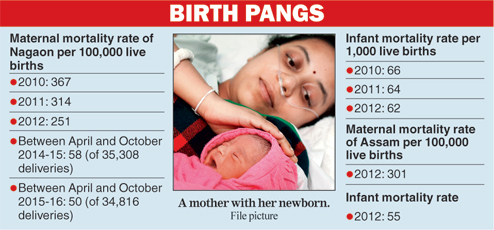
Anaemia and pregnancy-induced hypertension are the two main reasons for maternal mortality. According to official records, 50 women died while giving birth in the district between April and October 2015-16 (see chart).
"All health institutions have been instructed to keep an eye on special matters so that the local administration can provide essential medical treatment to pregnant women in need," Goswami said.
As part of the new plan, the district administration will involve all departments concerned, including social welfare, public health and rural development, to ensure reduction of maternal mortality. The district administration will soon arrange a meeting with representatives of all these departments to launch a united effort.
A source from the district health service, however, claimed that poor communication, ignorance, illiteracy and backwardness were the reasons why most pregnant women from remote areas do not come to hospitals for timely medical care.
"Nobody wants to take the risk of transporting a pregnant woman to a far away hospital through a bad road even if her guardians prefer institutional delivery. Again, some other elements play an unwanted role in bringing patients to hospital on time. We stress on awareness drives to make people realise the importance of institutional delivery," the source said.