The Opposition’s concern over the possible misuse of delimitation power by the Centre does not seem to be unfounded if the findings of a 2024 CAG report are taken into consideration.
The report of the Comptroller and Auditor General found that civic body elections in several states were delayed because the state governments were sitting on the delimitation of municipal wards.
According to the “Compendium of Performance Audits on the Implementation of 74th Constitutional Amendment Act (CAA), 1992: Landscape across India”, the CAG undertook performance audits to assess whether the 74th CAA has been effectively implemented by states.
The compendium covers the findings with respect to Andhra Pradesh, Assam, Chhattisgarh, Haryana, Himachal Pradesh, Jharkhand, Karnataka, Kerala, Madhya Pradesh, Maharashtra, Manipur, Odisha, Punjab, Rajasthan, Tamil Nadu, Telangana, Tripura and Uttarakhand.
Himachal Pradesh, Kerala, Maharashtra and Tamil Nadu had tasked State Election Commissions (SECs) with ward delimitation, while 11 others retained the power with themselves. Data were not available for Jharkhand, Manipur and Tripura.
“Audit also observed that the non-empowerment of SECs with delimitation of wards results in state governments holding power in deciding ward boundaries, which often becomes a hindrance in conducting timely municipal elections,” said the compendium. The Second Administrative Reforms Commission had recommended that the task of delimitation of wards and reservation be entrusted to the SECs. The audit found that 1,600 out of 2,625 urban local self governments (ULSGs) in 17 states did not have an elected council.
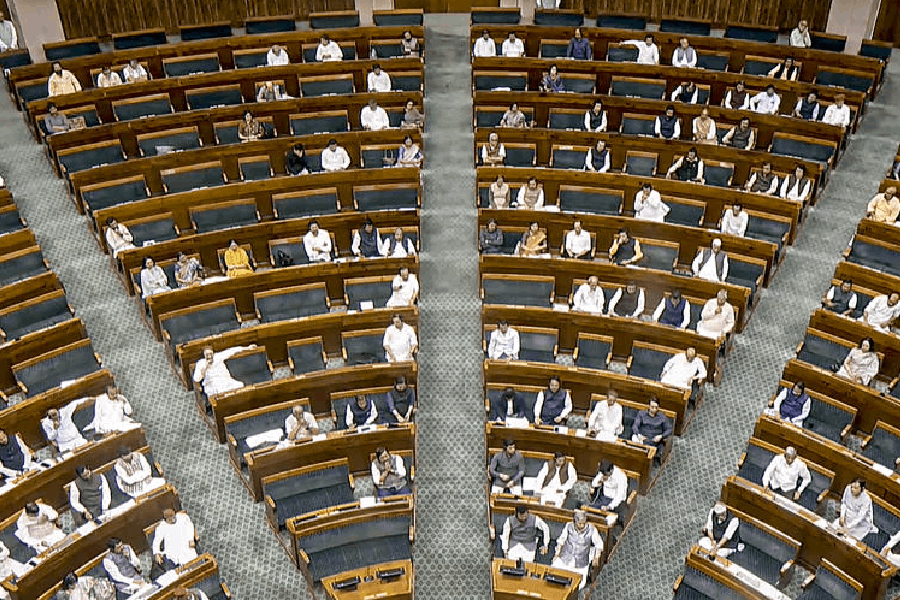
The NDA government’s 131st Constitutional Amendment Bill, which was defeated in the Lok Sabha on Friday, sought to give the Centre greater power to conduct delimitation for the allocation of seats in the Lok Sabha and division of states into territorial constituencies. The bill sought to amend Article 82 of the Constitution, which mandated allocation of seats “upon completion of each census”. The bill wanted to drop the words “upon completion of each census”, meaning the government could use the census data of 2011 to carry out the delimitation.
The bill sought to amend Articles 81 and 55 to modify the explanation of “population” to mean the population as ascertained at “such census, as Parliament may by law determine”. The existing articles define population as “ascertained at the last preceding census”.
DMK MP Kanimozhi said the proposed provision was vague and empowered the incumbent government to decide whichever census data it liked. She also criticised the provision in the delimitation bill where the delimitation commission is proposed to be set up by the Centre without consulting the Chief Justice of India, Parliament or the state governments. Five MPs and five MLAs have been proposed to be made associate members in the delimitation commission without the power to vote in the panel’s decisions.
Former Union minister of panchayati raj, V. Kishore Chandra Deo, told The Telegraph that the bills were aimed at the concentration of power at the Centre.
“Many provisions were opaque. We are a federal system, but the Centre is eroding the states. With more power, the Centre has greater scope to misuse it in the manner it likes,” Deo said.
On the CAG finding about states misusing the delimitation power, Deo said ruling parties in states tend to delay elections on various pretexts, including delimitation, if they sense defeat.
DMK MP P. Wilson said the defeated bills proposed to increase Lok Sabha seats up to 850, but did not provide the basis for such a calculation. “The decision to increase
the number of seats was unilaterally decided. The Union government did not consult any states before bringing these bills,” Wilson told this newspaper.
The 42nd Constitutional Amendment of 1976 froze the reallocation of Lok Sabha seats based on the 1971 census until 2001, while the 84th Constitutional Amendment of 2002 extended the freeze on reallocation of seats until 2026. The women’s reservation law of 2023 provides for the allocation of seats in the Lok Sabha based on a census conducted after 2026.