

So let me get this straight. You want to make a sequel to a very popular movie (based on an even more popular musical) whose best asset was Meryl Streep, a very famous actor, who after decades of intergalactic acclaim, was unveiled, at last, as a major movie star. And you’re going to make that film — Mamma Mia! Here We Go Again — with every other member of the movie’s original cast, except for her but including poor Pierce Brosnan, whose singing, as a lovelorn widower, remains a dare to file a noise complaint.
And you’re going to keep the musical’s Abba-centric conceit — only you used up all the great Abba songs the first time. So now you’ve got to lean on second- and third-tier stuff like My Love, My Life, I’ve Been Waiting for You and Kisses of Fire.
Now you don’t have Streep as Donna, the American proprietress of a Greek villa, and so because of scheduling, money, perhaps Streep’s dignity, you’ve killed Donna off. But you still need an element that lends the proceedings a whiff of showbiz. So you import the opposite of Meryl Streep. You import someone with one screen self (and one name!) as opposed to dozens, someone with buoyancy, immortality and a welcome sense of campiness, someone who can sing.
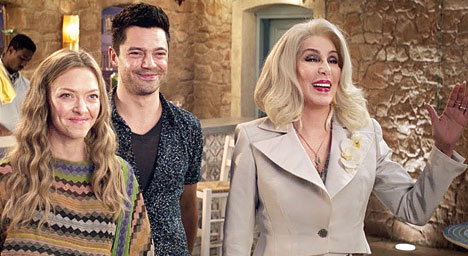
You bring in Cher. But you don’t bring her aboard to play Donna’s sister, childhood bestie, long-lost lover or even rival Mediterranean hotelier. You hire Cher to play — oh, I can’t. Do I have to? You hire Cher to play... her mother. It takes about 90 minutes to get here. Because, in part, the movie, which Ol Parker wrote and directed, has to thumb-twiddle with a plot involving the grand reopening of Donna’s villa by her daughter, Sophie, who’s still played with a damsel’s distress by Amanda Seyfried. Oh, the stress.
Will any of her three fathers — Stellan Skarsgard, Colin Firth and Brosnan — show up? Will her boyfriend, Sky (Dominic Cooper), or her mother’s best friends (Julie Walters and Christine Baranski, lascivious as ever)? And what about that catastrophic storm from the first movie? Yes, yes, yes, and yes — but it’s a pitiful cinematic event, especially compared with Hurricane Cher.
When she does arrive, it’s almost ominously — by chopper, the way, in Zero Dark Thirty, the SEALs sneak up on Osama bin Laden, or how, on Game of Thrones, a dragon might invade Westeros.
I know. It’s weird to fixate on a person who shows up with only 20 minutes to go. But believe me, it’s no hardship abandoning all the flashbacks to the tail end of the 1970s and the opening bits of the 1980s, when an obnoxiously blissed out 20-something Donna, who’s played by Lily James, sleeps her way around southern France and Greece, and does so immaculately, it must be said.
These are monotonous interludes meant to expand on and explain the legend of Donna — how she turned her university valediction into When I Kissed the Teacher, a number that not even the Muppets would endorse; how she wound up pregnant with a daughter of uncertain paternity; how she turned a bunch of dust and debris into the sort of seaside splendour you find only in a Nancy Meyers movie. It’s cruel to put an actor in the cross hairs of Streepists. So James deserves some credit for agreeing to make herself a target. And even though she did nothing for me, I’ll admit to admiring her choice to not even bother “doing” Meryl Streep. She seems a lot likelier to wind up as Dyan Cannon, a star of eventually spiked loveliness who is to Streep what a Lakers hat is to Carmen Miranda’s.
Streep’s near total absence leaves a hole Cher is expected to fill. It’s too little, way too late, of course, and because it’s Cher, it’s also too much. The movie doesn’t know what to do with her, anyway.
Parker does give the movie these flashes of old, literal-minded Hollywood staging, like when young Donna’s virginal suitor (Hugh Skinner) shoots Waterloo all over a French restaurant. But most of the movie’s 18 numbers just kind of sit there. You don’t feel much. So even when you get a goodie like Dancing Queen, wherein a lot of tan and actual brown people gyrate in unison on landward boats, you can simultaneously admire a perfect pop song and spare a thought for the real boat-bound migrants who’ve perished in waters just like these.
Most of the musical sequences are creaky, but not that far from some of what Damien Chazelle was going for with the singing and dancing in La La Land: passionate amateurism. But that’s some of what made the first movie such a kick. You were watching very good actors do karaoke in an Anglo-Nordic telenovela. Now you’re watching them do it in a sequel, which means you’re also watching something more inscrutably sad: karaoke of karaoke.
The New York Times News Service