 |
Your last three films — Man of Tai Chi, 47 Ronin and now John Wick — are almost like a trilogy about lone warriors. What do you make of that association?
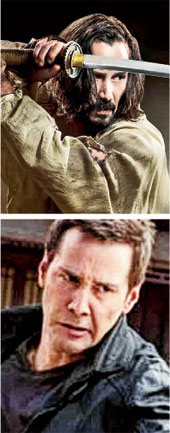
Kai from 47 Ronin and Donaka Mark from Man of Tai Chi and John Wick are all definitely isolated, pushed away, trying to get back in, manipulated. They all have interesting, mysterious pasts. It sounds like a good character to play. All of those roles have been really enjoyable. It’s part of the journey. It wasn’t intentional. I put the suit on. I’ve played different kinds of roles and worked in different genres, but I guess those kinds of characters are part of my taste.
Do you feel particularly attracted to certain kinds of films?
If we’re talking about the science fiction or action genres, I’ve always tried when I could to do them in a way that’s not just cookie-cutter — that they bring something fresh or original to it... have some kind of ideas to it. I’ve been fortunate, in some sense, to do those kinds of movies that are unique.
What’s unique about John Wick?
It’s the world they’ve created and the vision of the story. The shooting style: the colours, the way they shoot the action. They’re doing wide shots, not a lot of cuts. They’re wanting the action to unfold in front of you as opposed to changing perspectives. That feels different — it’s a little more intimate and objective. It’s not just visceral action. You can believe what you’re seeing and it’s not just sound and fury. You can see the fluidity and what they’re doing — like that one hall shot where they’re wrestling, and he just comes through and pounds a knife into the other guy’s chest. There’s no cut.
What kind of boundary-pushing techniques did you guys want to achieve in John Wick?
The bar got set really high, which is great. The directors were interested in integrating into this film what they call “gun-fu”, working with the weapons, and with jujitsu and judo. They were interested in seeing transitions, seeing escapes, seeing locks, seeing holds, and get there in inventive ways.
One of the most fascinating things in the film are the scenes of waking up. It’s presumably the morning when the dog wakes you up... how do you get into that space where we take it for granted it is first thing in the morning?
Yeah, waking-up scenes, I don’t like them. I don’t know about other actors but for me, it’s like ‘Okay, how are you going to wake up?’ For me, it’s always ‘What are they dreaming or where are they at before?’ It’s always “what’s the moment before” as an acting exercise. So what’s the moment before when they’re dreaming? For me, I always try to think symbolically of shape. How are they sleeping? Are they alone? In John Wick, if you notice, he’s on his side but when he wakes up on the dog his arm is out... but his wife’s not there, but the dog is there. So I’m always trying to figure out, and then how do they wake up? Are they going to be startled, is it slow, are they coming to consciousness, are they remembering? So there’s a lot that goes into that.
You have previously worked with Chad Stahelski in the iconic Matrix series. What was it like to team up with him for his directorial debut?
Both Chad and Dave (David Leitch, co-director) are experts in terms of this genre. The dialogue is hard-boiled but it’s also got the humour of graphic novels, the kind of amazingly original imagery and framing that we’ve come to associate with them. It’s a unique vision. I thought it was exciting and really cool to see all of these influences and experience and craft come together. Chad always thinks about action in terms of narrative. He knows how to storyboard and pre-visualise the choreography; he has a lot of experience with the camera and with production issues. It’s clear that this is what he should be doing right now.
In the early ’90s you paved the way for the idea that an action hero could look like a regular guy and didn’t have to be a bulky Schwarzenegger/ Stallone type. That is evident in John Wick too. Was that significant to you?
For me it was part of the story. I always thought that when we meet John, he’s kind of in his normal life. He’s not an assassin anymore. He’s just a guy. Then as you start to hear about his myth, for me it’s like that one scene in the shower. You see his back and you’re like, ‘Oh, he looks capable.’ But before then he’s just like a normal guy.
Keanu Reeves is a cool action hero because.... Tell t2@abp.in