
The birth centenary of literary trailblazer Ismat Chughtai was celebrated in the city over two days last week with a seminar on September 10 and a theatrical adaptation of her short stories the next day, organised by Kindle Magazine and Weavers Studio, in association with t2. Ismat Chughtai (1915-1991), lovingly called Ismat Apa, is a doyen of Urdu literature who wrote fiercely and fearlessly at a time when very few Muslim women were even allowed to go to school.
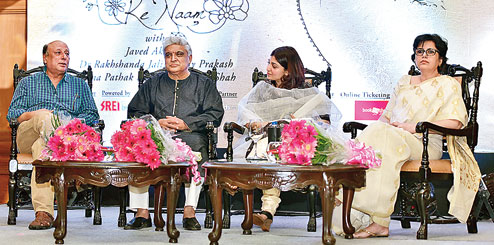
On Thursday evening, the Crystal Room at Taj Bengal filled out to hear a discussion on the life and works of the legendary writer, between poet-lyricist Javed Akhtar, Hindi writer Uday Prakash and scholar Rakhshanda Jalil, moderated by Pritha Kejriwal, editor-in-chief, Kindle Magazine.
The speakers dwelt on different facets of Chughtai, from her roots to her rejection of patriarchy, her feminist ideology to her irreverent, sparkling prose. One learnt about the woman and the writer. One learnt that Prakash has returned his Sahitya Akademi Award to protest the recent killing of Kannada scholar M.M. Kalburgi. One learnt that Jalil is bullish about the survival of the legacy of Ismat Chughtai. “Ismat opens a window to the past. But what she shows us through that window is perennially relevant. Ismat’s stories have human frailties that transcend their space and time,” she said.

One also learnt that when Javed saab is in a mischievous mood, no one is safe from his razor-sharp wit, be it a precocious member in the audience, a fellow speaker or Ismat Apa herself! Some moments from the evening....
Ismat Apa today
Akhtar opened on a serious note. “I think every good fiction writer is a historian. While historians write about kings and conquerors, fiction writers write about the common man... ones who have no names… ones who are perhaps only mentioned in the census. But these people have their own lives, their own dreams, their own sorrows.... Ismat Chughtai has, in a particular segment of society, observed so closely, so minutely. She was the only one who has seen and understood the nuances of that segment. She had encapsulated the times, the era, the culture.”
Javed saab’s Ismat
“I don’t remember when I first met Ismat Chughtai. Because my mother was her classmate. My father was a Progressive Writer, she too belonged to the movement. When we would visit Bombay, we would stay in her house. That was where I had first seen a refrigerator... yeh sab hotey nahin thhe Lucknow mein tab.
“What is great about this woman (Ismat Chughtai) is that she refuses to have pity for you. She has too much respect for you. Woh burey se burey waqt mein aap se sympathise nahin karna chahegi. Because she thinks that that will be condescending. Her defence is cynicism, tongue-in-cheek humour, but behind that is a person who knows how to respect human beings. She believed in human dignity.... She was such an observant person. Sitting in one corner of a party, she could tell you who was having a fling with whom… she had these little shining bright eyes! What a personality she was!”
But the best was saved for the last.
Pritha: She didn’t have a very high opinion of poets, did she?
Akhtar (poker face): Aati nahin thi na unko shayad (She possibly didn’t know how to write poetry).
The laughter in the hall took nearly a minute to die down!
Text: Samhita Chakraborty

Naseeruddin Shah was the guest of honour at the seminar.
“I had heard of Ismat Chughtai as a child, invariably as a writer of dirty stories. My mum used to read her and go ‘Tauba tauba.’
Ismat Apa was acting in this film Junoon. We spent two months with her in Lucknow… and she never once spoke about herself. I just took her for a cute, cuddly, gossipy grandma.
Years later, I picked up an English translation of her short stories…. The first three stories in the book became the three stories that we perform. When we started everyone was sceptical but the play has been running for 15 years now, it’s Motley’s most successful production,” said the veteran actor.
“And she gave us this. I was very much sold on the American idea of method acting, that the actor must become the character. But the camera catches the lie… that the naked eye cannot see. Having performed Ismat Apa for all these years, I think I have finally understood what method acting really is. That an actor must keep himself at a distance from the character he is playing.... The emotional indulgences which are the result of the so-called method, one learnt how to simulate that character for a few seconds, which is all that is necessary. It is certainly far from desirable to become the character. Imagine an actor who becomes Othello... Macbeth... or Shylock. He’ll want his pound of flesh.”