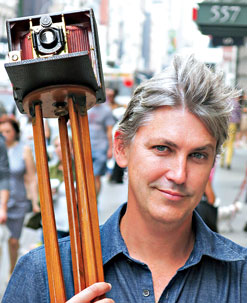

Popular science author Steven Johnson reveals the stories behind the ideas that made modern life possible and the unsung heroes who brought them into the world in his ninth book, How We Got To Now (Penguin Rs 599), that cracked the Top 5 on the NYT bestselling list and has been turned into a Discovery Channel mini-series. A t2 chat on telephone...
How do you connect disparate phenomena in a cause-and-effect link?
That’s the fun of the research for the book and the show. For example, there’s a story in the cold-on-demand episode about how air-conditioning triggered people’s movement to the southern desert states, which were too hot to live in. That had a major impact on American politics. We always looked for connections like that. It’s tricky. You follow some chains of cause and effect and end up nowhere. It took a couple of years of research to look for these connections. It’s an important way to look at history. All these innovations of the past shape how we live today.
What links the invention of refrigeration with four million babies?
Clarence Birdseye invented this technique called flash freezing, which he used to freeze vegetables. He figured out that if we freeze something quickly at a very low temperature, it will taste better when you cook it than something frozen more slowly. He created an empire around frozen food. The technology for freezing is now used to preserve human eggs, sperms and embryos. There are four to five million people alive in the world today because of this technology, which you wouldn’t have thought of when he came up with it in 1915.
How did you connect Hollywood to this?
One of the first places people experienced air-conditioning was in the movie theatre. No one wanted to go to the movies in summer — sitting with a crowd in a room on a hot day. The theatres invested in this new product and started advertising that their theatres were cool and that created the idea of the summer blockbuster.
And how did the battle for cleanliness lead to swimming pools, flat-screens and the iPhone?
Two things happened. A doctor came up with the idea of putting chlorine in drinking water. It was a radical idea because chlorine is a poison if you drink a reasonable quantity. But a small amount kills bacteria. Without asking for permission, he chlorinated the water of a big town near New York. He got into a bit of trouble as people thought he was trying to poison them. But he ended up proving his case and saved millions of lives. That led to the introduction of public swimming pools in the US as the pools were chlorinated and became safer. That changed the lifestyle of Americans as they started swimming more.
But you couldn’t drink the water as it was missing the basic minerals that normal drinking water should have. Instead, it started getting used in microchip production facilities as a solvent to clean microchips. A speck of dust on a tiny chip is like Mt Everest in Manhattan. You never think about it but the iPhone or any computer can’t be created without this ultra-clean water.
From light to Las Vegas...
In the early 1900s, they were making a huge quantity of liquid oxygen. Neon was the waste product. This was a gas that was sitting around with no use. Some mad scientist thought of seeing what would happen if he passed some current through it. It lit up in amazing colours. He came up with this idea of making illuminated neon signs with it. Some guy in Nevada heard about it and started making neon signs in Las Vegas and it became the city’s signature style.
What about video downloads?
Once they invented lasers, they were able to merge two technologies — really transparent fibres of glass and information encoded in light in the form of a laser. You put these things together and you get fibre optics. The entire Internet is connected at high speed through fibre optic cables that are basically light shining through tiny little fibres of glass. Our ability to create these highly concentrated beams of light allows us to download videos and do everything else on the Internet.
Would you say this trend of bringing science to the masses — and of science books becoming bestsellers — started with Stephen Hawking?
Hawking was obviously huge but there were others too. Carl Sagan did the TV show Cosmos and there were Richard Dawkins and Edward Wilson who had a big influence on me when I started writing in this mode. If you don’t overwhelm your audience with technical details and concentrate on the story, how the scientific idea affected their life, people like it, especially children.
Does India figure in your research?
The book has a number of India stories. One chapter is on the history of shopping... of departmental stores, malls. It has a huge section on Indian cotton, calico and chintz, which were crucial in Europe in igniting interest in fashion and departmental stores. It is one of the ways India and England were bound up. Of course it led to a depressing and violent period. There’s a whole story on Indian dyers who figured out ways to make this amazing fabric. That should find place in the next season I am planning.
Sudeshna Banerjee
(How We Got To Now airs on Monday at 9pm on Discovery Channel)