Since the days of New Year balls held at the governor-general’s residence or cricket matches between the Maharaja’s XI and the Viceroy’s XI, many a New Year season has come and gone but Calcutta has not grown a day older. Behind the triumphant success of the New Year parties in Calcutta back then was a touch of homesickness. British officials and their spouses flocked to New Year parties at the Grand Hotel (now The Oberoi Grand) and the Great Eastern Hotel (now The Lalit Great Eastern) as they felt exactly like the ones ‘back home’.
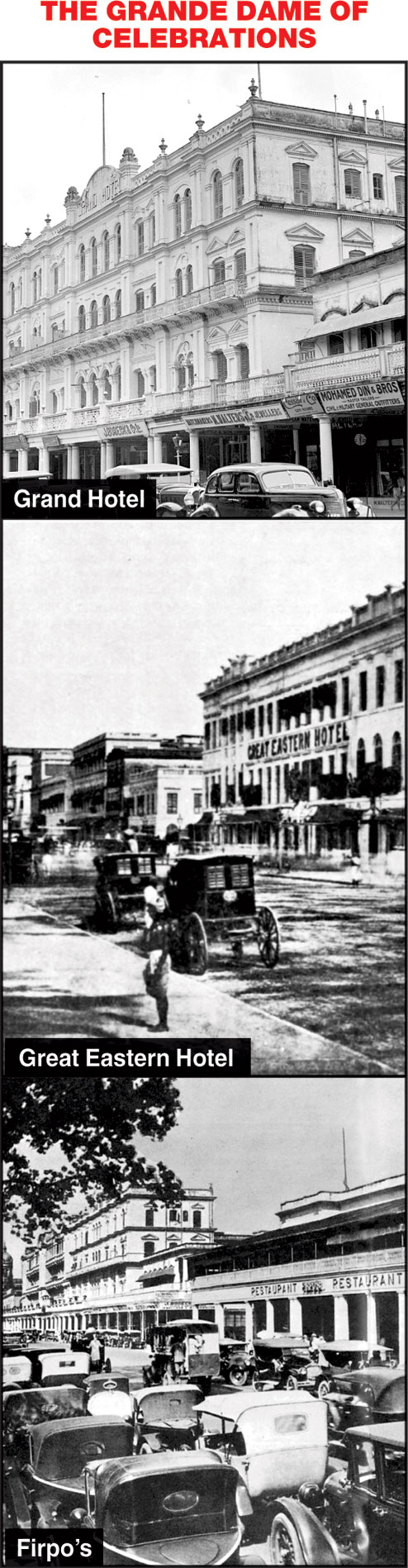
Colonel Grand’s residence on Chowringhee Road had been turned into a lodge before an Armenian merchant bought the property along with the neighbouring block and opened the Grand Hotel. It immediately became the Englishmen’s home away from home and on New Year’s Eve, it truly wore the high street look of Piccadilly.
The Grand was one of the first establishments to be festooned with the invention of the age: Electric lights. Under the glittering arcade, military bands struck up a tuneful homage to “old Blighty” and dancers streamed into the ballroom.
Arathoon Stephen, the then owner of the Grand, set a New Year’s Eve tradition by giving away expensive gifts to guests but the 12 little piglets obviously took the cake! The piglets were released into a room and one can only guess the happy commotion they must have caused. Finally, those who managed to catch a piglet were allowed to carry the new pet home. What an armload of happiness that must be to carry away from a party!
The hotel’s New Year party was not only the grande dame of celebrations, it expressed the all-embracing spirit which blends distinct cultures so easily in Calcutta. Four thousand US GIs put up at the hotel in the ’40s and Calcutta offered them such a warm stay that it kicked off a new tradition: The US Marines’ Ball became the symbol of the city’s New Year spirit very soon.
Dinner and dance
Searching for another symbol of Calcutta’s celebratory spirit leads us to the other neo-classical palace once famously called the Savoy of the East. Yes, the Great Eastern Hotel was known throughout the Orient as the perfect example of luxury. On New Year’s Eve, it would throw open its doors to British dignitaries, Maharajas and commoners alike.
Then there was Firpo’s restaurant. Its New Year’s Eve ‘dinner and dance’ was such a landmark event that people ordered their dinner jackets, evening gowns, pearls and gossamer saris months in advance. Dressing for dinner was mandatory and men were required to put on black ties with their jackets, no less. Its Italian owner, Angelo Firpo, created one of the finest Continental menus, one that was famed as the best in the British empire, this side of the Suez.
Chowringhee alone could not contain Calcutta’s surging party spirit for long. New Year’s was expanding with the city itself, and soon the dances and the feasts spilled among the rest of the civilians beyond the British rulers.
The largest party outside Chowringhee had to be at Bow Barracks. Here, the Anglo-Indian community hosted — and still do — one of the most heady and prolonged Christmas and New Year seasons.

Welcome to Party Street
By the ’60s, Calcutta was swinging on Park Street. Today, it feels incredible to think that this city hosted so many international forms of dance, music and food, long before television or the Internet arrived and made the world a smaller place. Calcutta has been a multicultural city in the truest sense and once matched the rest of the world at every dance step!
Entertainers and performers from all countries arrived here to a warm reception. It also drew talents from Madras, Shimla, Bombay and other Indian cities. Arabian, Spanish, jazz, cancan, cabaret and other performances kept the city dancing all night, and most of it was in and around the Park Street restaurants, like Blue Fox, Moulin Rouge, Mocambo and Trincas. With so much happening, devoted patrons began calling it the Party Street of Calcutta.
Though the middle-class Bengali family shied away from the wild New Year dancing, wining and dining, Park Street had something for them too. Every Calcuttan made it a point to drive or walk to this neighbourhood to see the spectacular lights and festoons decorating the whole street... and beyond. Marvelling at the lights, Calcuttans lost track of time. Then, at the stroke of midnight, the city welcomed New Year with loud cheers and crackers on the same street that has led a merry journey year after year.
For those who weren’t made for parties, the city had a rich spread of entertainment through its length and breadth. The wonderful part about Calcutta’s New Year is no one has ever felt left out of the celebrations. From New Year polo, tennis parties and horse racing to idyllic family picnics on the grounds of Botanical Gardens or fairs on the Maidan, each has his or her preferred way of saying goodbye to the past and welcoming the next year.
Ring in the new year
If Calcutta’s grown-ups were having a ball, the children were not to be left behind at home either. Circuses travelled to Calcutta from as far as Russia during winter and took our breath away with jaw-dropping acts. This was long before impossible stunts had become commonplace, like on big screens today, thanks to graphics and special effects. Those days, even the noisiest of children — those who were the little devils at home! — fell silent watching the real daredevils defy laws of physics and tempt danger with impunity.
I still feel the virtual thrill of computer games today is nothing compared to the rush of emotions we felt as children while watching the ‘Well of Death’ or the ‘Circle of Fire’. After the circus, there was just enough time to head straight to the favourite restaurant and fill oneself up with lip-smacking Chinese or Mughlai or Continental food.
Then there was a scurry to get home just before midnight because New Year had to be welcomed at home, with the whole family gathered around the only telephone in the house. Long-distance trunk calls would be made to family members staying in other cities... and every family member repeated the same New Year greeting, but with due cheeriness, into the telephone receiver.
The action has changed but not the warmth and sauciness. From the Chowringhee of ’30s to swinging ’60s on Park Street, Firpo’s feasts and club dinners to today’s spanking malls, global cuisine and DJ Nights, we have seen how Calcutta has gradually found its voice, its own dance step. That is why, instead of holding on to British relics of parties gone by, Calcutta has found its feet in today’s world on its own terms.
At the most happening parties dotting the city today, you don’t find nostalgic and homesick British officials anymore, trying to measure things up to celebrations “back home”. Today, Calcutta is home to its own people, their joys and sorrows, their past and future. Can a city bring in the New Year on a more promising note than this? Definitely, the party has just begun.