

The climactic moment in Omerta comes at the mark of 90 minutes in its 98-minute running time. Wall Street Journal reporter Daniel Pearl is hit by a bullet on his back as he tries to scale a wall and escape from his kidnappers in a dark compound somewhere in Karachi. His captor Omar Saeed Sheikh, incensed by Pearl’s attempt, asks for a knife and with the cold precision of a butcher, bends down and starts beheading him. Nothing is shown, but the sound of the knife filing away at flesh will make your stomach churn. So will Omar’s chilling smile when he brandishes Pearl’s decapitated head, calmly wiping away specks of blood from his spectacles.
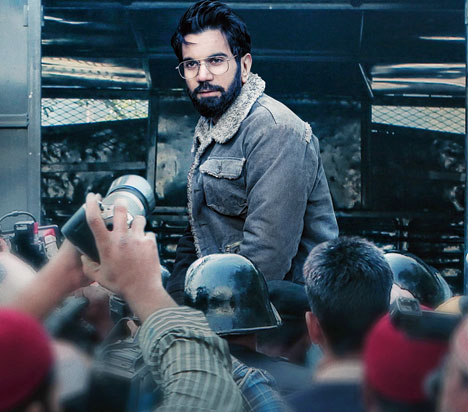
Rajkummar Rao is pure evil as Omar Saeed Sheikh in long-time collaborator Hansal Mehta’s Omerta. He breaks free of Bollywood’s romantic notions of an anti-hero — a man forced to be bad by circumstances — and becomes someone who is driven by fanaticism and blind hatred to become a killer with no moral pivot.
Based on the life of the real-life terrorist currently on death row in a Pakistani jail, Omerta adopts a non-linear narrative to trace the radicalisation of Omar, a British-born Pakistani brought up in a liberal household in Southall and who studied at London School of Economics.
The disclaimer at the beginning emphasises that Omerta is “based on real-life events that have been modified for dramatic and cinematic purposes”. However, Mehta shows Omar’s plunge into becoming a jihadi with very little backstory, except for passing references that he was affected by the massacre of his “brothers” in Bosnia, Palestine and Kashmir.
Omar travels to Pakistan to receive military training and is hand-picked by the ISI to carry forward their operations in India — from kidnapping foreign nationals to smuggling arms into the country. Caught and languishing in jail, his big moment arrives when the Indian government agrees to free him in exchange for a planeful of hostages in the 1999 Kandahar hijacking. From then on, Omar sees his stocks rising, with purported links to almost every significant terror attack around the world in the last two decades.
Mehta — who has written the film, with actor Mukul Dev being credited for the story — succeeds in blending drama with real-life footage, especially of 9/11 and 26/11 and the kidnapping and murder of Daniel Pearl. However, he turns Omerta into a dispassionate biopic, and in the bargain, ends up losing the film’s soul — something that made his Shahid and Aligarh the films they were. At best, Omerta is a mechanical look at the machinations of a killer without delving into his mind.
Known for his anti-establishment views, Mehta does take a stand. The state’s handling of the Kashmir problem is criticised scathingly in more than one scene, but he chooses to gloss over many other aspects. Like Omar’s role in 9/11 and 26/11, both done over with in two brief scenes.
The to-and-fro narrative technique may be novel but it makes the character of Omar neither convincing nor insightful. Omerta was subjected to a few snips by the censor scissors, which may account for how random it feels at places. Also, Mehta spends too much time on Omar’s training, his wedding and his exchanges with his fellow prisoners, none of which contributes substantially to the story. The title, though intriguing and meaning ‘code of silence’ specifically in the context of the Italian mafia, doesn’t really fit in with this story.
Where Omerta falters in its storytelling, it makes up for with technique. Editor Aditya Warrior does a good job, especially in the second half when a sense of urgency creeps in. Anuj Dhawan’s cinematography is top-notch — the cold recesses of a dark prison cell are as effective as the snow-clad peaks of Pakistan-occupied Kashmir.
It’s Rajkummar Rao who makes Omerta worth a watch. His British-accented Hindi may be inconsistent but not his ability to rise above a weak script. He makes Omar Saeed Sheikh a man you cannot even bear to look at by the time the end credits roll.
I liked/didn’t like Omerta because....
Tell t2@abp.in