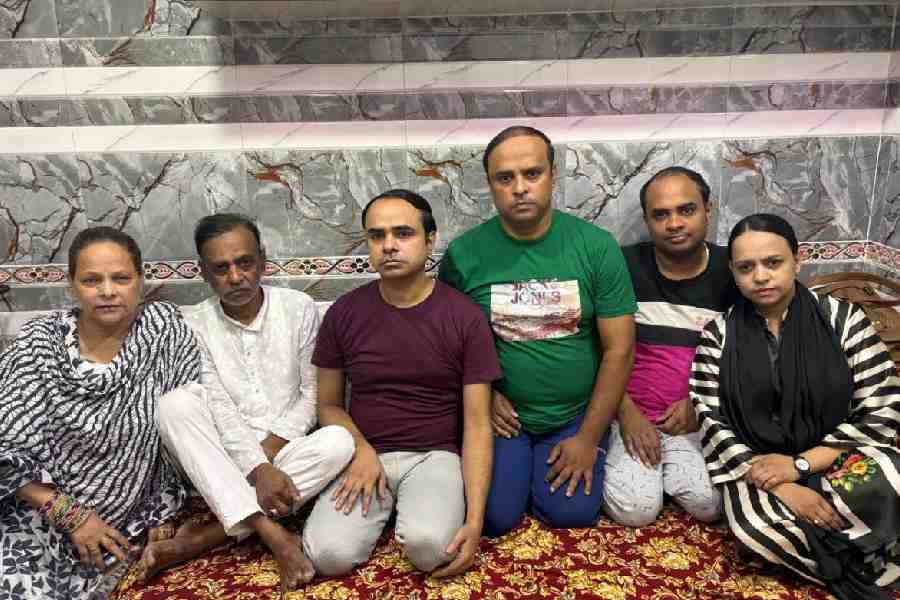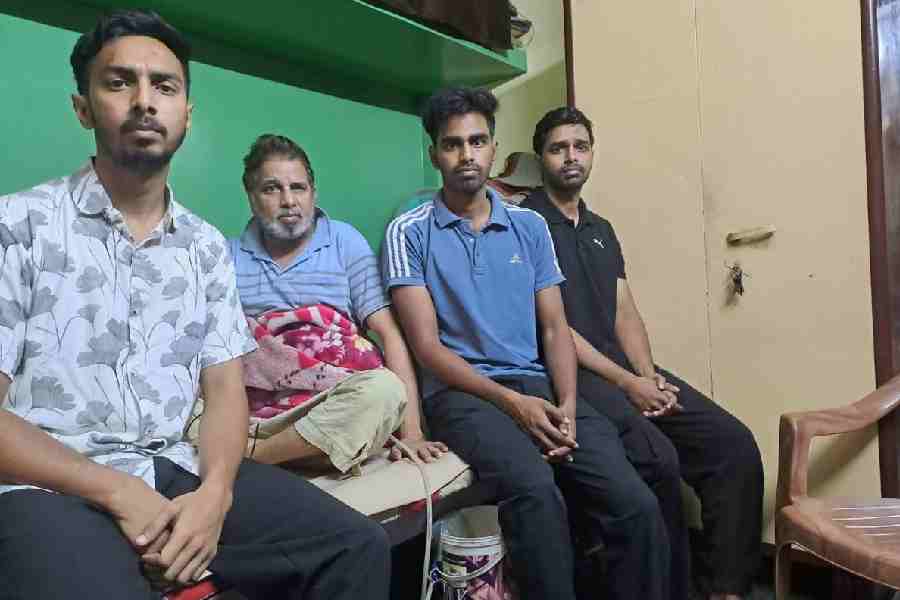
Mohammad Rounaque Pareez had a wheelchair ready for polling day.
One of his three sons, Mohammad Fahad, a software engineer, had bought it three months ago so his bedridden father could reach the polling station. On Wednesday morning, the wheelchair was not needed.
The 56-year-old shopkeeper’s name had been deleted from the electoral rolls during the revision exercise. So had the names of his three sons.
Inside their home in Dasubabu Bagan in Kamarhati, North 24-Parganas, the family struggled to process their grief as neighbours stepped out to cast their votes.
“Lag raha hai ki ghar mein beghar ho gaye hum (It feels like we have been left homeless in our own home),” Pareez said, tears in his eyes. “Polling day is a celebration — a celebration of democracy. We used to take part as a family. This time we are just witnesses. Aur kuch nahi kar sakte hum (We can’t do anything else). It hurts.”
A few months ago, a stroke left Pareez bedridden. Since then, he has been undergoing physiotherapy and medication, determined to regain some mobility. A long-time resident of Kamarhati, he worked hard to ensure his sons received a good education and grew up as part of the inclusive society his family believed in.
His efforts showed. The eldest son is a software engineer. The second, Mohammad Faizan Rounaque, is pursuing a BTech in computer science at Aliah University. The youngest is an undergraduate student at Maharaja Sris Chandra College in Shyambazar.
While Pareez’s name was deleted, those of his two brothers appeared on the revised rolls. “My father’s name eventually did not feature because of a technical glitch,” said Faizan. “Consequently, our names were also omitted.”
The brothers gathered around a small wooden cot, helping their father sit up as they spoke about their frustration.
“There is no clarity,” Faizan said. “We were born here, studied in institutions in this city, and grew up believing that our documents — passports and others — establish our identity. We still don’t know why we were not eligible to vote. No one answers these questions.”
Dasubabu Bagan, a cluster of small buildings packed into narrow lanes off Graham Road, lies about 13km north of Calcutta, near Sagore Dutta Hospital. On Wednesday, life moved on outside. Groups of men sat in discussion, trying to understand how the second phase of polling unfolded, while others headed to markets. Vans carrying central forces moved through the area, and police stood guard near polling booths.
“If we had time to present our cases properly, there would have been no deletions,” said Fahad. “Everything felt rushed. Give us time, and we can explain why we are voters of this constituency. But who is listening?”
Kamarhati, once a Left bastion marked by closed factories, booming real estate and a struggling middle class, saw its first political shift in 2011 when the Trinamool’s Madan Mitra won the seat by a margin of over 24,000 votes. He lost in 2016 and reclaimed it in 2021.
But on Wednesday, the focus in several neighbourhoods was not on who would win, but on who could vote.
Across pockets such as Madras Lane, Muslim Lane, Dhobia Bagan and Anwar Bagan, families grappled with similar frustrations after multiple names were struck off the rolls.
“My friends, with whom I grew up, across paras, don’t have their names on the list,” said Farhan, the youngest son. “They were all born in Calcutta, but that was not enough for them to qualify as voters.”