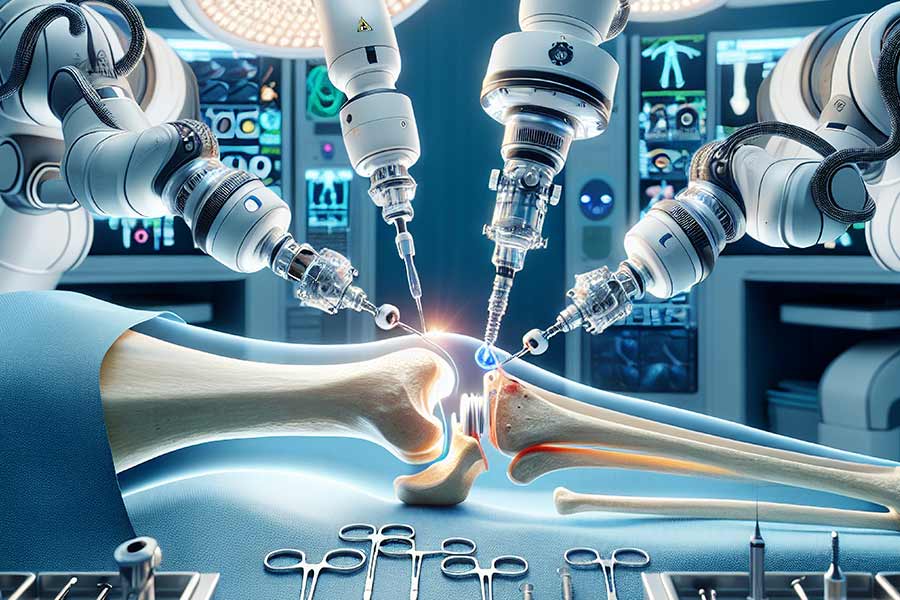
Medical science is advancing every day, and robotic surgery stands as a powerful example of this progress. With knee problems becoming increasingly common, many severe cases now require timely knee replacement. In today’s scenario, robotic surgery plays a vital role in ensuring precision and better outcomes in knee replacement procedures.
Recently, in an interview with anandabazar.com, Dr. Rajib Basu, Consultant Orthopaedics Specialist at Manipal Hospital, Dhakuria, MBBS, MCh (Ortho), FRCS (UK), along with Consultant - Orthopaedics, MBBS, DNB (Orthopaedics), Fellowship in Robotic Surgery and Sport Medicine, Dr. Vikrant Sinha Roy, spoke about robotic surgery.
Click the link below to learn more:
Dr. Rajib Basu said, “At Manipal Hospital, Dhakuria, the machine we use for knee replacement is called the Zimmer Biomet ROSA.”
Explaining how the system works, Dr. Vikrant Sinha Roy added, “This robot is operated by the surgeon. It cannot function on its own. We feed specific data into the system, and based on that information, ROSA executes a precise surgical plan.”
When it comes to knee replacement through robotic surgery, many people assume that the robot performs the operation on its own. This often leads to concerns among patients and their families about whether the procedure will be done correctly if the robot makes a mistake. Addressing this, Dr. Basu explained, “The surgeon is present throughout the procedure and remains in full control of the robot at all times.”
The advantage is that the data provided is captured by the camera integrated into the robot and displayed on the system’s screen. This allows surgeons to control the procedure themselves, helping them plan the surgery with greater accuracy. With the support of this technology, surgeons can ensure precise decisions regarding how much to cut and the exact manner in which the incision should be made during the operation.
In knee replacement surgery, the challenges and conditions vary from one patient to another. Dr. Vikrant explained, “With the help of this robot, we can create a customised plan tailored to the specific needs of each patient.”
Robotic surgery ensures a high level of precision during the operation. As a result, blood loss is reduced and patients do not need to stay in the hospital for long. Moreover, in robotic knee replacement, patients recover faster and are able to return to their normal lives sooner.
This is a sponsored article. This article has been produced on behalf of Manipal Hospitals by ABP Digital Brand Hub.