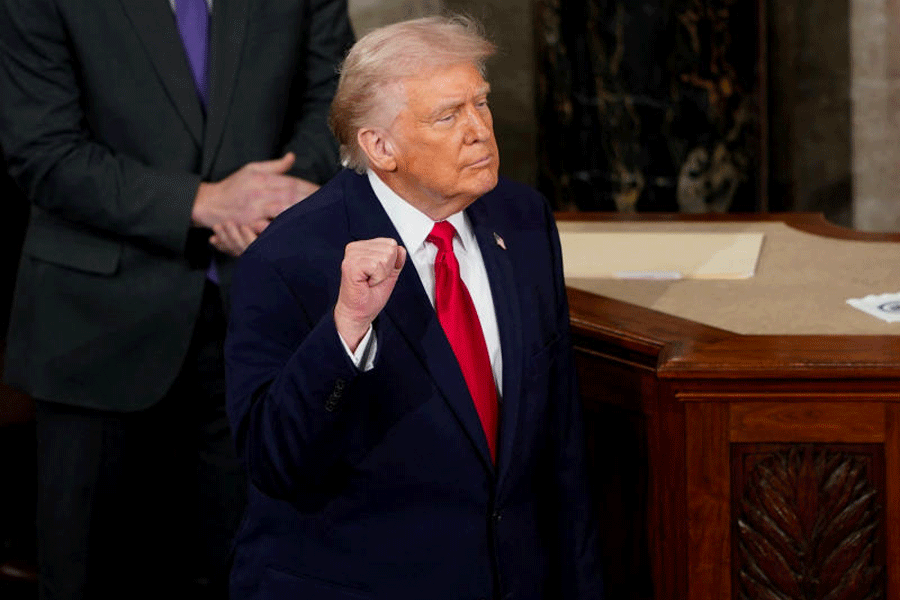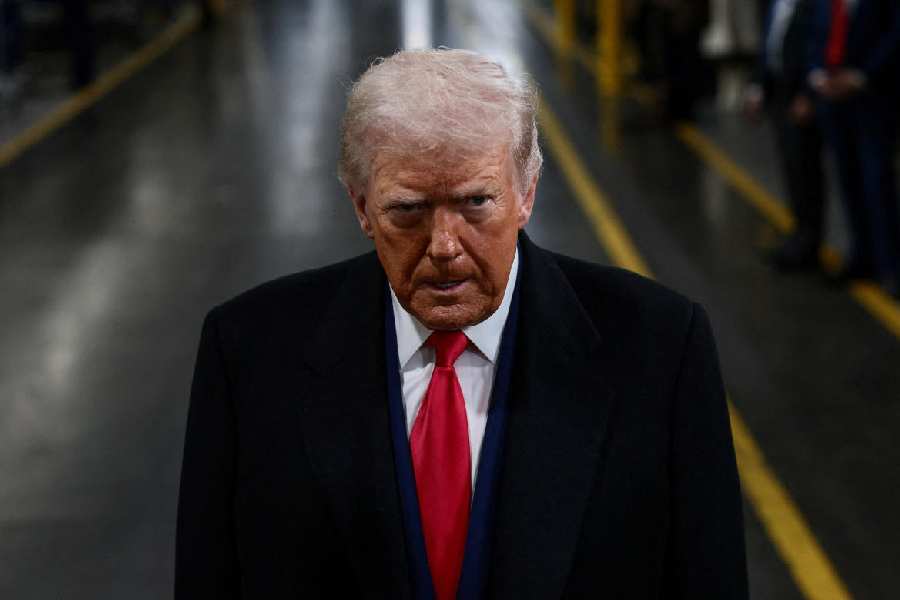
The US Congress is set to vote this week on the War Powers Resolution (WPR) as the US conflict with Iran enters its fifth day, in a move that could curb President Donald Trump’s authority to launch further strikes without legislative approval.
Passed in 1973, the WPR requires the President to seek Congressional authorisation for extended military action and mandates that unauthorised deployments end within 60 days unless lawmakers grant an extension.
While the US Constitution names the President commander-in-chief, the power to declare war rests with Congress.
Several Republican and Democratic lawmakers are expected to break ranks, though the measure is unlikely to secure the two-thirds majority needed to override a presidential veto.
The WPR vote revives doubts over executive war powers that have shaped US military interventions since World War II.
What does history tell us? It is clear that Presidents can bulldoze through their decisions.
Korea War (1950)
President Harry S. Truman’s order to intervene in the Korean War in June 1950, following North Korea’s invasion of South Korea, stands as the archetypal undeclared major conflict, despite no congressional declaration of war.
Truman framed his order as a “police action” under UN authorisation. The war resulted in over 36,000 American deaths.
Lebanon crisis (1958)
Amid Cold War tensions with the Soviets and Arab nationalism grappling the Middle East, President Dwight D. Eisenhower ordered Operation Blue Bat in Lebanon on July 1958, without a formal declaration of war.
This came after a request from Lebanese President Camille Chamoun, whose pro-Western government was facing a severe internal crisis.
Vietnam War
Lyndon B. Johnson and Richard Nixon used the Gulf of Tonkin Resolution, passed by Congress in 1964, to initiate and escalate war in Vietnam, without formally declaring war.
Although the presidents had Congressional authority to enter American in yet another conflict, critics argued that Johnson and Nixon used the resolution far more broadly than Congress intended.
Nixon’s unauthorised bombing of Cambodia and Laos, in the later half of Vietnam War, resulted in Congress pushing back against presidential veto with the War Powers resolution.
Grenada (1983)
President Ronald Reagan ordered the invasion of Grenada, citing the protection of American medical students and regional security concerns. The operation was launched without prior congressional authorisation or a formal declaration of war.
Panama (1989)
President George H.W. Bush initiated Operation Just Cause to remove Panamanian leader Manuel Noriega. The military intervention proceeded without a declaration of war, justified on grounds of protecting US interests and combating drug trafficking.
Kosovo (1999)
President Bill Clinton authorised a NATO air campaign against Yugoslavia during the Kosovo crisis. The bombing continued for 78 days without a formal declaration of war, despite the House of Representatives rejecting a resolution approving the operation.
Iraq war (2003)
Republican President George W. Bush launched an invasion of Iraq, without declaring war, under the Authorisation for Use of Military Force (AUMF) resolution passed by the U.S. Congress, which granted the President authority to use "necessary and appropriate force" against those responsible for the 9/11 attacks.
Bush cited weapons of mass destruction and Iraqi leader Saddam Hussein’s links to Al-Qaeda as reasons to launch the war, both claims which were later proven false.
Libya crisis (2011)
President Barack Obama sidestepped the War Powers Resolution and congressional AUMF to lead the US into a NATO campaign after the UN authorised force to protect civilians during Libya’s civil war against Muammar Gaddafi. He argued the limited US role did not trigger the War Powers Resolution’s 60-day clock.
The condition of Libya after the 2011 US–NATO intervention has been marked by prolonged instability, political fragmentation, militia rule, and periodic civil war, with limited recovery despite moments of diplomatic progress.
Venezuela operation
President Donald Trump ordered US military strikes on Caracas in January 2026, including bombing the capital and capturing Nicolas Maduro and his wife, without prior Congressional approval. Trump justified his order as a law enforcement operation against narcoterrorism.