Nepalis will vote for a new government on Thursday, the first election since a Gen Z revolution in September turned the Himalayan nation into a surprise symbol of youthful power.
Voter expectations feel as lofty as the mountains that dominate the landscape, even if previous elections have delivered a revolving door of coalition governments. This time around, a one-time rapper has electrified the electorate, with hopes that he can vanquish establishment rivals, like the Prime Minister ousted by the Gen Z movement.
For years, the country has been so stymied by corruption and political patronage that each year hundreds of thousands of Nepalis feel they have no choice but to go overseas for work. Many people want fairer opportunities at home and accountability for the deadly crackdown on the Gen Z protests, which was followed by a mass arson campaign that destroyed thousands of buildings nationwide.
“This election will decide whether my 4-year-old son will live in Nepal or migrate to another country,” said Biki Shrestha, a finance manager at an IT company. “We need change.”
The candidate
Ask young Nepalis who excites them and the answer is likely to be one word: Balen.
At 35, Balendra Shah, the former mayor of Kathmandu, the capital, is not quite Gen Z. But the millennial rapper, who tamed the city’s trash crisis, is considered the change candidate.
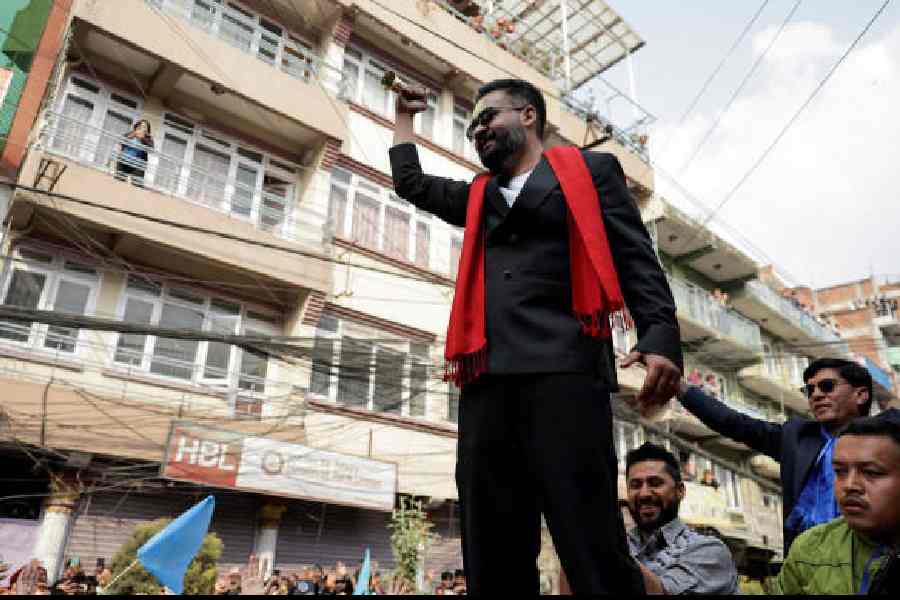
Shah — who rarely appears in public without black sunglasses, a black suit and a corps of social media chroniclers who try to offset his volatile posts blasting his political rivals and foreign powers — has pitched himself as the next Prime Minister of Nepal. He is running in the same eastern Nepal constituency as K.P. Sharma Oli, the Prime Minister ousted by the Gen Z movement after the deaths of 19 protesters.
“For many years, we have seen the same political parties, and they have not changed anything in Nepal,” said Sujan Sipai, a teacher from the ancient city of Bhaktapur. “That’s why, this time, the entire country has stood up against corruption and for Balen.”
Ahead of the election, Nepalis celebrated Holi. Politics weren’t supposed to colour the celebration. But the crowds in Kathmandu anointed each other with vibrant powders and shouted a single name: Balen.
Others in fray
Although Shah ran for mayor as an Independent, in this election, he has lent his star power to the Rastriya Swatantra Party, a young political force that markets itself as clean, technocratic and digitally fluent. The RSP is fielding nine Gen Z candidates, several of whom were aides to Shah.
That’s an implicit contrast to the other big political parties — two communist parties, and the centre-left Nepali Congress. The three have only a few Gen Z candidates among them, although they have powerful machineries and longstanding supporters. Until recently, they were all led by septuagenarians who had served as Prime Minister. Earlier this year, the Nepali Congress almost broke apart when Gagan Kumar Thapa, 49, ousted the party president, who was three decades his senior.
“It was due to that Gen Z movement that our party felt that the time has come,” Thapa said.
Sixty-five political parties are contesting the elections, and nearly 160 Gen Z candidates are running, roughly half as independents. Despite the prominent role women played in last year’s protests, there are only 15 Gen Z female candidates.
Gen Z role
Nepal’s Gen Z revolution occurred at warp speed. On September 8, young Nepalis took to the streets of Kathmandu to protest corruption, nepotism and a government social media ban. Security forces responded with lethal force.
A day later, chaos exploded across the country. Coordinated arson attacks burned many symbols of state, including Parliament and government ministries. Dozens more died. Oli resigned, but it was too late. A government was all but toppled in two days.
Since then, the pace of change has slowed. Despite a caretaker government formed with the blessing of Gen Z leaders, no one has been convicted in connection with the violence last September. Two commissions charged with investigating the deadly crackdown and the ensuing unrest have not released their reports, despite expectations that would happen before the elections.
Last month, Nepal’s former king, Gyanendra Shah, called for the elections to be postponed. Some Nepalis look back nostalgically on an era when the monarchy, in their view, served as a unifying force.
But voting is set to go ahead. Campaigning for the RSP reached the sweaty, shrieking fervour more often seen at pop concerts, with teens and bearded men alike screaming their adulation for Shah. Fleets of motorcycles cruised the streets flying flags with the RSP’s blue bell.
New York Times News Service