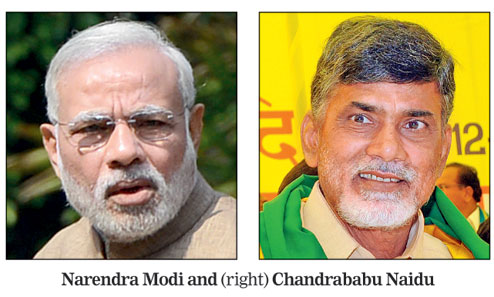

New Delhi, Aug. 26: Nitish Kumar's insistence on special status for Bihar has found resonance in Chandrababu Naidu's Andhra Pradesh.
"Special status is a sentimental issue for our people. People do not understand what exactly a special package means though one theory is that special packages are better for a state than special status," said Gokaraju Ganga Raju, the BJP's Narsapuram MP.
The concept of special category status was introduced in 1969 when the Fifth Finance Commission sought to lift "disadvantaged" states with preferential treatment in the form of central assistance and tax breaks.
The first three beneficiaries were Assam, Nagaland and Jammu and Kashmir. Since then eight other states were included - Arunachal Pradesh, Himachal Pradesh, Manipur, Meghalaya, Mizoram, Sikkim, Tripura and Uttarakhand.
The rationale for bestowing special status was that certain states inherently suffered from a low resource base and could not mobilize the resources required for development. The prerequisites for such a tag were a hilly and difficult terrain, low population density, a predominantly tribal population, strategic location along borders with neighbouring countries, economic and infrastructure backwardness and the non-viable nature of state finances.
These days, the Congress's Rajya Sabha MP from Andhra, Jesudasa Seelam, is poring over the Bihar package to understand what was "so special" about it. "Is it mathematical jugglery? Are there hidden things?" asked Seelam.
Andhra's dilemma was that when Telangana was carved out of it in 2014, the Andhra Pradesh Reorganisation Act legislating the bifurcation had enshrined seven assurances that included special category status, tax concessions and incentives, compensation of Rs 10,000 crore to be disbursed in tranches over the next 10 years and a Bundlekhand-type package for seven backward districts.
The then union cabinet, headed by Manmohan Singh, accepted some of the assurances but not the special status.
Then came the Modi government, of which the Telugu Desam Party is a constituent.
Yet all that chief minister Naidu has extracted so far from Modi is a special development package worth Rs 350 crore for the backward areas, ad hoc support of Rs 500 crore to bridge the projected resource gap in the central budget 2014-15 and certain stimulants to spur industrial growth.
"Peanuts," cried out TDP MP, CM Ramesh, adding, "Each district and not just the backward ones should get a minimum of Rs 1,000 crore."
To attract private investments to these hilly states, the UPA government had extended a special package of industrial incentives until 2017 wherein new as well as existing industrial units would be entitled to a central capital investment subsidy of 15 per cent on investments on plant and machinery but subject to a Rs 30 lakh cap. But the cap can be enhanced to Rs 50 lakh for medium and small industries.
Andhra already has an elaborate industries policy in place that allows for district industries centre, a single window law, rehabilitation of sick SSI units, relaxation from the Urban Land Ceiling Act, interest rebate for banks and financial institutions, deferment of clearing commercial tax arrears, relief in energy tariffs and a host of incentives that cover the gamut of industries including those set up by women and Dalits and tribals.
So why more tax holidays and fiscal boosters?
Seelam's explanation was, "That policy was meant for small and medium industries. It does not address the type of investments Andhra direly wants with potential industrial corridors, airports' expansion, refineries, research centres etc."
NE package
Political observers believe that the path-breaking initiatives for the Northeast came during the short-lived regime of HD Deve Gowda in 1996-97.
To enhance capital investment in the Northeast, Gowda directed all central ministries (barring a few) to earmark 10 per cent of their budgets for the region and further, if these ministries were unable to use up their budgeted funds during the financial year, the residual portions would go to a non-lapsable pool for the Northeast.
Gowda's initiatives were operationalised during the Atal Bihari Vajpayee regime. In January 2000, Vajpayee announced a Rs 10,271 crore socio-economic package for the development of all the states, including Sikkim. But he did not specify what amounts would be included in the normal plan allocations and what would not.