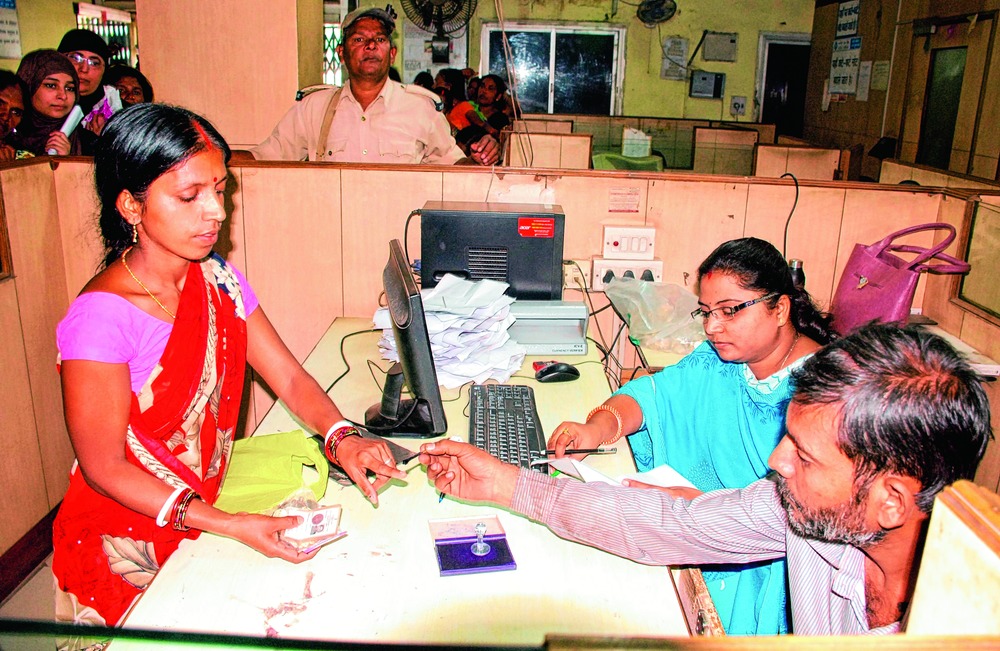

Many banks in Patna have started applying ink marks on the right-hand index finger of customers to stop repeat money exchangers, but it isn't always the indelible ink that the Reserve Bank of India guidelines mandate.
Many banks have not received the indelible ink - which is sourced from Mysore Paints and Varnish, a Karnataka government undertaking - from zonal offices, so some bankers have purchased ink from the market on their own while some even inked customers with marker pens. ICICI Bank's Danapur branch was one such bank.
"On Wednesday and Thursday, we didn't get indelible ink from our zonal office; we used marker pens," said branch manager Suman Saurabh. Asked if it does not violate RBI guidelines, he said it was a temporary solution and the bank has taken the decision after informing the zonal office.
The practice did reduce queues, bankers claimed.
"There has been drop of nearly 30 per cent in people rushing to exchange notes after the introduction of inking," Suman said.
At the SBI's Danapur branch, there was a large queue to exchange notes. However, bank officials claimed it was shorter compared to the past few days.
"There is decrease of at least 25 to 30 per cent in people coming for exchanging notes after the introduction of ink mark on finger," said regional manager S.K. Pani.
The SBI Danapur branch mainly caters to people from rural areas such as Danapur, Shahpur and the diara (river bank area) and has been witnessing a huge rush of people because of the fewer number of banks catering to a larger number of people than in Patna proper.
The bankers hoped the queues for exchanging notes would shorten further from Friday, with the Centre on Thursday reducing the amount a person can exchange from the earlier Rs 4,500 to Rs 2,000.
The easing of the rush was visible in Patna too. At the Bank of India's Raja Bazaar branch, around 100 people has exchanged notes; the figure on Tuesday was around 300.
"Our zonal office provided the ink today, but we bought ink from the local market and started applying from Wednesday itself," said branch manager Rakesh Kumar.
Multiple officials of different banks said there had been a drop in "ghost customers" - those standing in for others.
"The ghost money exchanger is being sent by those who want to hide their unaccounted-for wealth," Rakesh said. "On Thursday we announced that ink will be applied and that data of every person exchanging notes are preserved by the bank. Many customers left without exchanging notes after the announcement."