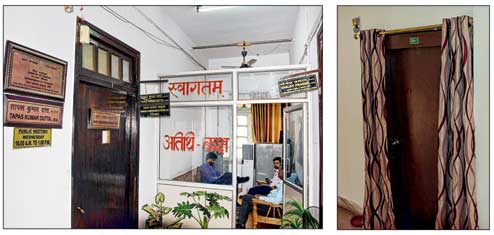
The government plans to demolish the old collectorate building and build a new one in its place. With experts torn between pragmatism and sentiment, Shuchismita Chakraborty spoke to J.K. Lall, an architect and convener of the state chapter of the Indian National Trust for Art and Cultural Heritage, and Patna divisional commissioner Anand Kishor
 Speak out to save history
J.K. Lall thought it is important to preserve the building, which he termed as an "architectural heritage".
When the iconic Penn Station in New York was dismantled in the early 1960s, it sparked a massive public outrage which
led to the architectural preservation legislation in the city. We hope Patna will not have to lose its historic, centuries-old landmark (referring to the collectorate buildings).
Spanning a history of over 200 years within its walls, the Patna Collectorate has parts of Dutch architecture to which the British later added on to. It stands as a sentinel of time on the banks of the Ganga. The government's decision to demolish it was made in haste, with scant regard for history. The Collectorate, despite its historic significance, has not been maintained properly for several decades and restoration work should have been undertaken long back. Unlike New York or Mumbai, where city landmarks are protected and graded, heritage buildings like the Collectorate are neither protected by the Archaeological Survey of India, nor maintained by the state archaeology department.
Patna Collectorate is a unique blend of Dutch and British designs. It is situated in the vicinity of Bankipore Church, Bankipore Club, the iconic Golghar and the Gandhi Maidan, which makes it an excellent sight for tourists. Instead of demolishing the existing structure, the government could construct a new building on a road such as Bailey Road. The existing building could be used for concerts and public performances. Given its high ceilings and iconic design, it will help people connect to their past and still moving forward - a win-win situation.
In Patna, the word restoration has not gained currency among policy-makers yet and old buildings are either demolished or renovated here without any prior understanding of its architectural integrity.
We can take the example of Delhi where the iconic British-era Bikaner House was recently opened to the public after painstaking restoration. The Kings
Theatre, which was built in 1929, was beautifully restored to its original glory in New York, last year, after decades of neglect.
Patna is filled with architectural beauties from the colonial era but they are looked upon with so much disdain. If only the government is willing, it could land itself with great opportunities with these structures, both aesthetic and economic.


 Human life more precious
Anand Kishor justified the government's decision to demolish the Patna Collectorate buildings. He attested his decision with factors such as lack of space and inability to repair the buildings.
There are many reasons for taking the decision.
First, we must consider the massive daily footfall in the buildings. There are some offices, including the registration office, the transport office and others, which is frequented by a large number of people. There are other offices like the arms section, the stamps section and the general section that a lot of people visit everyday. In light of the new challenges and the increased functions (the collector's function has undergone a vast change), we require a much larger space than what we have at present and so, the existing structure must be demolished.
New sections have also been added to the Collectorate. This includes the Right to Public Service and Public Grievance Redressal section for which we don't have space in the existing building.
The other issue that prompted the decision was the condition of the buildings. The structure is centuries-old and in many places, the roof has already caved in. Visit the Collectorate and you will find many rooms where only half of the roof exists. Ajay, a district supply officer, told me that a portion of the roof fell on his hand a few months ago. He has also shown me a room near his office, which was abandoned by the officials because few day back, a similar incident had occurred there. When I visited the Collectorate with architects and engineers of the building construction department two months back, the employees told me that a portion of the roof had fallen in one of the rooms, a day before my visit. A roof is falling in some room or the other every month. Even engineers and architects with the building construction department have informed us that it is not possible to repair or renovate the existing structure. In a way, they have condemned the existing building.
We are putting a lot of lives in jeopardy by continuing with the building, so, we have decided to demolish the existing structure. However, the new building that will come in its place will have the look of a heritage building. We have a design through which we are trying to maintain the old building's look.
Jaiswal & Associates have designed the new buildings. We will finalise the design and a presentation will be made before the chief secretary in a fortnight for the final approval.