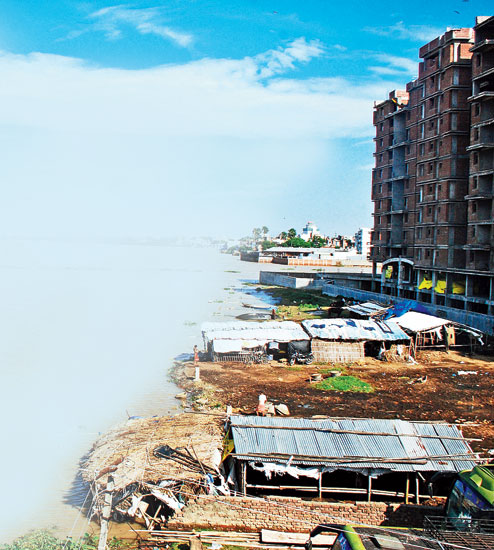

As Patna gradually bids adieu to floodwaters, the Ganga, which had come to the city’s doorsteps after a long time, is also retreating.
The floodwaters brought by the Sone are unlikely to bring the Ganga closer to Patna, experts said. The Ganga has shifted 2.5-3km away from its original course along Patna over the past couple of decades.
Water management experts said the Ganga is most likely to go back to its existing stream (2.5km away from the city) as the floodwaters recede. Rather, the heavy volume of silt brought by the Sone may get deposited near the Ganga banks along Patna, leading to further shift of the river away from the city or formation of sandbars like the Sabbalpur diara.
“The Ganga is flowing close to Patna due to increased volume of water but it will shrink to its original stream as soon as the floodwaters recede,” said R.K. Sinha, professor of zoology, Patna University, who has worked extensively on the Ganga and the Gangetic dolphin. “Besides, there is every possibility of further rise in the riverbed or further shift of the Ganga owing to heavy silt load to be deposited by the floodwaters.”
A recent study conducted by the National Institute of Hydrology (NIH), Patna, “Evaluation of shifting characteristics of river Ganga between Ara and Patna” from 1975 to 2000, said the river has shifted northward along Patna whereas near Ara and Maner, it has shifted to the south.
According to the report, the shift in the main course of the river is in the range of 1.45km to 2.76km. The maximum shift, of 2.76km, has occurred at Neknamtola near Ara, while the maximum widening of 3.8km is at Daudpur near Danapur. The rate of shifting of 0.11km per year is the highest at Neknamtola, while the rate of river widening at Daudpur is 0.15 km per year.


Experts claimed that human interference in the form of brick kilns and sand mining are the two root causes for the change in the course of Ganga. As per the records with Bihar State Pollution Control Board (BSPCB), the state capital has 596 brick kilns, most of which are located along the banks of the Ganga. A few areas on the banks in and around Patna where brick kilns have mushroomed in the recent past include the stretch between Maner, Danapur and Digha in the west, and between Didarganj and Fatuha in the east.
“Over the years, the accumulated waste material (from kilns) on the banks has contributed to its shift further north of the city,” said Patna-based water management expert Ashok Ghosh. “As the flow of the river shifted northwards, it led to erosion on its northern bank. Thus, the brick kilns led to continuous shift of Ganga away from the city.”
The ill-impact of sand mining, rampant at various places along the banks, including Maner, Danapur, Digha, Alamganj and several ghats in Patna City such as Kali Ghat, Damriyahi Ghat and Mahavir Ghat, has been similar.
“Unregulated and excessive removal of sand has caused soil erosion, riverbed coarsening and channel instability. Sand mining has been quite rampant near Maner, which has led to erosion of the river’s northern embankment in that area. The eroded sand from that area gets deposited on the banks of the Ganga at Digha, which has caused shifting of the river in that area,” said Ghosh.
The Patna High Court in March last year had directed authorities concerned, including the state government and central government agencies, to restore the original course of the Ganga in Patna.
Acting on the directives of the court, the water resources department constructed a 7km channel on the banks between Kali Ghat and Digha Ghat between mid-April and mid-June but it has now become a channel of wastewater thanks to the discharge of untreated sewage and lack of dredging.
TWISTS AND TURNS

The shifting of the Ganga from its banks along Patna (25km approximately) is in the range of 500m-3km north of its original course
ExpertSpeak: “Like all tropical rivers, Ganga undergoes natural shifting over a period of 70 years. At present, the
river is shifting north from its natural course along Patna. However, I am sceptical whether it would again return to its natural position close to Patna given the human encroachment, construction activity, illegal sand
mining and brick kilns among others.”
“Dolphin Man” R.K. Sinha
Encroachment problem
Around 30 multi- storey apartments have come up beyond the the 25km-long Ganga flood protection wall that separates the city from the riverbank, violating a Patna Regional Development Authority order of 1996 that bans construction there. A number of small residential colonies have also come up beyond the wall between Digha and Bans Ghat. In July 2013, Patna High Court ordered a blanket ban on construction of apartments on the dry Ganga riverbed.
Flood protection wall
Where to where: Rani Ghat in the east to Danapur cantonment in the west
Built: 1975-76 (after the 1975 flood)
Length: 24.2km