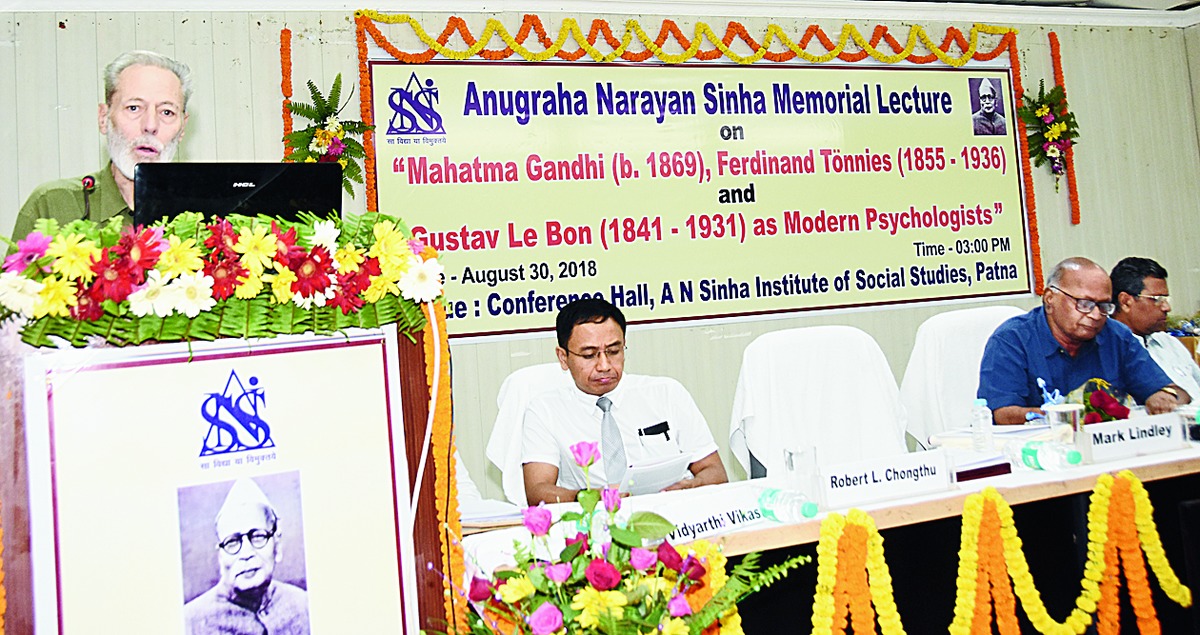

Patna: Mahatma Gandhi's firm belief in the political potential of the masses and deep understanding of crowd psychology was behind the success of his civil disobedience movement against the mighty British Empire, according to Mark Lindley, visiting professor at Dr Babasaheb Ambedkar Marathwada University in Aurangabad, Maharashtra.
"Gandhi's emphasis on inculcating self discipline, indomitable will power and commitment to not use violent means in the freedom struggle by the masses created a huge political force in the country; as a result India got independence from the British," Lindley said.
He was delivering the AN Sinha Memorial Lecture, on "Gandhi as psychologist", at the AN Sinha Institute of Social Studies here.
He said that Gandhi, through his deeper understanding of the political behaviour of the masses, realised that the secret of order in the society is not so much control but concord, the strong bond among different groups dedicated to a single common goal.
Also present were Robert L. Chongthu, the newly appointed Patna divisional commissioner who also holds the post of director of the Institute, Patna University vice-chancellor Rash Bihari Prasad Singh, and former Institute director D.M. Diwakar.
While comparing Gandhi's political methods with the thoughts of Gustav Le Bon, the French polymath who is considered the "inventor" of the concept of crowd psychology, Lindley said that le Bon outlined that the mob can play a destructive role only while Gandhi firmly believed that if the masses are politically educated and self disciplined enough then the mob could bring broader political, economic and social change.
Lindley concluded that Gandhi was a psychologist as far as his understanding of crowd psychology, a branch of social psychology which studies the behaviour of a crowd in a slew of situations, is concerned. Gandhi, he said, was very much aware that people united for a single goal can become a huge political force. In this way he was very much ahead of Gustav Le Bon and implemented the theory of Ferdinand Tönnies, German sociologist and philosopher who said that the secret of order in society is not so much control but concord.