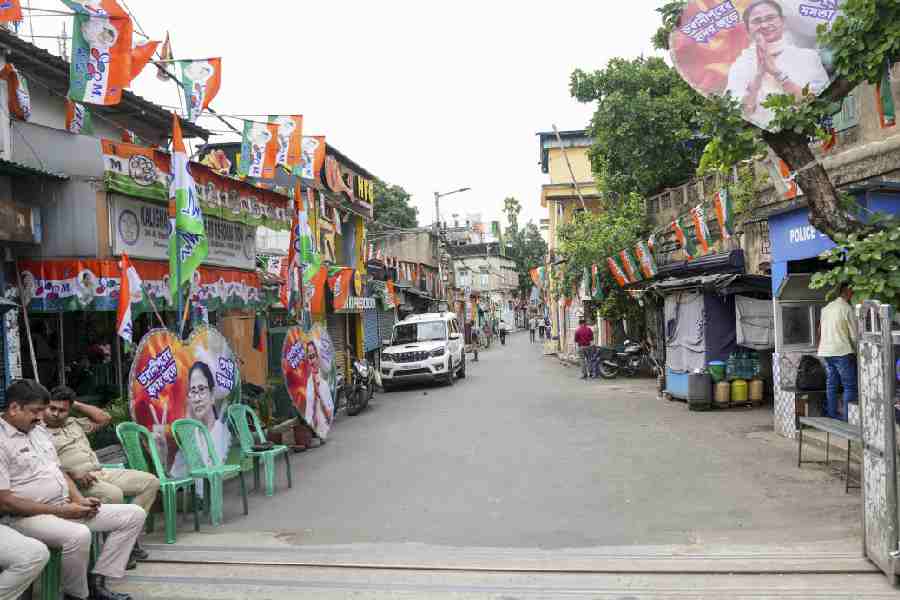
Whether the change of guard in Bengal will bring an end to the dreaded syndicate raj remains to be seen. But in the first few weeks of the BJP government, something has already shifted on the ground: police who once asked complainants to “sit and settle disputes” are now advising builders to refuse payments to extortionists.
An official in a senior managerial position at a private company working on a project off EM Bypass said no one from the local syndicate had been seen or heard in weeks.
“They have stopped calling and asking how many truckloads of sand we would need that day,” he said, requesting anonymity as he is not authorised to speak on sensitive matters. “I called one of the syndicate leaders recently, and he told me he was hiding in his village.”
The absence of the syndicates has, in some cases, temporarily snapped supply lines. The construction of an access road for the Bypass project stalled for 10 days because of a lack of sand suppliers.
“Finally, we found another supplier — and unlike the syndicate, he provided the right quantity and quality,” the official said. The syndicates, he added, would routinely deliver only 70 per cent of a consignment while charging full price.
The squeeze
The scale of the extortion was staggering. On a ₹300-crore construction project off the Bypass, at least ₹3 crore was paid to syndicates, according to a senior official of a construction company involved in several large projects.
“When the project was about to begin, we were forced into a meeting with several local syndicates. They insisted on supplying sand,” the official said.
“They also wanted to supply cement for a project that required at least 2,000 containers of readymix concrete, but we explained that readymix concrete was sourced from the company’s own unit — a volume they couldn’t match.”
The syndicates then demanded a fixed fee per container of readymix concrete — ₹1,200 a container on at least one healthcare project — simply for the right to a cut they could not earn through supply.
The sand swindle was brazen. “They promised to supply at market rate, on the condition that we would not measure the delivery. When the trucks were offloaded, we could see plainly it was about 70 per cent of what had been agreed,” the official said.
He added that syndicate leaders had told him that a large share of their earnings was being siphoned off by an influential Trinamool minister — a claim that has not been officially investigated.
Real estate bore the heaviest burden. According to a senior official of Credai (Confederation of Real Estate Developers’ Associations of India), developers across Calcutta and New Town were forced to pay between ₹500 and ₹1,000 per square foot to syndicates and local TMC leaders, depending on the size and location of a project. The cost was invariably passed on to the buyer, artificially inflating apartment prices across the city.
The demands went beyond building materials. Developers were pressed for large donations to blood camps and festivals. Some syndicates and Trinamool councillors demanded IPL tickets. In south Calcutta, a Trinamool leader’s brother was allegedly charging ₹25 lakh per cottah for any transfer of land, whether for sale
or development.
Ordinary homeowners were not spared, either. In Patuli, an elderly couple who had hired a professional company to repaint their home received a visit from three men shortly after. “They said it was fine that we had hired a paint company — but we would have to pay them ₹1 lakh, or they would not allow us to proceed,” the 72-year-old resident said.
Another Patuli resident said that anyone building a house was required to pay ₹30 per square foot to the local councillor’s men. “For a 5,000sqft house, that’s ₹1.5 lakh, before a brick has been laid.”
So far, at least 12 Trinamool councillors have been arrested — eight from the Kolkata Municipal Corporation and four from the Bidhannagar Municipal Corporation. Among them is Bappaditya Dasgupta, councillor from KMC Ward 101, which covers Patuli, arrested along with an associate, Sourav Ghosh, on charges of extortion, criminal trespass, criminal intimidation and attempted arson.
Swarup Biswas, brother of former minister Aroop Biswas, has been charged with sexual harassment, extortion and Arms Act offences.
However, despite the wave of political arrests, no action has been taken against syndicate operatives on the ground — the men who ran the day-to-day extortion networks. The criminal infrastructure, for now, remains intact.
The signal
A senior minister in chief minister Suvendu Adhikari’s cabinet said dismantling the syndicates was the first, essential step towards attracting investment to a state that has long been starved of industry.
“Industry will not come to Bengal overnight. As a first step, we are restoring law and order and trying to put an end to syndicates and extortionists. This will send a positive message to investors,” the minister said on the condition of anonymity. “We also have to improve infrastructure, which was in a shambles during Trinamool’s rule.”
Credai Kolkata has noticed the change in the police’s stand. According to the senior Credai official, developers across the city have been advised by the police not to pay money to anyone who demands it — a marked departure from the earlier practice of urging complainants to negotiate with the very people extorting them.
“When we complained earlier, the police would advise us to settle the dispute by talking to the syndicates. That has changed,” the official said.
But industry is watching carefully before committing itself.
“We hope these syndicate leaders won’t simply migrate into the new ruling party. Then it will be back to square one,” the Credai official warned. “Many businesses are holding onto their investments and waiting to see whether the change on the ground is real.”
It is a reasonable caution. The extortionists may have gone quiet. But so far, they have not been caught.