
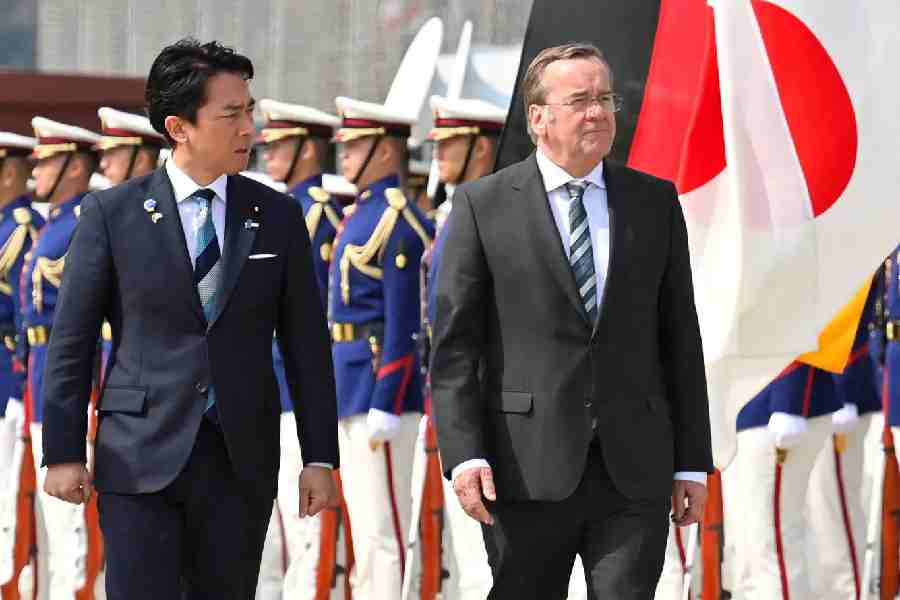
In 1940, the imperial regimes of Germany and Japan joined what would be known as the Axis powers, bound by mutual opposition to the United States. They fought a world war, and they lost it, and their populations spent the next 85 years with shrunken militaries and a heavy reliance on their former enemy, America, for security.
Now, both countries’ wariness of America has resurfaced, alongside heightened fears about a surging world power, China, and an aggressive Russia. Tokyo and Berlin are rushing to rebuild their militaries. And, once again, they are strengthening ties.
Their cooperation is expected to gather momentum at the meeting of the leaders of the Group of 7 nations in Evian, France, this week. It already includes sharing know-how, technology and weapons, like drones and helicopters, critical to the countries’ respective efforts to rearm.
It is hardly an Axis redux. This time, Japan and Germany are banding together from a defensive posture, with Berlin supporting Ukraine’s defense against Russia, and Tokyo wary of threats posed by China and North Korea. They are joining other like-minded “middle powers,” like fellow G7 members Britain, Canada and France — their enemies in World War II. And they are casting themselves as champions of international law and institutions that serve as bulwarks against the bullying behaviors of the world’s most powerful countries.
As Boris Pistorius, the German defense minister, said in March at a Japanese naval base, nations like Germany and Japan, “who still stand by the rules-based international order, must move even closer together and make clear what we stand for.”
Germany and Japan emerged from the devastation of World War II with a focus on rebuilding ravaged cities and stoking economic growth. They allowed the United States and other allies to shoulder much of the burden of keeping their citizens safe.
After Germany split in two, the United States built large military bases and stationed tens of thousands of troops in West Germany, a front-line outpost in the Cold War with the Soviet Union. The governments of both East and West Germany maintained their own large armies, but after the fall of the Berlin Wall and the end of the Cold War, the reunified country spent far more on social programs than on defense.
Postwar Japan adopted a U.S.-imposed constitution, drafted under Gen. Douglas MacArthur. It forced the Japanese to renounce war and prohibited keeping armed forces except for defensive purposes. That led to the creation of the Self-Defense Forces, which remains the official name for the country’s military.
In the decades after the war, anti-militarist movements gained traction in both countries, promoting the ideals of peace, diplomacy, free trade and cultural exchange.
But that sentiment has waned in recent years, especially since Russia’s full-scale invasion of Ukraine in 2022 and China’s increasingly assertive military and economic policies under its leader, Xi Jinping.
President Donald Trump’s threats to abandon security commitments in Europe and his eagerness to strike a trade deal with Xi accelerated both countries’ pushes toward rearmament.
Thomas Berger, a professor at Boston University who has studied the postwar history of Japan and Germany, said that the two countries were responsible for “perhaps the greatest catastrophe of the 20th century,” a reference to World War II, and that their defeats had “shattered their ideals and beliefs in empire and militarization.”
But the recent change in the global security landscape, particularly Trump’s volatility, has fueled anxiety and urgency for the countries’ relatively new leaders, both of them conservative and defense-minded. “There is this justifiable fear that the United States might sell them out,” Berger said.
Shortly before taking office a year ago, Friedrich Merz, the German chancellor, led a successful effort to suspend limits on Germany’s government borrowing in order to drastically increase military spending. In a few years, Germany’s military spending could be larger than that of France and Britain — combined.
Japan commits half as much as Germany, but it is still one of the world’s top spenders on defense, with a budget this year of about $58 billion.
Prime Minister Sanae Takaichi, a conservative lawmaker, won office last year with nationalist calls to revive the military. She has deployed long-range missiles — capable of reaching China — in southern Japan and has reversed postwar bans on arms exports.
Both Merz and Takaichi have made a point of trying to maintain warm ties with Trump, but both have also looked beyond Washington, increasingly, for military alliances.
Japan recently sealed a $6.5 billion deal to supply warships to Australia, and it is in talks with the Philippines and Indonesia about exporting warships. Germany has forged close ties with Ukraine in developing and deploying new weapons and has asked France to help provide it with a nuclear deterrent.
China and Russia have accused Takaichi of seeking to revive World War II-era militarism. But she has said her policies are necessary because Japan faces the “most severe and complex” security environment since that era, citing the threat of China and North Korea.
“No single country can now protect its own peace and security alone,” she said recently. “There is absolutely no change in our commitment to upholding the path we have followed as a peace-loving nation for over 80 years.”
The German public has embraced rearmament reluctantly, but faster than the Japanese have.
Recent surveys suggest a majority of Germans see the world now as more dangerous than it was during the Cold War. They also suggest that two-thirds of the country back higher spending on the military, even though the German armed forces, which do not enforce a draft, have struggled to persuade young people to enlist.
In Tokyo this spring, tens of thousands of people protested Takaichi’s security policies, including the decision to export more weapons and to establish a national intelligence agency. The protesters were concerned that Takaichi might next seek to scrap Article 9 of the constitution, which renounces war.
Nahoko Hishiyama, 37, who helped organize some protests, said Takaichi’s “policies are deeply concerning, as they aim to turn Japan into a military power.”
Alexandra Sakaki, a scholar at the German Institute for International and Security Affairs in Berlin who studies Japan, said rearmament would require further shifts in mindset in Germany and Japan, especially if officials turn to policies like conscription.
“They need to think about military and society in a whole different way,” she said. “Will they be ready for combat? Will they be ready to fight? Japan and Germany need the public to back that vision.”
One country has applauded the German and Japanese shifts: the United States.
Trump has long pushed allies to spend more on their own defense so the U.S. military can focus elsewhere. Meeting last year with Merz, he welcomed Germany’s spending surge — though not without reservation. In a quip, Trump noted that a remilitarized Germany might not please the U.S. leaders who defeated Nazi Germany in World War II.
“I’m not sure that Gen. MacArthur would have said it was positive, you know?” he said.
The New York Times Services