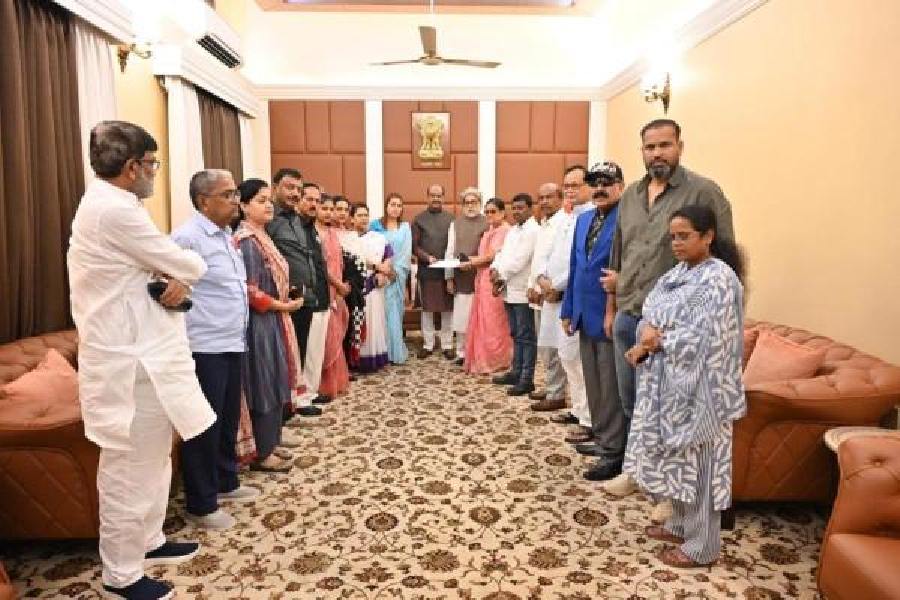
Trinamool’s rebel camp in the Lok Sabha has sought a “merger” with an obscure political party to escape the axe of the anti-defection law that does not recognise splinter or breakaway factions.
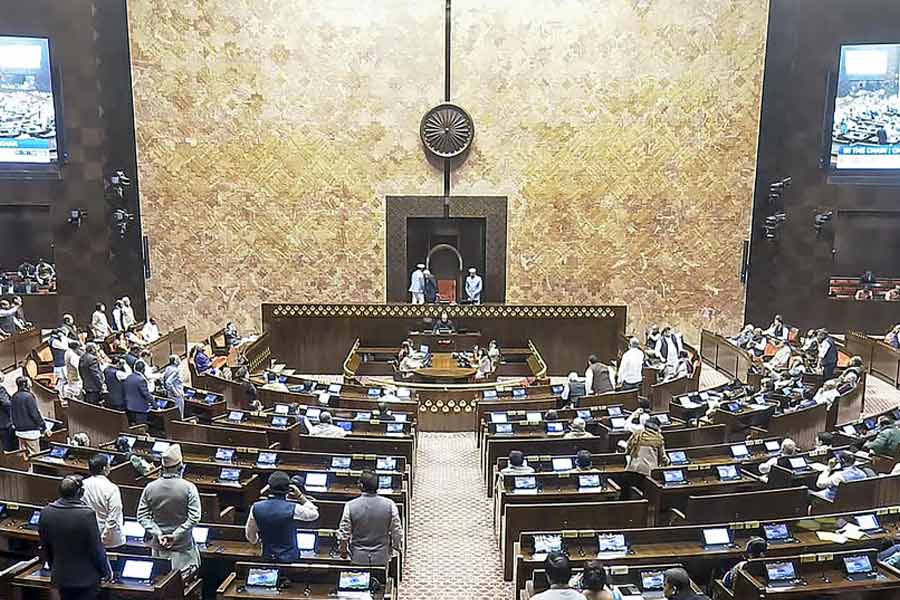
Twenty rebel Trinamool MPs on Sunday met Lok Sabha Speaker Om Birla at his residence and submitted a letter seeking a merger with the Nationalist Citizen Party of India (NCPI), which has no MPs or MLAs.
Ironically, an election poster of the NCPI from the 2023 Tripura Assembly polls hits out at “dalbadlus” (turncoats or party-hoppers) right at the top.
The rebels’ move came shortly after Trinamool MPs Kirti Azad and Sagarika Ghose met the Speaker and handed him a letter from legislative party leader Abhishek Banerjee. It underlined that the anti-defection law, as reaffirmed by a Supreme Court judgment, allows defectors only to merge with existing parties, not to form separate factions in the House.
The NCPI is a registered but unrecognised political party. Its only known electoral foray came in the 2023 Tripura elections, where it contested three seats without success.
One of its election posters from that election — for Chawamanu candidate Barjeda Tripura — begins by saying: “Shun turncoats to safeguard your rights. Stand by social workers, not political personalities.”
It further asks people to vote for the kalam (pen) symbol to protect “the human rights of all, irrespective of caste, religion, colour or language”.
Records show that the NCPI was registered in 2022 at an address in Howrah district of Bengal. The party’s registration details list Shewly Kundu as its president. The election poster names the vice-president as Uttiyo Kundu and the “ogs” — which could stand for “organisational secretary” — as Shantanu Dey.
Facebook searches threw up a Ranaghat-based husband-wife couple, Shewly Kundu and Uttiya (spelt with an “a”) Kundu, but neither mentioned any link with the NCPI.

A campaign poster of the NCPI for the 2023 Assembly polls urges voters to shun turncoats Sourced by The Telegraph
Uttiya’s profile, however, features a photograph with Bengal chief minister Suvendu Adhikari, uploaded on May 10. Uttiya describes himself as a motivational speaker, mathematics teacher, ISO auditor and secretary of Jago Biswa, a weekly Bengali newspaper. Shewly says she is a sub-editor with the publication.
The rebels have over the past week maintained they have signed a letter to be submitted to the Speaker, seeking recognition as a separate bloc in the Lok Sabha while extending support to the NDA government.
Rebel leader Kakoli Ghosh Dastidar, however, changed her tune after Sunday’s meeting with Birla.
“We, the 20 MPs elected from the AITC, met the Speaker and submitted a letter requesting to sit separately. These 20 MPs constitute more than two-thirds of our (Trinamool’s) total strength (of 28 in the House),” she told reporters.
“We are merging with the Nationalist Citizens Party. Moving forward, we will work for the nation and collaborate with the NDA under the leadership of the Prime Minister.”
Trinamool called the move illegal. “All these things are being attempted because of the overall illegality, illegitimacy of what they are doing,” Bardhaman-Durgapur Lok Sabha member Azad said. Sources said Mamata Banerjee would issue a detailed statement.
Abhishek’s letter to Birla, delivered shortly before and dated June 10, asked the Speaker not to recognise any breakaway faction and treat the All India Trinamool Congress as a single, unified party in the House.
The letter cited a 2023 Supreme Court constitution bench judgment in the Shiv Sena case and argued the defence of a “split” no longer existed under the amended anti-defection law, and only mergers were allowed.
Under the anti-defection law, disqualification does not apply if a political party merges with another party and at least two-thirds of the members of the original legislative party agree to the merger.
The rebel MPs must now formally constitute themselves as a separate group and pass a resolution approving the merger with the NCPI. The NCPI leadership must also communicate to the Speaker that it has accepted the Trinamool rebel faction’s merger into the party.
A source in the rebel bloc in the Bengal Assembly, however, said: “As far as we know, we do not need to do this (a merger). We would have been instructed to do so by now had that been the case.”
He added: “We are making calls to Delhi to find out.”
The senior-most rebel in the Lok Sabha, Sudip Bandyopadhyay, indicated that while the bloc was merging with the NCPI for now, it could next month move court to claim “real TMC” status.
“We will merge with the Nationalist Citizens Party.… It is a regional party. This is the system. When you leave with two-thirds of the party, you cannot demand the name of that party on the first day itself,” he said.
“In July, we will make a demand to give us (the label of) ‘Trinamool’ since we have two-thirds majority from Trinamool. Then the court will decide.…”
Legal expert and former Union minister Kapil Sibal demanded the disqualification of the rebels, arguing their proposed merger with the NCPI was legally untenable.
“TMC rebels: Will merge with Nationalist Citizens Party (NCP). Indian Democracy has become the ‘theatre of the absurd’ A joke!” he posted on X.
“The rebels of the TMC legislative party cannot merge with a political party; that can happen only if the TMC wished to do so! Disqualify them!”
Ahead of the meeting with Birla, the rebels had assembled at Union environment minister Bupender Yadav’s residence, an address that has over the past week witnessed many of the bloc’s huddles, buttressing the charge of BJP stewardship of the revolt.
Several of the rebels — including latest entrant Sudip, first rebel Kakoli, and actors Satabdi Roy and Saayoni Ghosh — were seen arriving at Yadav’s home. Later, Ghatal MP and actor Dev was pictured at Speaker Birla’s residence along with other rebels.
Some others, including Khalilur Rehman and Abu Taher Khan, were said to have arrived later, having caught a late afternoon flight to Delhi.
The Trinamool split reflects the BJP’s determination to secure a two-thirds majority in the Lok Sabha and pass key bills. One of these aims to amend the Constitution to facilitate a delimitation of constituencies, to which the government has tied the implementation of women’s reservation in the legislatures.
The constitutional amendment bill was defeated in the Lok Sabha in April.
Additional reporting by our Bengal bureau