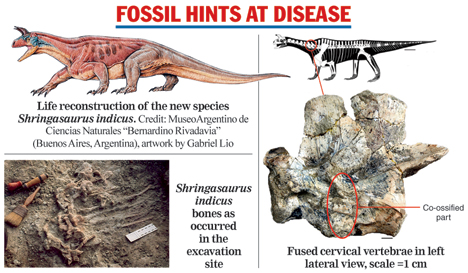

Bonhooghly: The fossil of a diseased, one-horned Middle Triassic reptile discovered by a team of geologists from the Indian Statistical Institute (ISI) in Madhya Pradesh has been found to have spinal characteristics resembling the modern scourge of spondylitis.
Saradee Sengupta, an assistant professor of geology at Durgapur Government College, has just published an article detailing the findings in the International Journal of Paleopathology.
The possibility of the painful neck-and-back condition plaguing life forms nearly 245 million years ago adds to the significance of the discovery of Shringasaurus indicus, the horned reptile genus that straddled the Satpura Gondwana basin in Madhya Pradesh long before dinosaurs ruled.
Among the fossils dug up near Tekapar was one with two cervical vertebrae in fused condition. "I tried to reconstruct what could have caused the two cervical vertebrae to be fused. Most likely it was a congenital disease or the animal suffered from spondylitis, a disease caused when two vertebrae conjoin. Or it could even be an infection," Saradee said.
In modern mammals, cervical fusion caused by spondylitis often results in an advanced stage of the disease. The shringasaurus with fused vertebrae possibly had little chance of survival till adulthood, according to the research team.
This is the first instance of a disease being diagnosed in a vertebrate fossil belonging to the Triassic period in India.
Apart from the diseased shringasaurus, there were fossils of at least six other members of the same genus. These horned reptiles are classified in the archosauromorph group that includes crocodiles, dinosaurs and their descendants, birds and their ancestors.
The researchers named their discovery Shringasaurus indicus based on its singularly striking characteristic, the horn (shringa means horn in Sanskrit). The discovery and identification of the new species had been published in scientific reports last year.
Saradee, Saswati and Martin D. Ezcurra co-authored the report "A new horned and long-necked herbivorous stem-archosaur from the Middle Triassic of India".
"The most striking feature of the Shringasaurus indicus is the presence of a pair of large supraorbital horns that resemble those of some ceratopsid dinosaurs," the trio wrote.
This overturned the earlier notion that horned reptiles were restricted to dinosaurs of the Cretaceous period, dating back 140 million years.
"When I first saw the horn that was dug up at the site, I mistook it for scutes," said Saswati, who works in the Geological Studies Unit of ISI and was Saradee's PhD guide.
The eureka moment came while cleaning the fossil later - the Triassic period was till then not known to have horned reptiles.
"This is a dimorphic horn, which means that only the male species had one. It was probably for use as a weapon in intrasexual combat driven by sexual selection," Saswati said.
Unlike the other reptiles of the Triassic period, the shringasaurus was three to four metres in length. Animals of that age were generally about 2.5 metres in length.
The shringasaurus had a relatively long neck and small head. It had leaf-shaped teeth with small cusps that suggest it was herbivorous.
The animal, Saswati said, had some "advanced features" alongside some "primitive features".