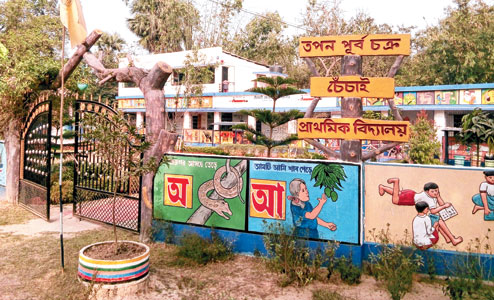


A "smart" school is changing a village in South Dinajpur. But to do so, the government primary school at Chenchai in Tapan block first changed itself.
The institution was set up in 1983 but it was revolutionised in the last six years by a visionary headmaster.
About 90 families, mostly from several scheduled tribes, live in Chenchai, about 20km from Balurghat, the district headquarters.
Pabitra Mahanta, the headmaster, has transformed Chenchai Prathamik Vidyalay from an ordinary school into an institution that would do any locality proud.
The poor families are glad to send their children to a school with facilities that were beyond their dreams.
The school is also reaching out to the villagers.
The co-educational institution has pre-primary to Class IV. The classrooms are on the ground floor of a two-storey building. Above the classrooms are the kitchen and the dinning area for children.
The school has CCTV monitoring facility, a TV and a computer each in all four classrooms, fresh drinking water, modern toilets, a sound system to address the students and healthy mid-day meals.
The latest addition is a smartboard, a gift from the district administration. It is a large monitor on which teachers can key in anything required for lessons.
"All students are from very poor families and most are first-generation learners. They have neither seen the hills nor the sea or anything outside their environment. While teaching, we often face problems in explaining to the kids what we are talking about. If lessons are presented in an audio-visual mode, it is easier for them. We requested the district magistrate for a smartboard. Now we are teaching through it," said Mahanta, who has been the headmaster since 2009.
The institution has 52 students and two teachers, including Mahanta.
The CCTV has been installed at four points - the entrance, the main passage, dining room and a shop inside the school. The school sound system includes speakers set up at eight points and it is also used to address the villagers.
"Most people here do not read newspapers or watch television. We use the sound system to announce programmes like pulse polio inoculation and literacy drives. If we feel there is a need to talk to villagers or guardians, we call them through the sound system," said Mahanta.
The school alarm system is also for the entire village. Four alarms are sounded every day that ring over a radius of 2km.
At 4.30am there is a wake-up call for students, at 10am is the call to get ready for school. The 11am alarm is to indicate that the school has started and 4pm alarm tells everyone that school is over.
The institution has an unusual store, Amader Dokan (our Store). It is unique, as there is no shopkeeper in the shop (dokan) which is situated on the landing between the two floors of the building. Children buy stationery and drop money in a box. "It is monitored by the CCTV. No one has been dishonest so far," said Sanjib Majumdar, the other teacher.
Before entering classes, students put away their shoes in a shoe rack. The school also has a library and a guesthouse and holds yoga classes for students. Students also form mock cabinets with "ministers" for different "departments". Mid-day meals are cooked in well-maintained kitchen.
The institution has also helped to establish sanitation across the village. Six years ago, there was hardly any toilet in the area. The school headmaster with assistance from the block administration organised construction of toilets at subsidised rates.
"I always believe that school and locality are complementary to each other. To better the school you need to improve the locality. Now almost all families have a toilet in the village," said the headmaster.
Amal Tapno, a resident of the village, said: "With the school, the village has developed a lot. No one in the village has the ability to send a child to a private school."
District magistrate Tapas Chaudhury, who had inaugurated the smartboard in the school, said: "If I had not come here I would have never believed that there could be such a beautiful school."
Kalyan Kundu, chairman of the district primary school council in South Dinajpur, said he was very happy. "I am really moved by the example set up by the school."
Mahanta said he had miles to go. "I am not satisfied yet. We have plans to give vocational training to students as well as seniors who have passed from this school. I also dream of setting up a community hall where we can uphold the tribal culture," he said.