 |
Crumbling bitumen, perilous potholes, jutting rods, bad drainage, poor lighting and inadequate police presence.
Name a problem and you get one along the 200m Patipukur underpass near Belgachhia Metro station in north Calcutta. After being in the making for 11 years, the underpass was inaugurated in 2012 and in less than a year it has become a nightmare for motorists.
In fact, an hour’s rain washed away the bitumen top of the road barely 11 days after it was opened for traffic. Concrete has replaced the cracking asphalt as the authorities tried to control the damage.
But the problems continued. Experts said a flawed drainage design and poor quality of material used during construction have dealt a double whammy to the underpass.
Metro visited the underpass last week and found out how dangerous it has become.
Rod terror
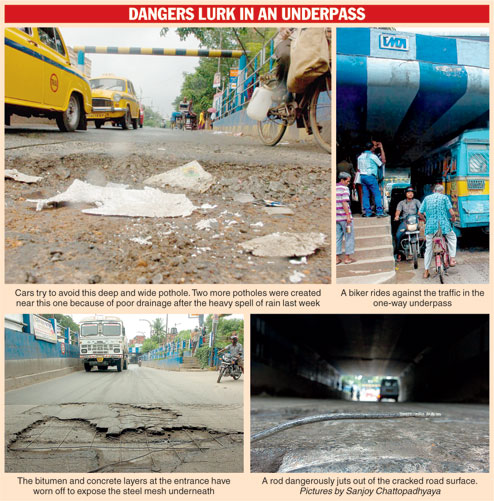
Steel rods were jutting out dangerously from underneath the road’s top layer at least in two places.
Civil engineers said the reinforced bars were placed to prevent cracks on the surface and minimise damage to the top layer. But the rods got exposed after the concrete cover disintegrated because inferior material was used during construction, they added.
Some rods are protruding at an acute angle — and straight up at one place. An accident is waiting to happen because any of these rods can pierce through a car’s floor or flatten a tyre.
“Last week, a wheel of a cycle got entangled in a rod and the cyclist fell in front of a bus. Cops cut the portion of the rod that was sticking up, but another one came off the mesh a couple of days later,” said Satyajit Mukherjee, a resident of the area.
Pothole peril
At least four potholes, each around 3ft wide, dot the stretch. The deepest was around 10 inches at the entrance to the underpass on the Lake Town end. If not a major accident, it definitely could cause serious damage to a car’s shock absorber, a motorist said.
Of late, two more potholes have sprung up near the big one, forcing cars to slow down and trigger a snarl. The craters often knock over motorcycles and autorickshaws, residents said. Poor lighting inside the underpass added to the woes.
“The craters have been there for over a month and impossible to avoid. I noticed a crack on my car’s underbelly because it touches the pothole edges. I would have stopped using this road if I had a choice,” said Rupak Dasgupta, a Lake Town resident.
“We have done patchwork on some of the potholes but that didn’t help. We will fully repair the stretch and put a fresh coat of concrete on the road after monsoon. Any repairs now would come to nought because rain and waterlogging will again damage the road,” said a senior Calcutta Metropolitan Development Authority (CMDA) official.
Dismal drainage
The underpass gets submerged in knee-deep water after a 30-minute downpour. An hour-long rain means waist-high water. Poor drainage ensures waterlogging for at least two hours.
“There is an underground pipe to drain out water to Duttabagan pumping station. Engineers realised only after construction that the station is at a higher ground and water can’t drain out automatically. We have to rely on a pumping machine and deploy men to manually drain out water after every downpour,” said an official of the CMDA, which maintains the underpass.
Shoddy maintenance of the gully pits worsens the situation. “These pits are always clogged with muck and solid waste, seldom cleared or cleaned,” a resident said.
Against the traffic
The 12ft-wide underpass is meant for one-way traffic from Lake Town to Belgachhia. But bikers, rickshaws, cyclists and even autorickshaws and cars often drive in from the opposite end, taking advantage of the lack of policeman to stop them. These violations trigger traffic snarls — inevitably during the morning and evening peak hours.
“There is a road to a neighbourhood across the underpass. To reach that road, vehicles drive against the traffic. We keep our men posted in the underpass and often book offenders,” an officer of the Shyambazar traffic guard said.