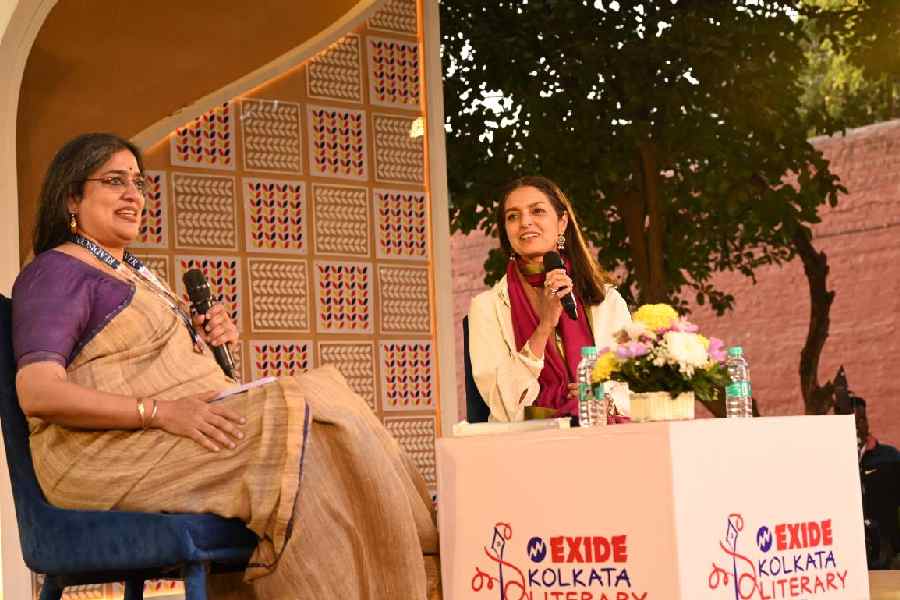
Pulitzer Prize-winning Bengali-American author Jhumpa Lahiri returned to Calcutta’s favourite literature festival after 12 years, championing the short story form.
“Two things make the short form really magical and unique. One is that it pays attention to every word and every sentence — something that is really hard to sustain in long-form. There is a tightness, an attention and awareness, that make the short story more akin to poetry. The other incredible thing is that short stories, like many poems, by virtue of their brevity, can be read in one sitting. This is something beautiful, almost sacred,” Jhumpa said on the opening day of the Exide Kolkata Literary Meet, partnered by The Telegraph.
Jhumpa, who last attended the festival in 2014, was in conversation with Malavika Banerjee, the festival director, about her book, Roman Stories — a collection of short stories written in Italian, the language Jhumpa now writes in. Since moving to Rome in 2012, Jhumpa has explored themes of displacement, belonging, and the immigrant experience, using the city as a vivid backdrop.
The Kalam lawns at the Alipore Museum were packed. Every seat was filled, and a sizeable part of the audience stood, jostling for space
while listening intently to Jhumpa.
Discussing her book, Banerjee noted how publishers often favour novels over short stories. Jhumpa seized the opportunity to pay tribute to the short form.
“I was raised by a passionate reader of Bengali literature, my mother. Our house was filled with short stories. Sometimes she would read them to me. I grew to like reading short stories written in or translated into English. I wouldn’t be a writer if I hadn’t read the short stories of James Joyce or Anton Chekhov or Gabriel Garcia Marquez,” she said.
“I think it is ironic because our attention span is now at a historic low, almost nothing, and yet publishers still get excited when you put a 900-page manuscript on the desk... There is no hierarchy between a short story and a novel. It is just absurd to think that a Chekhov story could be minor compared to a mediocre 500-page novel,” she added.
Steps in Rome
A key section of Roman Stories, titled “The Steps”, uses a staircase as its central setting, observing the lives of the people who use it daily.
On Thursday, Banerjee asked the author about the significance of the steps: “Coming back to the structure of the book, placing the steps as central is so beautiful and central to any tourist or outsider’s experience in Rome. What was the structure of how you placed these stories?”
Jhumpa said she was glad Banerjee mentioned outsiders.
“The whole book is about outsiders — what it means to be one. There is a question of belonging. Not only is everybody in Rome an outsider, but we are all outsiders. If we
don’t understand this basic thing about us, we don’t truly understand what it means to be human beings,” she said.
“Rome is full of such staircases because it is a hilly city. I live just beside one of them. It is an extraordinary microcosm of urban life... I am fortunate to have lived in amazing cities — New York, Rome, and of course, my lifelong relationship with this city. There is a poetry to urban life that cannot be replicated. This staircase is a place that belongs to everybody and nobody. That is the beauty of cities and urban spaces that create these places that belong to everybody and nobody,” Jhumpa said.