A high court judge on Thursday gave a lawyer 10 minutes to answer a single question: why was his client, Abhishek Banerjee, not appearing before the CID?
That question led to a clear assurance. Abhishek’s counsel told the court that the Trinamool Congress’s second-in-command would appear before the CID whenever the court directed him to do so. The court then set a deadline of 6pm.
The dramatic flow of events kicked off with a surprise turn in the courtroom.
Senior advocate and Trinamool MP Kalyan Banerjee was allowed on Wednesday to move the court on Abhishek’s behalf, alleging police harassment. Justice Kaushik Chanda agreed to hear the matter and said it would be taken up on Thursday.
In his court on Thursday, there was a junior lawyer with the same appeal but one that was part of a different petition. This one, filed by Ayan Bhattacharjee.
It was Bhattacharjee who assured the court later that Abhishek would appear before the CID.
After hearing Bhattacharjee and the CID counsel, Justice Chanda granted Abhishek interim protection from coercive police action.
Justice Chanda asked Abhishek to cooperate with the investigation and restrained the agency from taking coercive steps against him for three weeks.
Additional solicitor-general Rajdeep Majumdar told the court that Abhishek had been sent three notices. The terms of each of them have expired, he said. The appeal is not maintainable, he argued.
“Prima facie, the investigation suggests the involvement of Abhishek Banerjee. He has failed to produce the original resolution despite the notices. The search operations have not yielded anything significant. So, custodial interrogation was necessary,” said Majumdar.
This prompted the judge to ask if the previous notices were a “house trap”.
“The notices asked for his appearance. Now, you are talking about custody,” said the judge.
The judge said that an accused could not be compelled to produce a document that may incriminate him. “Show me one provision in law that allows the investigative agency to compel an accused to produce a document. You have to search and seize,” Justice Chanda said.
The CID is probing the allegation that the signatures of several Trinamool Congress MLAs were forged on an official document, submitted to the Bengal Assembly, nominating Sobhandeb Chattopadhyay as the leader of the Opposition.
The CID informed the court that Abhishek had sent the relevant resolution to the Speaker. Multiple MLAs have since alleged they were not present at the meeting, but their signatures appear on the resolution. “The authenticity of the resolution is being probed,” Majumdar said.
The probe has so far revealed serious discrepancies, additional solicitor-general Rajdeep Majumdar said.
Abhishek had initially informed the Speaker about the unanimous choice of the Leader of the Opposition without enclosing any minutes of the meeting, he alleged.
It was only after theSpeaker sought supporting documents that theresolution bearing the MLAs’ signatures was furnished, Majumdar said.
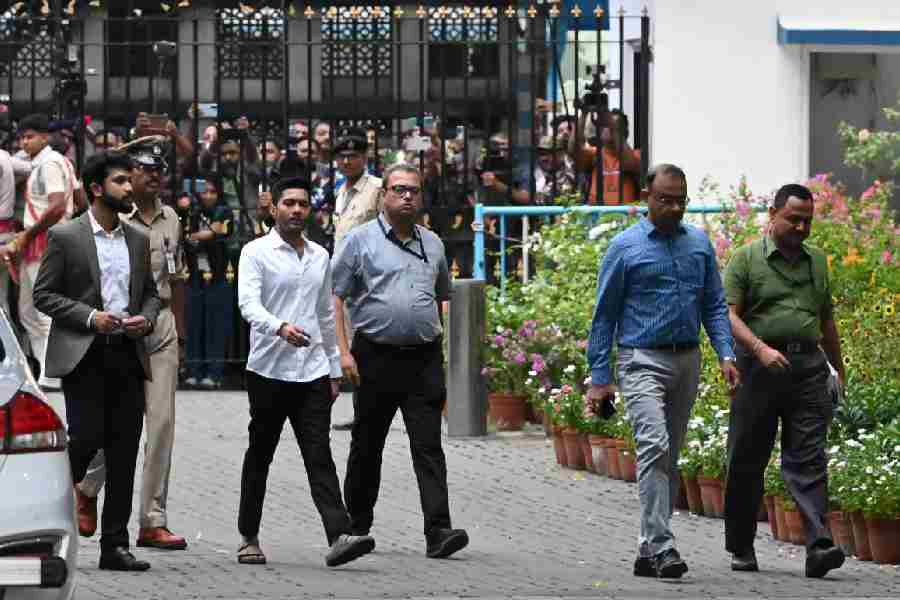
Abhishek approached the high court after separate CID teams conducted searches at the Trinamool office on Harish Chatterjee Street — located on the same premises as Mamata Banerjee’s Kalighat residence — and at Abhishek’s office on Camac Street.
Abhishek’s lawyer, Bhattacharjee, assured the court that his client was ready to cooperate with the investigation whenever summoned.
Justice Chanda acknowledged the seriousness of the allegations but held that Abhishek’s willingness to cooperate with the probe justified interim protection.
“The investigation agency can interrogate, conduct search operations andtake all other steps related to the probe. But no coercive action can be taken against Abhishek until further directions from the court,” the judgesaid.
The matter will be heard again after three weeks. The interim protection will be in force till then.