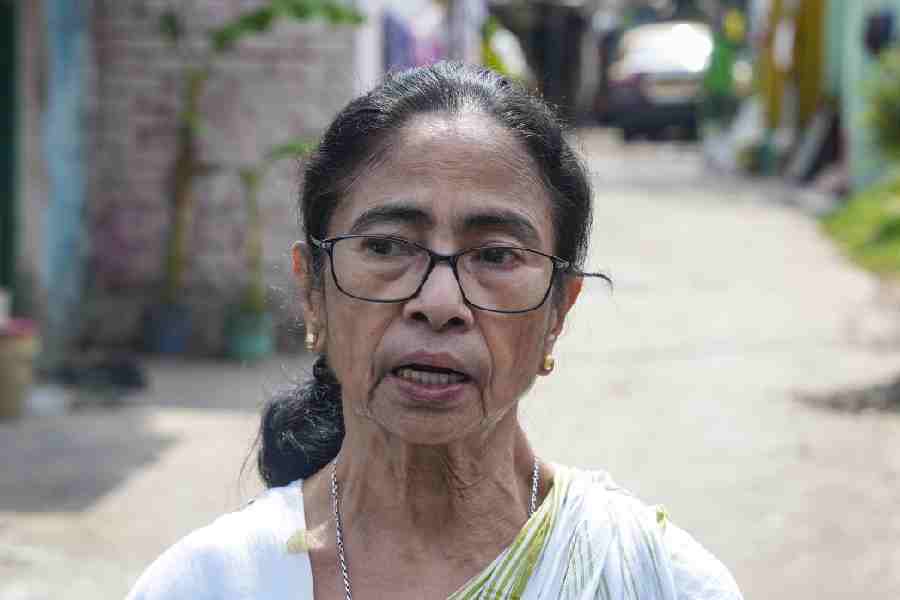
At stake for Mamata Banerjee, as the Trinamool Congress continues to implode, is not merely the political capital that she built over four decades in public life, but capital as the financial world knows it.
A question mark looms over the party, its symbol and, more importantly, the assets that the party accumulated after being in power for 15 years in Bengal.
For the 2024-25 fiscal year, the Trinamool Congress had declared Rs 219.3538 crore as total earnings in its income-tax returns filed on October 13, 2025. A report by the Association for Democratic Reforms published on May 27 this year ranked the Trinamool in the second spot after the Telugu Desam Party as the highest earners among 36 regional parties analysed by the organisation.
The Trinamool had received Rs 184.08 crore as donations last year, the highest among all regional parties. Another Rs 33.685 crore was earned as interest on fixed deposits.
In the 2023-24 fiscal year, the TMC had earned Rs 646.293 crore.
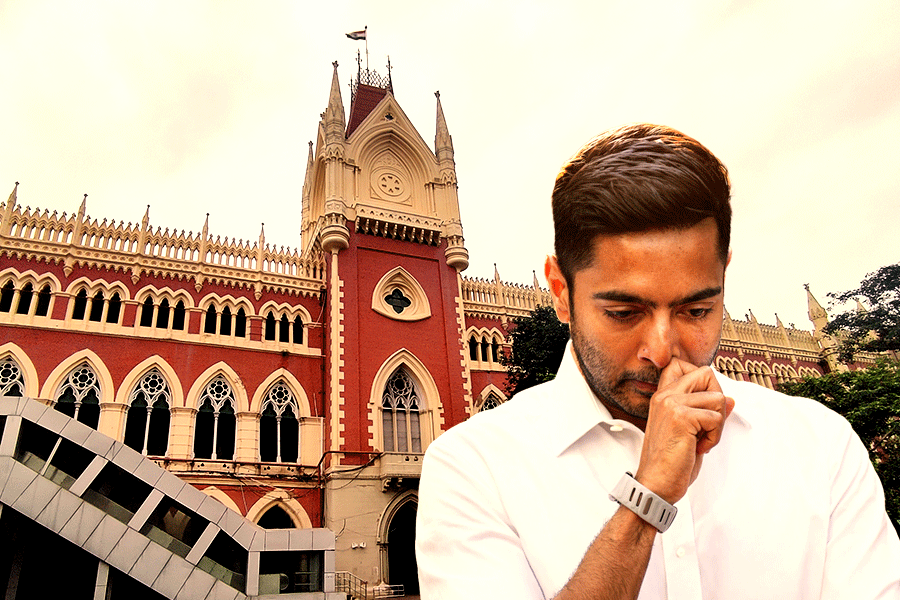
Till the Supreme Court announced electoral bonds as unconstitutional, Mamata Banerjee’s party had encashed Rs 1,609.5 crore between April 2019 and January 2024, the second-largest recipient among all political parties.
The audit for the financial year of 2025-26 is yet to be done.
"This is not the time to discuss these issues,” a Mamata-loyalist Trinamool MLA told The Telegraph Online. “Everything is in a state of flux. It is true that they [the rebel MLAs and MPs] have the numbers on their side. But I don't think even the rebels are certain what their next step is going to be."
The numbers in the Bengal Assembly are mostly clear. Out of the 80 Trinamool MLAs who won in this April's Assembly elections, two were expelled and 56 others have extended support to expelled TMC MLA Ritabrata Banerjee to lead the Opposition.
In Parliament, the Trinamool is crumbling. In the Rajya Sabha, where the Trinamool had 13 MPs, the party has lost three and the tally now stands at 10. On Thursday, Prakash Chik Baraik resigned following the footsteps of Sukhendu Sekhar Ray and Sushmita Dev.
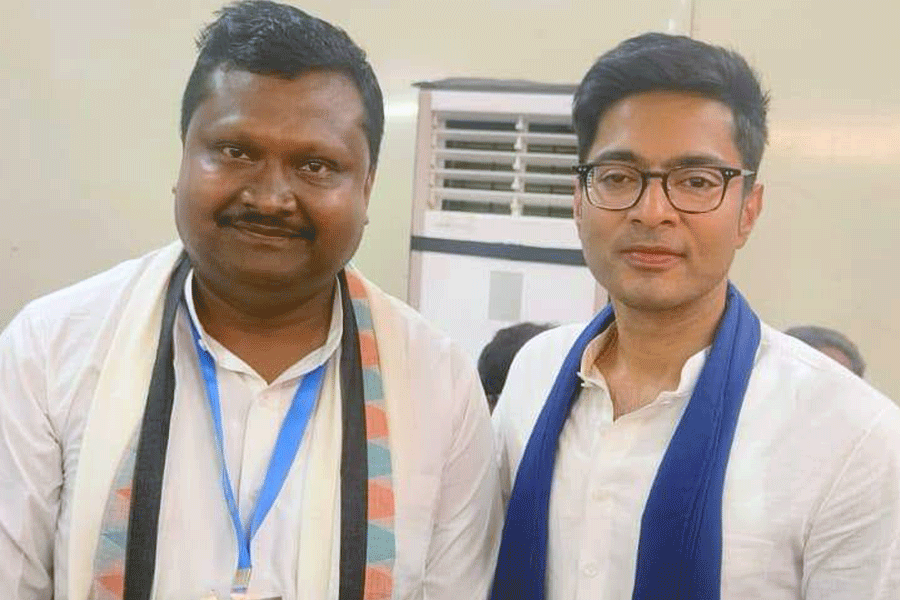
In the Lok Sabha, 19 of the 28 Trinamool MLAs are reported to have broken ranks with the party to form a separate group.
Calls made to the leaders of the two rebel groups in Calcutta and Delhi, Ritabrata Banerjee and Kakoli Ghosh Dastidar, went unanswered.
Same road that Indira Gandhi walked, twice
Twice in her political career, in 1969 and 1978, the late Indira Gandhi had walked the same road that Mamata finds herself on today.
After the Congress split into Congress (O) and the Indian National Congress (Requisitionists) in 1969 (the latter led by Indira) the symbol of two bulls carrying a yoke used by the party in elections held between 1952 and 1969 went to the Congress (O).
"Not only did she lose the symbol but also the office at 7 Jantar Mantar road, the library and other assets," said a senior Congress leader.
Allotted the new symbol of calf and cow, Indira made a triumphant return in the 1971 elections.
On January 1, 1978 Indira Gandhi was expelled by Kasu Brahmananda Reddy, who served as the Union home minister in the Indira cabinet, the person who drafted and signed the declaration of Emergency four years later.
"I am legally and constitutionally the president of the Indian National Congress, and if any organisation is formed under the name 'Indian National Congress' it is illegal and unconstitutional," Reddy wrote to the Election Commission.
One Congress leader (now deceased) from Bengal had then commented: "We are not carrying the burden of Indira Gandhi any more."
Indira-loyalists in the Congress collected signatures of around 700-odd AICC members from across the country. A convention was held at New Delhi's Mavalankar Hall where Indira announced her new party.
The cost of the new party was a loss of support from 76 of 153 MPs in the Lok Sabha.
Over objections from the Reddy-led group, the Election Commission froze the "cow and calf" symbol, leaving Indira Gandhi without a party symbol.
Neither of the breakaway groups from the Trinamool has yet approached the Election Commission over the symbol.
The Election Symbols (Reservation and Allotment) Order, 1968 gives the Election Commission the authority to decide on the claims of rival factions in case of a split in a political party.
Para 15 of the order says: …when the Commission is satisfied on information in its possession that there are rival sections or groups of a recognised political party each of whom claims to be that party the Commission may, after taking into account all the available facts and circumstances of the case and hearing such representatives of the sections or groups and other persons as desire to be heard decide that one such rival section or group or none of such rival sections or groups is that recognised political party and the decision of the Commission shall be binding on all such rival sections or groups.
The Trinamool's old office in Topsia, off the Eastern Metropolitan bypass in eastern Kolkata, is under renovation. The makeshift Trinamool office, on A/P-1/A Canal South Road, was rented three years ago. The owners have asked Bengal's former ruling party to vacate the premises.
The only legal challenge thus far in the aftermath of the unravelling of the Trinamool has been hurled by Sobhandeb Chattopadhyay, who was Mamata's choice to be leader of the Opposition in the 294-member Bengal Assembly.
Chattopadhyay has moved Calcutta High Court challenging the rebel faction’s decision of appointing Ritabrata Banerjee as the leader of Opposition.
Defection without merger?
The Tenth Schedule of the Constitution, also known as the anti-defection law, states that disqualification of a member on ground of defection does not apply in case of a merger with another political party.
Vivek Tankha, senior advocate in the Supreme Court and a Rajya Sabha MP from the Congress, said the spirit of the Tenth Schedule is dead.
"A split in the parliamentary or legislature party is being deemed as a split in the real party. We have seen this in Goa, Maharashtra and some other states," Tankha told The Telegraph Online.
"When the Maharashtra case [split in the Shiv Sena and the NCP] came up, had the Supreme Court stayed the order on day one the face of Maharashtra would have been different. Some judgments have ensured complete erosion of moral values in the political sphere."