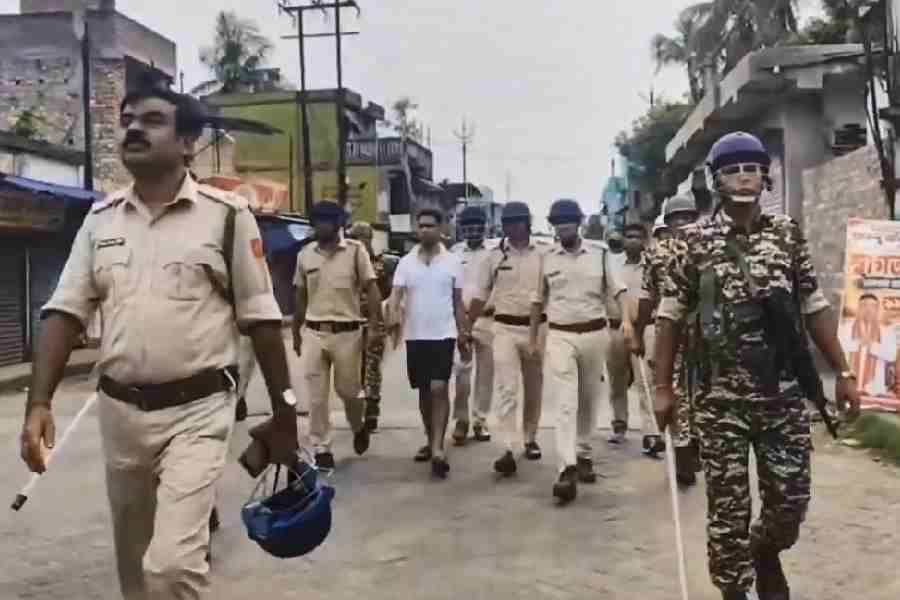
Trinamool Congress leader Jahangir Khan was paraded by police through parts of West Bengal's Falta on Thursday, days after the Calcutta High Court criticised the parading of accused persons and sought a report from the state police on the practice.
Jahangir, who had once compared himself to the fictional character 'Pushpa' and said he drew inspiration from Bollywood villain 'Gabbar Singh', was arrested on Monday near the India-Nepal border in Panitanki, north Bengal.
A court remanded him to five days' police custody on Tuesday in connection with allegations including extortion and other charges. Seven FIRs have been filed against Jahangir.
Jahangir, regarded as close to the party's national general secretary Abhishek Banerjee, had verbally withdrawn from the contest for the Falta Assembly seat and had not been seen in the South 24 Parganas constituency since shortly before the repoll held there on 21 May.
Videos and photographs from Thursday showed Jahangir being taken through the locality by police.
Since the BJP came to power in West Bengal last month, several Trinamool leaders have been arrested on charges ranging from violence and extortion to other criminal offences.
Many of them have been publicly paraded in their neighbourhoods after arrest. Social media footage from several such incidents showed accused persons being escorted through public areas.
On 5 June, a vacation bench comprising Justices Jay Sengupta and Smita Das sought a report from the state police within three weeks on allegations that accused persons were being publicly paraded.
According to reports, the bench observed that while the police had the authority to arrest an individual, they could not publicly defame them.
The controversy has also renewed attention on the legal limits of police restraint and public exposure of accused persons.
Section 43(3) of the Bharatiya Nagarik Suraksha Sanhita permits police officers to use handcuffs in specified categories of serious offences, including organised crime, terrorism, murder, rape, human trafficking and offences against the State.
The provision states that officers "may" use restraints in such cases and requires them to consider the nature of the offence and the circumstances of the individual case, reported Indian Express.
In April, the Madhya Pradesh High Court ordered an inquiry into allegations that an accused man had been deliberately paraded on foot while being taken from a police station to court, stressing that actions intended to humiliate individuals would violate constitutional protections.
In January, the Rajasthan High Court observed that allegations of arrested individuals being photographed and publicly displayed pointed to a potential violation of the constitutional right to live with dignity.